
Eden Court at 50: CEO Rebecca Holt on making the venue 'a place where risk is possible'


As Eden Court in Inverness celebrates its 50th anniversary, the venue’s chief executive Rebecca Holt looks ahead to what challenges and opportunities the next half a century might bring
Imagine opening night at the Highlands’ new theatre in 1976. If you had asked Eden Court audiences what Scottish cultural life would look like 50 years later, what would they have said? Would they have imagined a world where we can watch theatre and music whenever we want, across multiple platforms, alongside the almost limitless distractions offered by a phone in our pocket? Probably not.
The ways we make, experience and share culture have changed hugely. In Eden Court’s 50th year, I’ve found myself thinking a lot about what the next 50 years might look like. We don’t really know what audiences will want or what artists will create in 2076. What we can do is create the conditions in which artists - from across the whole of Scotland - have the opportunity to imagine that future for us, and create it with us.
Culture is increasingly encountered through individual digital spaces. Algorithms reinforce what we already know we like. What is the current role of an arts centre in this siloed space? Is it to always provide audiences with something familiar? What strikes me at Eden Court is how much has changed over the years while one relationship has remained constant: the one between artists, audiences and place.
We’re nothing without an audience, and an audience disappears without our artists. Arts centres play an important role in this dynamic. They need to be a place where audiences can experience art beyond familiar choices, and artists can develop new ideas. This is what we are exploring with Confluence, a new promenade theatre experience using both the front and backstage spaces of Eden Court. Five artists working across disciplines have been commissioned to create new work, while audiences are invited on a physical journey through the building.
We have not done this before. There has been uncertainty and risk throughout the project’s development. We are asking artists to create something that will sit in conversation with other artforms - and we’re asking audiences to encounter it without knowing exactly what that experience will be. It’s a little bit scary for everyone involved, but supporting artists also means asking audiences to take a chance: to step into an entirely unpredictable evening of theatre, dance and music.
That does not mean familiar work has no place. Audiences - like me - who come to see an acclaimed West End musical or their favourite comedian are what keeps us going. There is huge artistry and innovation in established acts, and arts organisations have a responsibility to sustain the work people value. But there needs to be room for something new alongside it. If we give audiences only what we already know they want, we risk simply preserving a cultural landscape rather than helping to create a new one.
I also believe that where we make art shapes it; the stories, how it looks, who it speaks to. Edinburgh and Glasgow are essential cultural centres, with audiences, institutions and creative communities that enrich the whole of Scotland. But Scotland’s cultural life should not be imagined as something created in a handful of places and then distributed outwards. If we want our cultural future to reflect the country as a whole, ambitious new work must be able to emerge from towns, villages, rural communities and islands too.
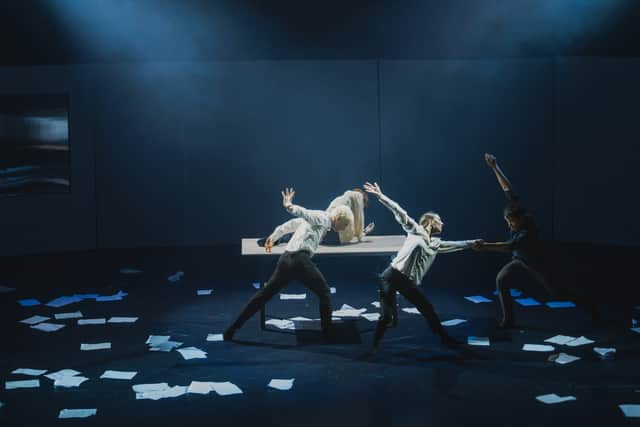
PCK Dance is a case in point. As Eden Court’s Dance Company in Residence, it is developing new contemporary dance work here in the Highlands, including The Panic Room, a major production combining dance, theatre, original music and immersive visual design. The company’s co-founder, James Pett, first developed his dance skills at Eden Court before pursuing an international career and returning to Scotland with a desire to create opportunities for artists and audiences here. Our role is to provide rehearsal space, production support and marketing, but also the space and time for artists to develop ambitious work and take risks.
Another Eden Court project, In On The Act, offers a different kind of model. Professional artists worked alongside communities in Skye, Balmacara, Morvern and Lairg to create four newly commissioned performances rooted in local voices, experiences and hopes for the future. And our free artist support scheme, Eden Court Connect, attempts to address the isolation that can be felt by artists dispersed across this vast region by providing year-round advice, residency opportunities and access to networks.
The easiest investment for a cultural organisation to justify is often the one whose outcome feels known - a paying audience, a full house. The more important investment might just be in the possibility of the unknown: giving artists the opportunity to test an idea, bringing together different disciplines or communities, and allowing audiences to connect with something entirely new. An arts centre should be a place where that kind of risk is possible - providing the space to experiment, develop and create work that could not have existed without it.
When Eden Court opened in 1976, no one could have known exactly what the next 50 years would bring. We can’t know what the next 50 years will bring either. But perhaps the question we should be asking is this: are we creating enough space and opportunity for our future cultural landscape to emerge? That means ensuring creative opportunities exist across Scotland, from our cities to our vibrant rural communities, so that the culture of the future is a true reflection of our country.
Rebecca Holt is chief executive of Eden Court Theatre. Confluence is at Eden Court from 30 October until 8 November.
The Scotsman’s arts newsletter is now sent twice a week - subscribe today
Enjoying the Arts & Culture journalism on scotsman.com? Make it easier to find by selecting us as a preferred Google source
Want the latest Scottish headlines sent directly to your phone? Sign up to our new WhatsApp channel here
Comments
Want to join the conversation? Please or to comment on this article.