
First look at Titanic Exhibition telling history of disaster ‘in most vivid way possible’
The exhibition is on at the Royal Highland Centre until February 14


As visitors enter the Titanic Exhibition at Edinburgh’s Royal Highland Centre - through a series of corridors which feels like they are boarding the ship - they are handed a boarding pass bearing the name of a real passenger or crew member.
“I think that personal connection makes it very impactful,” explains event manager Joe Levy. “It’s a story that resonates with everybody.”
My passenger is Lawrence Beesley, a man travelling in second class on the Titanic - then the world’s largest ship afloat - which sank after hitting an iceberg on its maiden voyage in April 1912. Of the 2,200 passengers on board, more than 1,500 lost their lives.
A Titanic enthusiast, Mr Levy’s colleague Tom Rudderham, director of White Star Heritage, has collected objects from and relating to the ship over years, to create the largest display of Titanic artefacts on show in the UK.
The displays include the only known surviving door from the ship - a wooden hatch from the galley - and an original curved dining chair from the Olympus, which visitors can sit in to get a feel for first class dining.
Cutlery and crockery from the ship are also on display, alongside personal possessions of individual passengers - and an ornate carved section of wood from the grand staircase in the first class section of the ship, which has been made iconic through its portrayal in films of the disaster. The fragment, believed to be the largest surviving part of the staircase, was found floating in the sea a few days after the disaster. Many of the remnants of the Titanic near the surface were destroyed by the pressure of the water, while a large number of the objects which did survive ended up in the US.
“I think often people don’t appreciate how little actually survived,” says Mr Levy. “And I don’t think they realise how far down the wreck is, it’s two and a half miles down on the bottom of the ocean. They think there must be loads of things around, but especially in the UK, there is very little available.”
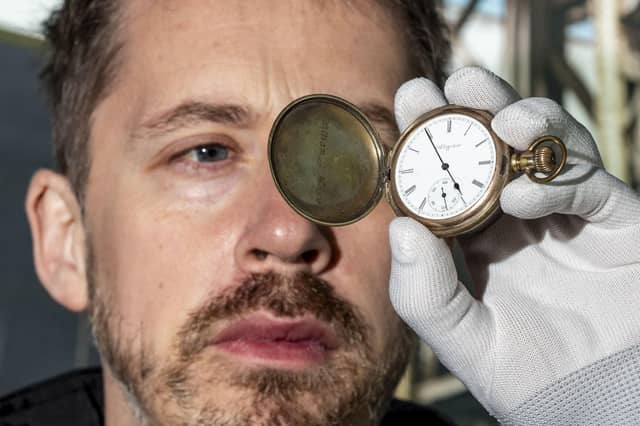
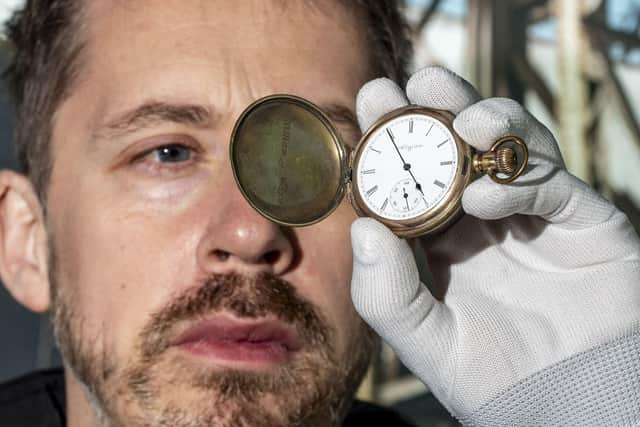
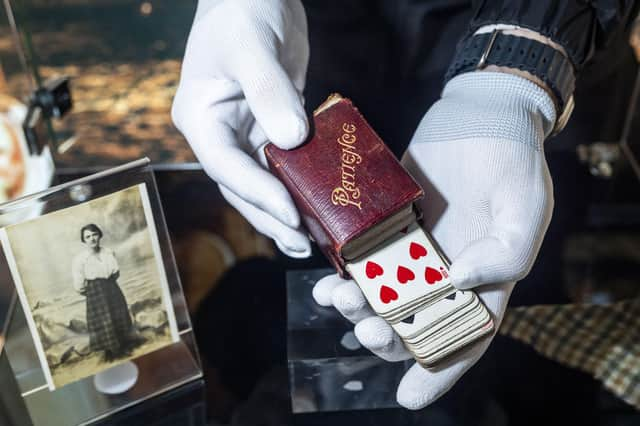
A fid, used to unpick ropes, a pocket watch and a button belonging to William James Major, one of the firemen on board, is among the artefacts displayed, as is a pack of playing cards belonging to passenger Elsie Bowerman. Ms Bowerman survived the disaster and later went on to become the first female barrister to practice at the Old Bailey and later worked at the United Nations to set up the Commission on the Status of Women.
“She was a first class passenger in the lounge when the ship hit the iceberg,” explains Mr Levy. “She put these playing cards into her pocket and escaped into lifeboat six and survived.”
An original deckchair from outside the cabin of first class passenger Edith Russell is also on show.
“It has the number seven marked on it, so we know exactly what position it was on on the ship,” says Mr Levy. “It’s that little detail that makes it all so tangible. The deckchair is such an ordinary item, but it has so much significance because of how it was used. They would have been thrown over the side by the chief baker, Charles Joughin, as flotation devices, hoping people would hold on to them. Unfortunately, only seven people were pulled out of the water alive because it was so cold.”
An extra addition created for the Edinburgh event is a display explaining the Titanic’s Scottish connections. First class carpets on the Titanic were made by Scottish company Blackwood and Morton from Kilmarnock anchor windlass was made by the Napier Brothers in Glasgow.
Meanwhile, Edinburgh engineering firm Brown Brothers, which specialised in marine technology, created the telemotor which helped steer the ship.
John York Hume, from Dumfries, a band member who played as the ship went down, will also be remembered at the exhibition, as will Robert Norman, an Edinburgh-born passenger on the Titanic, who is remembered for playing the piano during a hymn service held on board.
The exhibition includes almost life-sized images of the original Titanic - or sister ship the Olympus - which have been colourised to bring the ship to life.
“Rather than fabricating everything, we want people to see history as it was, but in the most vivid way possible,” says Mr Levy. “We want to create the feeling of being aboard, but not so much that nothing’s left to the imagination.”
Mr Rudderham’s two dogs, Henry and Midi feature in the exhibition, in a video display behind a lift hatch, showing passengers using the elevators on board.
“There were dogs in the Titanic,” says Mr Levy. “There was also a ship’s cat, but most of the dogs belonged to the passengers, mainly the first class, there was a kennel up by the fourth false funnel. Some of them didn’t make it. It’s awful, but I think that sometimes makes people more sad than the fact that 1,500 people died.”
Finally, Mr Levy leads me to a wall where the names of all 2,200 passengers are inscribed - divided by the class of ticket they held and if they survived the disaster or not.
To my relief, Mr Beesley was on the survival list.
“This is where visitors can identify whether their passenger has survived,” he says. “When you tell people a number of people who died, it sometimes doesn’t mean as much, but looking at the fate of an individual person gives it an emotional quality.
“A lot of people think they know the story of the Titanic, but do they know the story of the people who were aboard the Titanic? That includes really ordinary people, not just the rich and famous. So this wall really hits people quite hard. We’re carrying on a legacy in a way.”
He adds: “There is always more to learn, history especially disasters, reminds us of how we’ve got to where we are, all the lessons we’ve learned from the disaster. The Titanic really changed the way the world works.”
The exhibition also includes artefacts from the wreck site, which was discovered by by a joint French–American expedition in 1985 - including what is believed to be the only surviving fragment of paint from the sunk ship.
Organisers have created a large model of the hull of the ship - as it currently exists under the sea. However, the original Titanic wreck is fast-changing.
“Even our recreation is a time capsule within itself. How it looked five years ago when we made this model isn’t how it looks now,” says Mr Levy, pointing to railings which were present when the model was created five years ago, but have since been eaten away by “rusticles”, created by iron-eating microbes which literally consume the vessel.
“Truth be told, the Titanic wreck will not last much longer, it will be decades, not centuries, so there will come a time where it won’t be around.”
The exhibition is on at the Royal Highland Centre until February 14.
Comments
Want to join the conversation? Please or to comment on this article.