
The Odyssey review: 'a thrilling, thoughtful, bloody epic'
Christopher Nolan’s all-star spectacular combines huge scale and intimate storytelling to explore the fragility of civilisation, writes Alistair Harkness
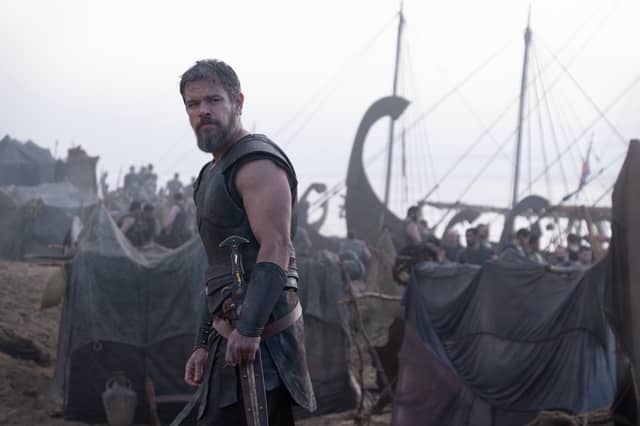

The Odyssey (15) ★★★★★
The first thing you see in Christopher Nolan’s gargantuan adaptation of The Odyssey is the fabled Trojan horse lying on a beach. Jutting out of the sand and surf like the half-buried Statue of Liberty at the end of Planet of the Apes, it’s a striking image and an appropriately sly one too. Just as Odysseus (Matt Damon) has designed the confounding structure to sneak his men past Troy’s impregnable walls, so Nolan turns Homer’s epic 3,000-year-old poem into his own cinematic Trojan horse, using the guise of a bravura blockbuster spectacle to surreptitiously confront the chaos of the current moment.
Set in a time of “apparent magic” – one with cyclopes, giants, sirens, witches and wrathful gods and goddesses – he blends these more fantastical elements with a more grounded, psychological approach that takes on board the trauma of war and the guilt of sacrificing so many for so little. Which may sound lofty, but as he did with his thematically similar Dark Knight trilogy and his Oscar-garlanded Oppenheimer, Nolan – drawing on Emily Wilson’s acclaimed 2017 translation – transforms his source material in surprising ways. Deploying fractured timelines and nested narratives, he turns Odysseus’ decade-long journey home following the decade-long Trojan War into a thrilling, thoughtful, bloody epic that questions and deconstructs the whole notion of heroism.
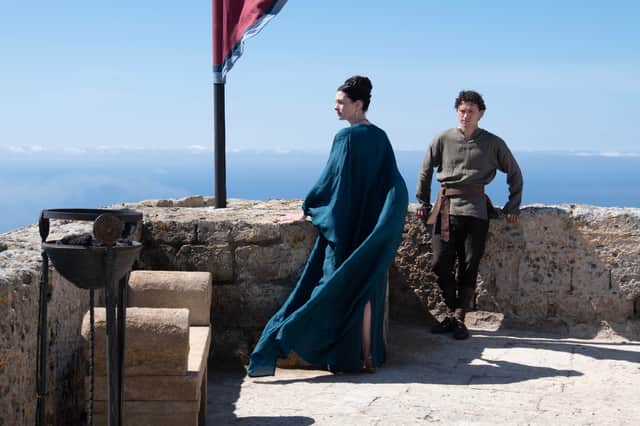
Like the tortured protagonist in Oppenheimer, Damon’s Odysseus is an uber-smart problem-solver with blood on his hands and his dawning realisation of who he is and what he’s done is complicating his desire to return home to the family he abandoned when his son Telemachus was an infant. As the film opens the now grown-up Telemachus (Tom Holland) doesn’t know if Odysseus is alive or dead and his mother, Penelope (a fiery and fearsome Anne Hathaway), is doing all she can to fend off the suitors – among them an enjoyably smarmy Robert Pattinson – hoping to take her husband’s place on the throne of Ithaca after his years-long failure to return from Troy.
As Telemachus sets out on a quest for news of his dad, Nolan drip-feeds us backstory through judicious and inventive use of flashbacks and flash-forwards. Jumping around in the timeline of Odysseus’s life as he’s trapped on an island with the goddess Calypso (Charlize Theron), the film sketches out the complexities of his marriage to Penelope and the personal sacrifices inherent in his decision to go to war. But it’s when Nolan starts detailing the trials he’s been through that the film really makes good on all the pre-release hype.
READ MORE: The Odyssey Fim Premiere in Pictures
Shot entirely with IMAX cameras – a first for any filmmaker – it’s jaw-dropping even by Nolan’s standards. Once again, the larger format enhances his penchant for practical effects, brilliantly conveying the scale and intensity of filming his cast navigating the chilly waters of the Moray Firth in replica Greek ships or battling giant cannibals in Culbin Forest, the latter a double for the mythical land of Laestrygonia (location shoots also took in Greece, Iceland, Morocco and the US). But the set-pieces also see Nolan stretching himself, finding ever more imaginative ways to make even the most fantastical scenes feel tactile and real, as in the properly horrifying encounter – also shot in Scotland – that Odysseus’ men have with Samantha Morton’s Circe, whose talents for metamorphosis bring out their swine-like nature. Morton’s hypnotically weird performance as she shapes the men’s faces like bread dough plays like a gleeful evolution of the gross-out transformation scene in An American Werewolf in London.
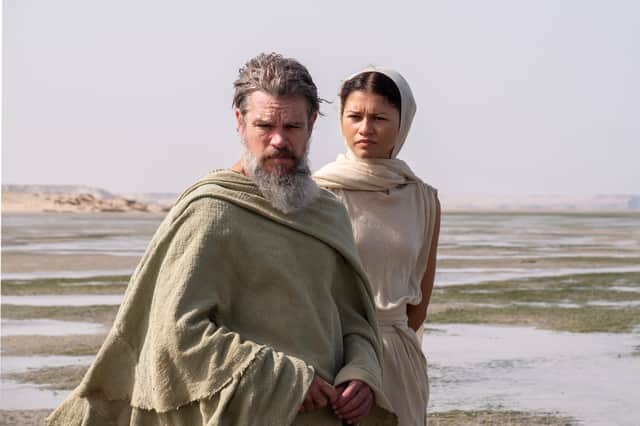
It hardly needs to be said that this isn’t Jason and the Argonauts or Clash of the Titans (as fun and inventive as those Ray Harryhausen movies were in their day). Nor is it Gladiator or Troy (a movie Nolan was briefly attached to direct early in his career). It’s far stranger, far more intense, far more powerful. At three hours it moves with real speed, aided by Nolan’s smart decision – taking his cues again from Emily Wilson’s translation – to modernise the language and eschew the cod-Shakespearean dialogue and enunciation to which so many movies of this type default.
Bad-faith participants in the culture wars have already taken the film to task for this (sight unseen of course); and they’ve launched even more insidious attacks on the casting of Zendaya as the goddess Athena and Lupita Nyong’o as Helen of Troy, two fictional characters whose race is inconsequential to the story at hand. That’s all noise, but it also reinforces the value of what Nolan’s doing with The Odyssey. As the film builds up to the sacking of Troy – rendered here with gut-wrenching horror – Nolan transforms it into a searing exploration of how quickly the bonds of civilisation can fall apart when the pursuit of power violates our own humanity. It feels like Nolan’s angriest film to date. It’s also one of his best.
The Odyssey is in cinemas from 17 July
The Scotsman’s arts newsletter is now sent twice a week - subscribe today
Want the latest Scottish headlines sent directly to your phone? Sign up to our new WhatsApp channel here
Comments
Want to join the conversation? Please or to comment on this article.