
Edinburgh Fringe theatre reviews: AI: The Waiting Room – An Audiovisual Journey | Couac... Physical Comedy | Dead Air | Stampin' in the Graveyard | A.I. Campfire
Do robots dream of electric sheep? Or are they just on a mission to replace your job and sell your data? Sally Stott watches a mixed bag of AI-themed Fringe theatre shows in search of answers
THEATRE
AI: The Waiting Room – An Audiovisual Journey ★★
C ARTS | C venues | C alto (Venue 40) until 16 August
DANCE, PHYSICAL THEATRE AND CIRCUS
Couac... Physical Comedy ★★★
Gilded Balloon Patter House (Venue 24) until 17 August
THEATRE
Dead Air ★★★★
Pleasance Courtyard (Venue 60) until 24 August
THEATRE
Stampin' in the Graveyard ★★★
Summerhall (Venue 26) until 25 August
THEATRE
A.I. Campfire ★★★
Venue 13 (Venue 13) until 23 August
Have I written this with AI?—
Ask better questions, these shows about the topic seem to reply; ideally ones that aren’t part of a narrative driven by AI companies which, as commercial entities, clearly have an incentive to (yes!) replace your job, sell your data and monopolise a marketplace called your life.

AI: The Waiting Room – An Audiovisual Journey begins with entering a lot of personal information into a smart phone app in a piece that seems to be trying to find out what I’d do in a societal meltdown. Not typing all of my plans into a screen, obviously. But if the apocalypse takes as long to arrive as my individually tailored ‘script’ does to upload, I’ll have time to emigrate to Mars – and also escape the chatbot trying to persuade me it’s a real person.
Once in the theatre, I, along with the rest of the audience roam around the space in headphones in a piece that has me lugging a virtual version of the “one item I’d save” (Brompton bicycle) across a swirlingly standard on-screen metaverse refusing to give it up for the collective good, because why would I do that? Eventually, I liaise with my mother at the pre-arranged meeting place, where she greets me with “Sally, my dear heart”, something she would never, ever say.
The attempt to fuse AI with live theatre is an interesting idea, but the reality highlights the inaccurate naming of a technology as ‘artificial intelligence’ when it’s clearly the former rather than the latter. ‘Dance party?’ the show’s captions suggest at the end to the largely apathetic audience. This leads to one of the producers swaying in front of a tower of boxes that we built earlier, capturing a lonely, haunting emptiness in a way that is insightful but probably not deliberate.
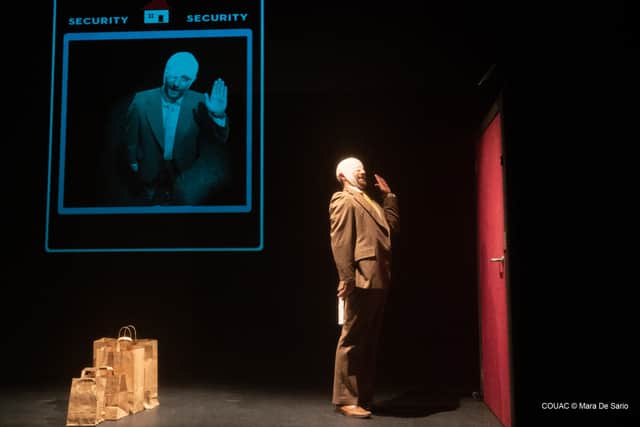
The transformation of daily life into a series of technology-enabled tasks is more critically explored in Couac... Physical Comedy, a clown show in which an increasingly worn-down man named Jo, dressed in the rich, dusty colour palette of a more classy era, tries and fails to navigate a city of interconnected apps, surveillance cameras and other AI-based ‘assistance’ under the flashing lights of state control. It’s a precisely performed silent satire, led by experienced circus performer Sébastien Domogalla where – through the ingenious use of a large translucent tulle sheet as a stage-covering screen – animations encase our protagonist in the interface of the digital world.
From supermarket to home, Joe stumbles, with his shopping, through a city that’s constantly out-smarting him, in a rewards-based system of never-ending clicks and empty affirmations (“You’re magnificent”) for every mundane task completed. With online banking connected to a social credits system, ‘friends’ reduced to anonymous ‘likes’ and every interaction accompanied by and advert, it imagines a totally banal dystopia well within reach, should we want it. It feels like some kind of reckoning or resistance must surely be coming. But it doesn’t. “To be continued…” says a caption, and mysteriously ends.
The technology seems to have become (a bit) more personalised in comedy-drama-horror Dead Air, a near-futuristic Frankenstein-esque story about an angry young woman called Alfie who, haunted by the “ghosts” of multiple miscarriages, attempts to resurrect her recently deceased father with the help of an AI enhanced-chatbot company.
Writer/performer Alfrun Rose’s monologue beautifully blends her protagonist’s grief-induced cynicism, a comic cast of family members and the sadness of losing a loved one with the cool, corporate world of AiR, with its subscription ‘packages’ and endless ‘upgrades’. It’s cleverly written to capture the ways AI attaches itself to notions that we might relate to, affirms that we are always right, and intersects with real life in a way that can both enhance and destroy it with elaborations that technology companies might describe as “hallucinations” but in any other industry would be deemed factually incorrect and trigger an Ofcom investigation.
As the AI generating Alfie’s ‘father’ is “turned up” or “turned down”, the piece takes on a psychedelic quality that fuses snapshots of the past with wishful thinking, challenging behaviour and QR codes. It’s a strange but not unappealing kind of magic – one that, unless Alfie can find thousands of pounds to keep it going, is eventually going to be switched off. Finally, she finds the courage to let go, but it’s a testament to Rose’s moving writing and performance that’s it’s such a wrench, for Alfie as well as us.
-Valeriia-Poholsha-4.jpg?trim=739,0,1260,0&width=640&quality=65)
In Stampin' in the Graveyard, Elisabeth Gunawan plays Rose, another AI chatbot in human form that, this time, provides “wisdom and comfort” for those at the end of the world – the place where all of the previous shows feel like they’re heading – programmed to make everything feel OK when clearly, it’s not.
Like Dead Air, it explores an unfulfilled desire to have children, with Rose the digital ‘daughter’ of a woman (‘Mother’) and her partner (‘Father’) whose lives are full of mini metaphorical ‘deaths’ – of times, connections and events – that form a half-recalled tapestry of a past that, with the audience deciding the ‘prompts’ (through hand signals), includes a mix of part-truths and fantasies in a jumbled up order that sees every ending lead to another beginning.
“If it doesn’t make sense, feel it,” says Rose at the start of this melancholic kaleidoscope of a show, one that, despite being about AI, is firmly embedded in the physical world of a live, interactive performance, with an intriguing miniature model mechanical set, that requires being in a room, together, to experience. Really, it’s about human storytelling, albeit a kind that sometimes gets lost in its own dream-like state. A powerful speech from Gunawan breaks the façade at the end and asks what we’re looking for in AI that we don’t have already, and what we’re prepared to protect that it could destroy.
A.I Campfire goes back further in time, using modern technology to conjure up the mythical legends of traditional Scottish folklore. It’s immersive show in which the ancient world is evoked using a combination of (recorded) human storytelling and multiple AI softwares to create magical-realist imagery, which is projected onto a large screen to envelop the audience. Interestingly, the virtual nature of the digital fire that we all sit around doesn’t make the mood any less warm – even though we might be waiting some time for it to toast the marshmallows on sticks that we’re holding.
The on-screen imagery is at times reminiscent of James Cameron’s Avatar, while the stories are based on shapeshifting Selkie tales: one familiar one involving a woman ripped from the sea and held prisoner by a fisherman and another about a murderous male kite surfer stalking the streets of Portobello. Both contain messages being free, caring for the natural world and being vigilant to nefarious forces with ulterior motives who might wish to do us harm. Created by Vanesa Kelly and Ian Garrett, it’s a transportive experience to a lovely space that they have collaboratively made – one that feels like part of a bigger ongoing project. We all have a chat about it at the end, like people have been doing for thousands of years, sitting on the floor and talking in a circle.
Make sure you keep up to date with Arts and Culture news from across Scotland by signing up to our free newsletter here.
Comments
Want to join the conversation? Please or to comment on this article.