
Mere Mortals: Aszure Barton on unboxing Pandora for the AI generation at EIF
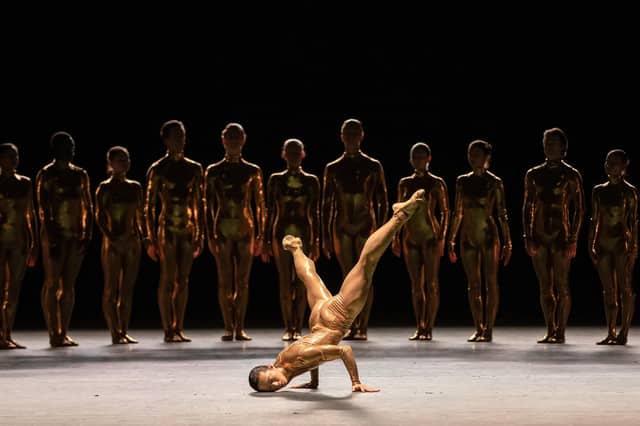

Choreographer Aszure Barton tells Kelly Apter why her commission for San Francisco Ballet is on point with the future
When you’re the first female in San Francisco Ballet’s 93-year history commissioned to make a full evening work, the last thing you want to do is bring another woman down. So when choreographer Aszure Barton was invited to create a piece about Pandora’s box, she was initially hesitant.
“I definitely wouldn’t have been on board if it was going to be based on traditional misinformation,” says Barton. “I hadn’t thought about the story before this project, it was just one of those phrases you’re raised with. But I didn’t like the idea that this woman was seen as some kind of bad energy.”
In Greek myth, Pandora is deemed responsible for unleashing sickness, death and various other “evil gifts” upon the world, having opened a box left in her care. Modern thinking, however, tells the story quite differently, relinquishing Pandora from her role as a bringer of chaos.
“After reading and listening, I discovered that so much in our lives can be misread or misinterpreted,” says Barton. “And I loved the fact Pandora was so much more than we had imagined, that she was a human with agency. So I thought ‘Oh yes, I can do this.’”
The commission came with a composer attached and, again, Barton needed a moment to think about it. Artistic director Tamara Rojo wanted electronic music producer and DJ Sam Shepherd (aka Floating Points) to create the score, and his long-time collaborators Hamill Industries to work on the production design and visuals. “I didn’t know Sam’s music at all,” says Barton. “So obviously before agreeing to take on the project I did a deep dive into his work. I thought it was so cool, and I wanted to push myself into unknown territory.”
Enjoying The Scotsman's coverage of the Edinburgh festivals? For just £2 a month you can get unlimited access to scotsman.com plus 2-for-1 Fringe tickets. For details visit www.scotsman.com/subscriptions
Known for blurring the edges of classical ballet and contemporary dance, Barton makes regular forays into new terrain: her deep love and respect for balletic tradition sits alongside a desire to take risks and “be unruly”, as she puts it. This fusing of past and present was the perfect combination for Mere Mortals, a piece that explores two concepts born centuries apart: Greek myth and AI. With the backlash against AI growing almost as fast as our appreciation of it, Barton’s work not only captures the zeitgeist but was created in the city at the epicentre of it all.
“I recognise the beauty within AI and I think there’s so much to celebrate,” says Barton. “The technology is mind-blowing and the science extraordinary, but it can also be incredibly dangerous. We made Mere Mortals in San Francisco, literally in the heart of where all of this is being activated and created. But we are also human beings, so I was interested in harnessing what I love most about creating – that sense of togetherness.” This ethos fed into the studio during rehearsals. Ordinarily in a large ballet company, the corps de ballet and soloists beaver away in one room, while the principal dancers work elsewhere. Barton had other ideas, however, dispensing completely with the usual hierarchy and bringing the 40-strong cast together in one place.
“It can really ruffle some feathers,” she admits. “But it’s important for me to create that sense of sharing, and this piece is very much about the mass group, so I wanted everyone to learn all the material. Principal dancers are used to just learning their role, but hats off to them, they were really wonderful to work with and it was nice to see them teaching some of the younger dancers.”
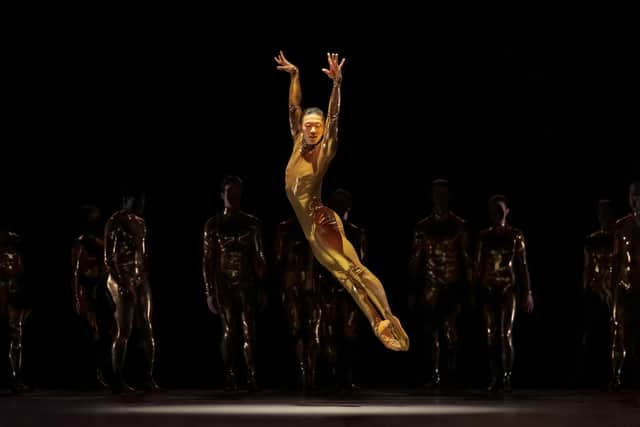
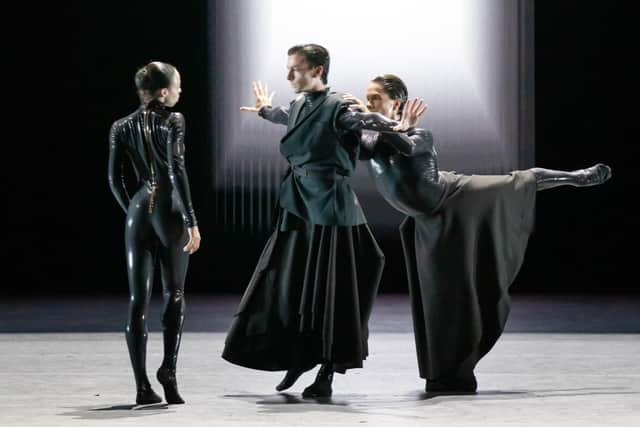
Two of the principals in question play key roles in Mere Mortals which, although largely abstract, features four characters (Prometheus, Pandora, Epimetheus and Hope) alongside the vast ensemble. Wei Wang, who takes on the role of Hope (the only thing left in the jar after Pandora opens it), moved from China to train at San Francisco Ballet School at the age of 12. Having joined the company upon graduation, he worked his way up from apprentice to principal in six short years, so enjoyed rehearsing alongside other ranks again. “I love being a principal because I enjoy discovering my own artistry, but this was definitely a different experience,” he says. “And because I’ve climbed up the ladder and experienced all the different ranks, it was a privilege to work with everyone in the same studio again, especially the younger ones, it really inspired me.”
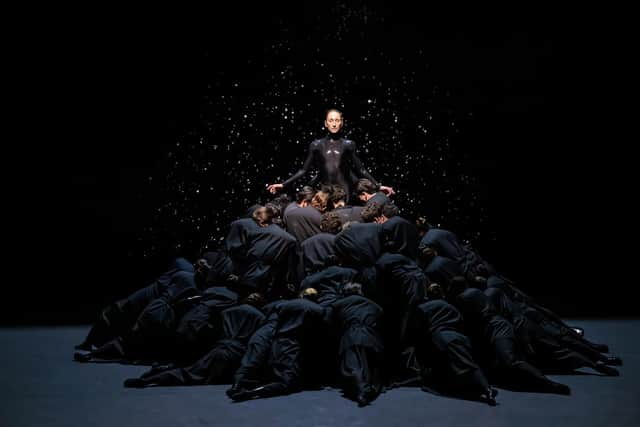
Swedish-born Nikisha Fogo, who joined the company as a principal dancer in 2020, had the same experience. “It was nice to feel the camaraderie, and a sense that everyone was in it together creating this piece,” she says. “And I even gained some new friends because I was in rehearsals with people I wouldn’t normally be.” Fogo plays Pandora, a role she approached with “a lot of curiosity” due to its more abstract nature. It was also novel to find herself dancing to the Floating Points beats which, in Edinburgh, will be delivered alongside music from the Royal Scottish National Orchestra.
“We normally dance to more classical music, so it was special to hear the electronic music combined with the orchestra,” says Fogo. “And to have Sam in the orchestra for every performance, was really unique and fun. I also feel like it brought new audiences to the ballet, because people know Sam from concerts and festivals.”
As for AI, Fogo and Wang agree that what comes next is something of a mystery. “I feel like the box has been opened with AI,” says Fogo. “And we don’t know where it’s going to take us, or where we’re going to be in the future because of it, good or bad.”
For Wang, working with Barton has been transformational – not just because of the myriad choreographic styles she uses in her work but because of its thought-provoking content. “It really made me think differently about art,” says Wang. “Because before, I thought art just needs to bring the positives. Now, I think art is supposed to start conversations, to make people think, and to help build a better community. Especially right now, when there are so many difficult topics to navigate, ballet can bring people together.
“Mere Mortals is so relevant because everyone is talking about AI right now, and worrying if it will take people’s jobs. We don’t know what the future will look like, whether politically or culturally, nor do we know what the relationship between humans and AI will be. With this piece, I’m stepping out of my comfort zone, but I’m not afraid to do that. It’s been eye-opening for sure, and I’m proud to be presenting it in Edinburgh. I want to hear what people have to say, to keep the conversation going, because that’s the whole point of us doing this.”
San Francisco Ballet: Mere Mortals, Edinburgh Playhouse, 28-30 August
The Scotsman’s arts newsletter is now sent twice a week - subscribe today
Enjoying the Arts & Culture journalism on scotsman.com? Make it easier to find by selecting us as a preferred Google source
Want the latest Scottish headlines sent directly to your phone? Sign up to our new WhatsApp channel here
Comments
Want to join the conversation? Please or to comment on this article.