
'I felt a big weight of responsibility' - acclaimed author Omar Musa on his epic new novel Fierceland
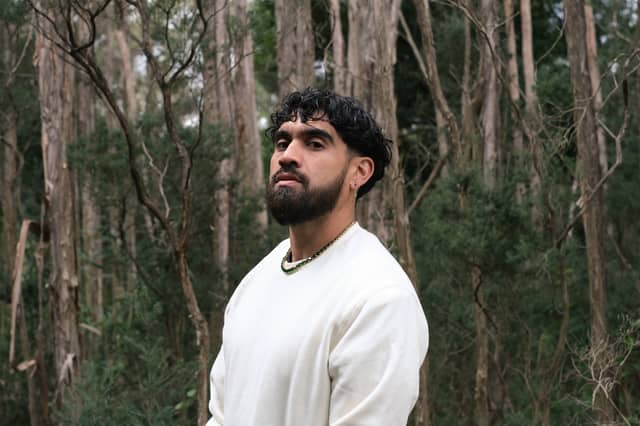

Susan Mansfield meets Omar Musa, a Malaysian-Australian rapper, poet, visual artist and author whose latest novel, Fierceland, is an environmentally conscious epic that took a decade to write and research.
Omar Musa is talking about a tree, a great dipterocarp tree in the Bornean rainforest, 100 metres tall, 1000 years old. He’s talking about recording the sound of its sap moving by embedding a tiny microphone in its trunk: “this deep, guttural, basey sound, like blood pumping through a body mixed with the waves of the ocean”.
This pulsing heart of the rainforest might just be the heart of his new novel, Fierceland, which has just been named as the winner of the 2026 Miles Franklin Award, Australia’s most prestigious book prize. The Malaysian-Australian rapper, poet and visual artist has written a sprawling polyphonic novel of Malaysian Borneo, a book of myth, inheritance, family and environmental damage.
It took a decade to write and 21 drafts to corral its “exploded” structure into an order which felt right.
“It took a lot of travelling around and thinking and experimenting and an aborted writing missions to realise that I wanted to focus in particular on Malaysian Borneo, on the rainforest and on logging and oil palm corruption. A book like this where you’re trying to inhabit so many characters, is something I aspired to in my early work but didn’t quite have the chops to pull it off.”
Enjoying The Scotsman's coverage of the Edinburgh festivals? For just £2 a month you can get unlimited access to scotsman.com plus 2-for-1 Fringe tickets. For details visit www.scotsman.com/subscriptions
Musa, 42, was born in Australia to an Irish-Australian mother and a Malaysian-Bornean father. His first novel, Here Come The Dogs (2014) was about race and toxic masculinity in his home town of Queanbeyan, New South Wales, and was praised by writers such as Irvine Welsh.
“I knew that once I had finished that book I wanted to turn my gaze back to my origins in South East Asia,” he says.
“I’ve met a lot of people my age who are from Borneo, or even the Philippines or Indonesia or Thailand, who are western-educated, very progressive, environmentally conscious, but when you scratch the surface you’ll often find out that their privilege stems from ill-gotten gains or unscrupulous business practices on the part of their parents. I became fascinated by that because I thought you could use that type of family dynamic as a window to explore issues to do with colonialsim, capitalism, exploitation, power.”
While writing the book, he moved for a time to Kota Kinabalu, the capital of Sabah, where his father came from.
“I realised I needed to live there because that enables you to take off the rose-tinted glasses you often have being part of a diaspora where you can mythologise or romanticise the homeland. I wanted to become a regular punter who would go to the gym, go to the local market, complain about the traffic. People will make fun of your accent, sometimes you stick out like a sore thumb, but it was worth it because I made my own connection to the place outside of my family.”
At the centre of Fierceland are Roz and Harun, returning to Kota Kinabalu for the funeral of their father, Yusuf, a palm oil baron. Harun is a tech entrepreneur in LA, Roz a struggling artist in Sydney, but both are haunted by their father’s legacy, particular the memories of a trip they took into the rainforest with him as children, and what they witnessed there.
The book ranges widely in time and place, to Nigeria in the 1970s, mid 19th-century Venice, and to the Borneo of the 1880s, where Musa writes a cameo for Joseph Conrad, to date the best-known writer associated with the country. There are experiments such as a short poem which is translated into 16 of Malaysia’s indigenous languages, a visual representation of the sound wave of sap in the dipterocarp tree. And there are many voices, each with its own register, including the poetic, incantatory voice of the forest itself.
“Almost like a Greek chorus. A Malaysian Bornean chorus!” says Musa, who adds that he was encouraged to explore this voice by the writer Max Porter, who offered him “crucial” feedback on one of his drafts. The forest is, perhaps, the book’s central spine, much of it now ravished by logging and oil palm cultivation, yet a living thing, a repository of myths, memory and culture.
There’s no disputing the environmental damage, and yet even that situation is more complex.
“Palm oil has a really bad name in the west, and rightly so because it’s an extractive, exploitative practive,” says Musa. “But it’s also more complicated than that. Most of my cousins grew up on oil palm estates where their parents were labourers. Even though it was mostly a few people at the top who became rich, it was an economic turbo-charging which helped pull a lot of people out of poverty.
“I felt a big weight of responsibility, of trying to get it ‘right’, whatever that means. To me that means that [the book] resonates and rings true to local readers back in Malaysian Borneo. There’s a lot of self doubt, a lot of imposter syndrome, but I didn’t want that imposter syndrome to paralyse me, I wanted to use it to motivate me to research harder, have more conversations, go on more adventures up the river to remote areas, interrogate my aunties and cousins and grandparents about their lives.”
One of the most vivid images which stays in the mind from the novel is the pontianak, a female vampire-ghost from Malaysian folklore who is said to haunt the men wronged her. The pontianak laughs, but the laughter is louder far away, quieter when closer she is.
“A good scary Malaysian ghost story!” laughs Musa. “I loved hearing those stories from my dad. In the stories, she was always tamed, but she didn’t disappear, she turned from a bloodthirsty ghost into a domesticated housewife again. [As an adult] I started thinking, ‘Wow, these folk tales actually become a way of perpetuating entrenched patriarchy or misogyny!’”
In a way, it’s a novel of ghosts: of the past, of colonialism, of the vanishing forest. Some have described it as magic realism, a term which Musa resists.
“I don’t think about it in that way because these types of folk tales are much older than that genre of magic realism. I just feel that gritty realism isn’t sufficient to capture the truth of this world, so I like to lean into those stranger, more surreal, speculative elements.” Susan Mansfield
Omar Musa is talking about Fierceland at the Edinburgh International Book Festival on 29 August at 7pm. Fierceland is published by Footnote Press, £9.99
Comments
Want to join the conversation? Please or to comment on this article.