
The Shortest History of Scotland, by Murray Pittock: 'incisive'
No matter how good AI gets in the future, we will always need historians like Murray Pittock to help illuminate our past, writes David Robinson

Last month, in a Sunday Times analysis of the jobs in which people were most at risk of being replaced by AI, historians came out second only to translators. How can this be? How can a subject which, as Tom Devine rightly asserts is “the queen of all disciplines”, underpinning everything else, possibly be facing the scrapheap?
Well, I’m not sure it is. One reason is that if I asked AI to write anything like Murray Pittock’s latest book, I doubt it could do so. Yes, it could give me 50,000 words on the things that mattered in Scotland in the 1,330 years between the reigns of Pictish king Bridei III and Charles III. But they would be deeply boring “on the one hand, on the other hand” words, marked by an absolute terror of bias and a determination to cover everything, even facts, political movements and ideologies inimical to any overarching thesis. Plus, when did you ever see AI do intellectual self-confidence and panache?
For that, you’d have to train AI to think like Pittock, who in 1984 was a debating champion at Oxford Union alongside Boris Johnson. Politically, they are poles apart, although Johnson’s belief in (mainly) English exceptionalism is somewhat mirrored in Pittock’s faith in its Scottish equivalent.
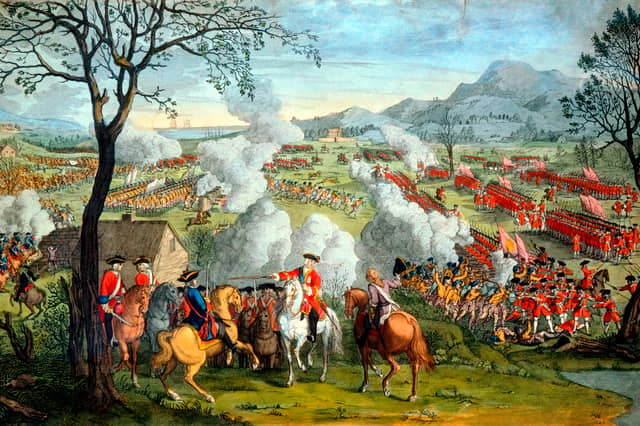
For 2014’s failure to get independence done, read 1745. Pittock's rise to fame as a historian was largely fuelled by his 1995 book The Myth of the Jacobite Clans, in which he claimed that the Rising wasn’t just an ill-focused rebellion of mainly Catholic Highland clans but a nationwide revolt with credible and achievable political aims.
READ MORE: Like a Cat Loves a Bird: The Nine Lives of Muriel Spark by James Bailey review: 'inventive'
Tellingly, nowhere else in his new book does he venture into counterfactual history. But Culloden is different. If it had been won, he argues, a weakened Britain might not have fought the Seven Years’ War with France (1756-63), a million men wouldn’t have died, France wouldn’t have lost, the Americans wouldn’t have dared to revolt, there would have been no French Revolution and hence no Napoleon, which would have at least put back German and maybe Italian unification, which... but you get the drift.
In fairness, there is a coherence to his thesis. Going forwards, it goes like this: Culloden cleared the way for a British empire in which Scots prospered and so were disproportionately hit by its collapse, so when, in and after the Second World War, Britain started to neglect Scotland, a rise in Scottish nationalism was inevitable.
Going backwards from Culloden, Pittock is keen to downplay any Highland/Lowland and Gaelic/non-Gaelic divide within Scotland and rightly emphasises the depth of medieval Scotland’s European connections and the importance of Scottish soldiery both in Europe and in Britain. As he points out, 60 per cent of the Parliamentary forces at the pivotal battle of Marston Moor in 1644, which destroyed Royalist power in Northern England, were Scottish.
In such a short book, there is necessarily much that can’t be covered. Here that seems to include most things affecting Scotland that had strong roots south of the Border, from the Davidian revolution in the 13th century to Chartism and the suffragette movement in the 19th or the welfare state in the 20th.
He can’t, however, ignore that key English import: Protestantism. “From the beginning,” he writes, “Reformation ideals were bound up with elements of pro-English feeling.” Worse still, “Instead of the unified patriot Church that had once defended Scotland” the English language started to spread in Protestant discourse. By 1617, he notes, interpreters were no longer thought to be necessary in London.
Which brings me back to where I started. Because no matter how good Google Translate becomes, I still believe that there are nuances in our language that we need humans to interpret. And there are nuances in our past that we still need historians rather than AI to explain, especially if they write as incisively as Pittock does here.
The Shortest History of Scotland, by Murray Pittock, Old Street, £14.99
The Scotsman’s arts newsletter is now sent twice a week - subscribe today
Want the latest Scottish headlines sent directly to your phone? Sign up to our new WhatsApp channel here
Comments
Want to join the conversation? Please or to comment on this article.