
Like a Cat Loves a Bird: The Nine Lives of Muriel Spark by James Bailey review: 'inventive'
This is a shapeshifting biography for a shapeshifting subject, writes David Robinson
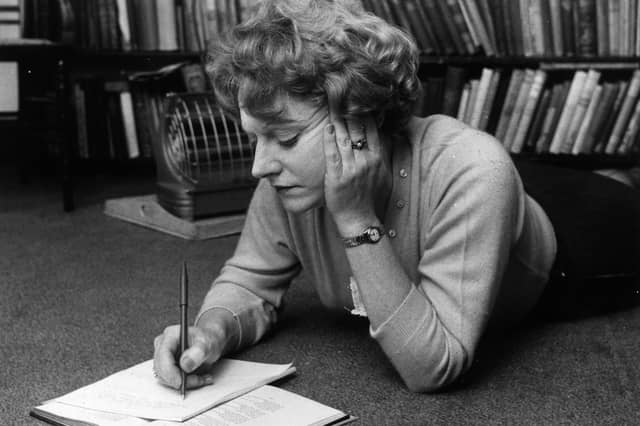

For someone who wrote biographies of writers early on in her career, Muriel Spark grew to be suspicious of the genre. As she warned American academic Dorothea Walker in 1988, “A number of biographical pieces already written about me are completely wrong, sometimes pure inventions.”
In his new book about Spark (“as sly, nimble and elegant as her own work” claims his publisher, raising the bar ridiculously high), James Bailey consigns biography’s normal rules to the footnotes and opts for inventiveness instead. So here, for example, is the young Muriel, playing with her two dolls, Red Rosie and Queen, at her family’s dining table: “Delicately, Muriel tilts an empty teacup to Queenie’s closed lips, signifying the doll’s frosty contempt for her jealous companion.” Or here she is again, this time aged 39 and writing The Comforters, and he imagines her opening a bottle sent to her by Graham Greene, “she might have tilted the glass this way and that, watching as the wine took on the curves and contours of its new vessel: one shape becoming another.”
What can one say? She might have done both these things. Then again, she might not. Does it matter? It would if Bailey had completely made up his facts, but he hasn’t: he is being inventive not inventing. Graham Greene did indeed send Spark money along with cases of wine when she was at her lowest ebb in the mid-1950s (on condition that she didn’t pray for him), and her dolls Red Rosie and Queenie made their literary debut in Spark’s 1992 memoir Curriculum Vitae.
These are, of course, the tiniest details in a spectacularly large life whose story is, as Bailey notes “every bit as strange, slippery and rife with contradictions as those she wrote”, and which ranges from a happy Edinburgh childhood to marital misery in Rhodesia to black propaganda work in wartime London to literary superstardom in New York, and a contented old age in a Tuscan rectory. In telling it, Bailey’s approach isn’t a conventional “life” so much as a hybrid of literary criticism, personal appreciation and a novel (“A late summer evening. St John’s Wood at sunset. A London sky the hue of a bloodshot eye. She walks slowly, several steps behind the woman she met on the train...”).
Provided it is properly researched – which, with its 25-page bibliography Bailey’s book certainly is, even if Dan Gunn’s excellent Letters of Muriel Spark Vol 1 arrived too late last year to make the cut - I have no problem with this. There’s no reason a shapeshifting author shouldn’t have a shapeshifting book written about her. No reason it shouldn’t zoom forwards and back across her life at whiplash speed, because that is the way our minds work and the way Spark’s fiction did too. It might even, 20 years after her death (the actual anniversary is 13 April) spread the word to a more literature-averse generation.
Last year, in her wildly apophenic biography Electric Spark, Frances Wilson wrote about how she “felt, on every page, her control of my hand” as she tried to puzzle out the convoluted paths of Spark’s fiction and (in the words of her book’s blurb) “crack her code”. Bailey, by contrast, both delights in and accepts Spark’s elusiveness. “Just when we think we have the measure of her,” he writes, “she slinks out of sight. She reemerges with a new way of writing from a desk in another part of the world... It is this lifelong slipperiness, this sense of perpetual reinvention that I seek to capture.”
By and large he does, though I don’t think he would object if I gave the last word to Dame Muriel. “There’s nothing I can tell the public about my life that can clarify my books,” she once told Harding Lemay, her US editor at Knopf, when he asked her for publicity material. “It’s rather the books that clarify my life.”
Like a Cat Loves a Bird: The Nine Lives of Muriel Spark, by James Bailey, Sceptre, £20
The Scotsman’s arts newsletter is now sent twice a week - subscribe today
Want the latest Scottish headlines sent directly to your phone? Sign up to our new WhatsApp channel here
Comments
Want to join the conversation? Please or to comment on this article.