
The Bohemian Queen by Jean Findlay review: ‘a four-dimensional portrait’
In this novelisation of the life of Elizabeth Stuart, Queen of Bohemia, Jean Findlay paints a psychologically credible portrait of her tragic subject, writes David Robinson
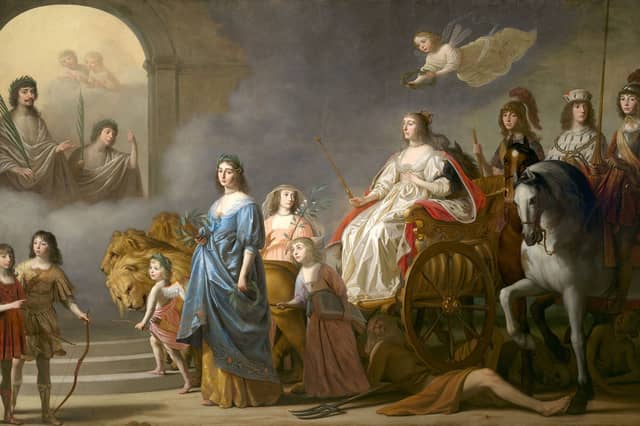

Towards the end of Jean Findlay’s novel about James VI’s daughter Elizabeth, there is a scene in which she is sitting for a portrait by the great Dutch Golden Age painter Gerrit van Honthorst. He shows her in a chariot being pulled by three lions, surrounded by her family, both alive and dead. The painting is called The Triumph of the Winter Queen.
What triumph? Elizabeth’s husband Frederick was seven years dead in 1636 when van Honthorst finished his painting, as was her eldest son, and he shows them both looking down at her from a heavenly alcove. Much of the political clout she had from marrying the Elector Palatine, Protestant ruler of Heidelberg, had long since vanished. Together they had been kicked out of Bohemia, where their reign in Prague was so short - less than a year - that Elizabeth was known then and ever since as The Winter Queen. Heidelberg fell next, and she spent the next 42 years in exile until her death in 1662. She couldn’t even afford to pay van Honthorst for his painting.
Historically, Elizabeth’s importance lies in her role as propagandist for the Protestant cause in the Thirty Years’ War, which churned up Europe on a scale barely imaginable until the First World War (and even then, it was responsible for proportionately more German casualties). Yet not only did she fail to secure her father’s backing for Frederick’s attempts to regain the Bohemian throne, she also failed to persuade her own brother to become involved too. None of the three lions pulling her chariot in van Honthorst’s paintings - allegorically, England, the Dutch and the Palatinate - lived up to Elizabeth’s expectations.
In Findlay’s novel, the long war's ebbs and flows largely happen offstage - no small mercy given the relentless breaking and forming of diplomatic and military alliances involved. The main focus never shifts from Elizabeth. In a sense, Findlay is attempting to do for her subject what van Honthorst was doing, except her portrait has to be four-dimensional instead of two as she shows us how Elizabeth’s character changes from the young bride in a rare dynastic love marriage to the exiled widow who refuses to give up on her children’s claims to her dead husband’s lands - even when the Emperor has already given them away to Catholic rulers.
She shows other changes too. As the daughter of both a king and a queen, Elizabeth had a sense of her own worth and initially expected to take precedence over everyone else at court in Heidelberg - including, rather awkwardly, her mother-in-law. You might have thought that echoing her father’s belief in the divine right of kings would become problematic: after all, not only had Elizabeth and Frederick lost the Bohemian throne, but the Dutch republic, in which she lived in exile, was then Europe’s most successful (or at least richest) country.
That, though, is to apply 21st century logic, and Findlay is much too good a historical novelist to do so. Her portrait of Elizabeth is psychologically credible, well imagined and told in a third person present tense which somehow manages to span five decades without becoming tiresome. The sequel to her well-received debut The Queen’s Lender, this is the middle book in a planned “Queens of Europe” trilogy, the next one of which will look at two of Elizabeth’s daughters.
Elizabeth believed above all in her own dynasty, in the eight living children who surround her in van Honthorst’s painting. She was right to do so. Mary Queen of Scots, Elizabeth’s grandmother, fell to the executioner’s axe, and so too did her brother, Charles II. But her daughter Sofia, six years old in the painting, married the Elector of Hanover and their son became George I of Great Britain. Even though she never lived to see it, in the end the Winter Queen did indeed triumph.
The Bohemian Queen, by Jean Findlay, Scotland Street Press, £14.99
The Scotsman’s arts newsletter is now sent twice a week - subscribe today
Enjoying the Arts & Culture journalism on scotsman.com? Make it easier to find by selecting us as a preferred Google source
Want the latest Scottish headlines sent directly to your phone? Sign up to our new WhatsApp channel here
Comments
Want to join the conversation? Please or to comment on this article.