
Marjorie Lotfi on poetry and the refugee experience: 'my past is always present'
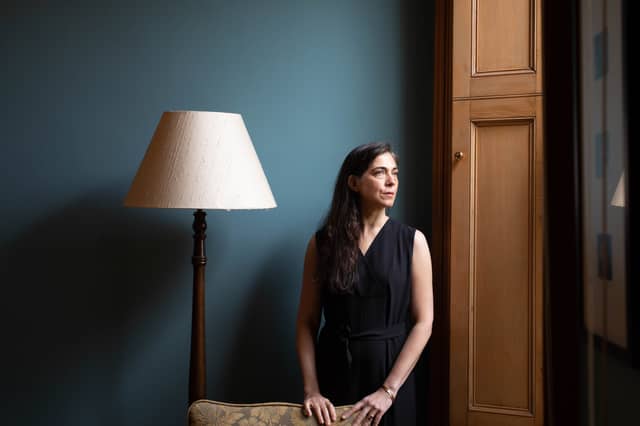

Marjorie Lotfi’s family fled Iran with one suitcase and an hour’s notice during the Iranian Revolution. A prize-winning poet, she is involved with three events at this year’s Wigtown Book Festival. Here she explores the relationship between poetry, exile, the refugee experience and political resistance
At a time when immigration is headline news, and it’s acceptable to demonise those arriving in Britain, can poetry about migration help to challenge this rhetoric? In her 1991 poem “What Kind of Times Are These?”, Adrienne Rich describes a refuge “abandoned by the persecuted/ who disappeared into those shadows.” I studied this poem at university, noting how it named the persecuted while withholding the location of their refuge. For me, poems like this are powerful precisely because they speak truth while refusing to tell all or connect every dot for their readers.
The gap between narrative and meaning is useful in poems about my history, too. With less than an hour’s notice, my American mother, brother and I left Tehran in 1979 during the Iranian Revolution. We’d left it late. My mother knew that my Iranian father couldn’t leave the country, so we stayed after the embassy closed and into months when it wasn’t safe for her to go out. My brother and I ran errands and noted anti-American graffiti on our wall. A neighbour insisted we shelter in his house when a violent demonstration passed, men running across the roof above us. Our journey to the airport was on a day of city-wide protests, with my mother cowering in the back of our car:
She wraps a black scarf
around her white face
the way her mother-in-law has shown her
when the car edges towards Shayad Square
No voices just a roar no birdsong
but gunfire in winter sunlight
this the mother of all riots
(from “To the Airport”, from The Wrong Person to Ask, Bloodaxe Books)
My father joined us in the US a few months later, having left everything – our possessions, family, a self-made business – behind. What followed was more difficult
than the displacement itself, but that’s another story. I’ve written about Iran for over a decade now, carefully treading a line because we still have family there. Rather than tackling political questions, it’s easiest (and safest) for me to write in narrative form, to let the reader draw their own conclusions.
My collection The Wrong Person to Ask takes its title from the final line from “On seeing Iran in the news, I want to say”, a poem that lists personal memories of Iran as a response to those asking current political questions. Like Rich, I describe the place and people we left behind in the poem, but not what the reader should do with that information.
Perhaps my most conscious form of resistance is writing against the idea that a safe landing equates with a new start; displacement doesn’t end when you arrive, it becomes a lens through which you see everything that follows. Our lives aren’t a single, clean story told across a timeline, and my poetry about Iran is both an articulation of that experience and a form of resistance against the ‘it’s fine now’ (or worse, the ‘you should be grateful’) rhetoric.
The recent conflict between my homelands, Iran and the USA, has triggered memories and brought new complications. I spend hours scrolling the internet for news about Iran, sometimes even dreaming in Farsi. The opening poem of No Known God, my forthcoming collection with Bloodaxe Books, layers this past across the current conflict:
.
Pentecost
.
“When death was a winged horse, I escaped my country” – Nick Makoha
On a plane overloaded with bodies, some
moving, others still, only half of them in seats,
the pilot offered one last chance to leave
before closing the door, before we flew.
No one moved. Tehran airport had been shut
for days, its ground crew on strike, the vehicles
scattered across the runway moved off just
for our flight. Who were we to leave this way?
.
My American mother sat silent, draped
in a black chador. What I didn’t know then:
I’d never learn to write in my first tongue, always
caught between speech and song. This morning
I woke from a dream in which every person
spoke only Farsi and I understood them all.
.
When it’s hard to look a difficult subject in the eye, I often turn to metaphor, one subject framing my thoughts about another. A story about the discovery of a crab apple tree in the Hebrides reminded me of those who chose (or were forced) to stay during conflict, in Iran or Gaza:
.
The Hebridean Crab Apple
.
This, I understand: the instinct to cling,
at any cost, to the place you are rooted,
to see another season through, though
the others seed elsewhere. Even in this
.
sedentary act you push the limit: winter
becomes summer becomes winter
and you are steadfast on your crag,
your outcrop. No one knows the shape
.
of your limbs against a darkening sky;
you question the need to grow against
the wind. Despite what they say,
there’s no mystery in simply holding on.
.
And what is home if not the choice —
over and over again — to stay?
(from The Wrong Person to Ask, Bloodaxe Books)
.
But why write poems about migration – directly or in metaphor – at all? The honest answer is that my past is always present when I write, and that experience is a part of whatever story I tell. Adrienne Rich asks this same question, then answers it at the end of her poem “why do I tell you/ anything? Because you still listen, because in times like these/to have you listen at all, it's necessary/ to talk about trees.”
Marjorie Lotfi’s events at Wigtown Book Festival include Iranian Women’s Voices, an evening of poetry’ film and music, see www.wigtownbookfestival.com. The Scotsman is the 2026 media partner of the Wigtown Poetry Prizes, see www.wigtownpoetryprize.com
The Scotsman’s arts newsletter is now sent twice a week - subscribe today
Enjoying the Arts & Culture journalism on scotsman.com? Make it easier to find by selecting us as a preferred Google source
Want the latest Scottish headlines sent directly to your phone? Sign up to our new WhatsApp channel here
Comments
Want to join the conversation? Please or to comment on this article.