
The Edge of Revolution by David Torrance review: 'balanced and solidly researched'
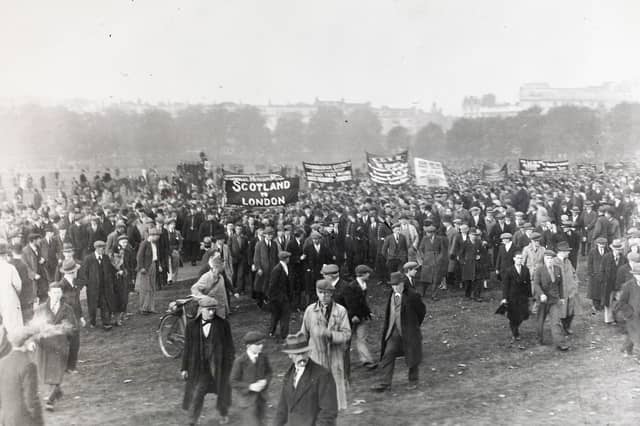

A century on from the biggest strike in British history, David Torrance’s new book asks how close we really came to “the edge of revolution.” Review by David Robinson
We call it the General Strike, but it wasn’t. A hundred years ago this May, our cotton and wool mills were still busy, civil servants and local authority workers turned up for work, hospitals and doctors’ surgeries remained open and even the engineers and shipyard workers on “Red Clydeside” carried on as normal.
And yet in May 1926, two million workers stopped work in the biggest strike in British history. For nine days, public transport ground to a halt, as did most industries relying on gas or electricity. Apart from The Scotsman and the Edinburgh Evening Dispatch, and the news sheets produced by Churchill (for the government) and by old Fettesian journalist Hamilton Fyfe (for the unions), no newspapers were printed.
All of this was done, in a rather impressive demonstration of unselfishness, in support of the miners. In the First World War, the government had taken control of the mines and imposed a relatively generous pay deal, but now the pits were back under private ownership, coal exports were down, and the mine owners were insisting on pay cuts. Collectively, they were an unimpressive bunch. As Torrance points out, Lord Birkenhead spoke for many of his Cabinet colleagues when he caustically observed, "it would be possible to say without exaggeration of the miners’ leaders that they were the stupidest men in England if we had not had frequent occasion to meet the owners”.
Stanley Baldwin’s government - in 1925 not yet ready for a conflict with an industry on which four million of its citizens depended - bought peace in the pits with a Royal Commission and a nine-month Treasury subsidy. In March 1926 the Commission’s report came down against any reduction in miners’ wages, in April the Treasury subsidy ran out and the mine owners posted notices of a lockout unless miners accepted a cut in wages, and on 4 May the country’s first multi-union national strike began.
Was it really “the edge of revolution” as Torrance’s title suggests? Certainly that’s what miners’ leader Arthur Cook hoped it would be: he had been calling for a general strike to achieve revolutionary change since 1918, when he was jailed for sedition. It’s what Home Secretary Sir William Joynson-Hicks thought too, and the reason 2,500 members of the Communist Party were arrested, though their influence on events was wildly exaggerated.
Such violence as there was fell far short of normal revolutionary levels. A bus was stopped and set on fire at London’s Elephant and Castle, drivers were forced by crowds to abandon their cars on the city’s East India Dock Road and the Blackwall Tunnel: inconvenient no doubt, but - unlike the deliberate derailing of a train ten miles north of Newcastle - not life-threatening (and even then only one passenger was injured). And what kind of revolution has strike committees organising games of football with the police?
A case can be made that the General Strike was, for most people, what social reformer Beatrice Webb said it was - “a batch of compulsory bank holidays” when middle-class volunteers got to play at being bus conductors or train drivers (interestingly, none of them seem to have wanted to try their hand at being miners). For the miners themselves, those nine days were anything but a jolly jape. When the General Strike ended, they stayed on strike for a further six months and went back to work on lower wages with none of their demands met. The next year 1,129 of them died in workplace accidents.
Torrance’s account is balanced, solidly researched, and takes the story of the strike further beyond London than many similar histories manage. In Edinburgh, for example, three people died when trains driven by non-striking/volunteer drivers collided (see www.generalstrike100.com), and a police horse was killed and a policeman slashed with a razor in a riot in the Old Town. Again, not quite a revolution, but close enough to one for many to worry about.
The day after the General Strike ended, the Daily Mail was quite sure about had happened. “Revolution Routed,” its headline read.
The Edge of Revolution: The General Strike that Shook Britain, by David Torrance, Bloomsbury, 304pp, £20
The Scotsman’s arts newsletter is now sent twice a week - subscribe today
Want the latest Scottish headlines sent directly to your phone? Sign up to our new WhatsApp channel here
Comments
Want to join the conversation? Please or to comment on this article.