
Hugh McMillan: at a time when many struggle to get by, what’s the point of poetry?
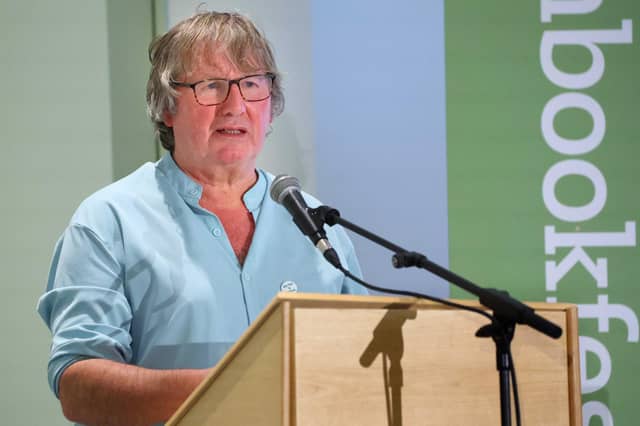

This year’s Wigtown Book Festival will be awash with poetry, alongside every other kind of literature. To kick off our new weekly series of Wigtown Poetry Essays, Hugh McMillan sets out to answer a question put to him in the pub: ‘what’s the point of poets and poetry in a world going to hell in a handcart?’
The Galloway Bar in Wigtown is a pub the way pubs were meant to be. Full of locals, banter, lager, not a charcuterie tray or mai tai in sight. People express their opinions, and they’re not always comfortable to hear. When I was researching an article, for instance, about the impact on the economy of Wigtown’s official designation as Scotland’s National Book Town, I asked an auld heid and he said “Aye, this town used to be a f***ing dump – and now it’s a f***ing dump with a book festival.”
I once had the misfortune to appear on TV talking about being a poet while I was in the pub, prompting such abuse the landlord still gives me a free pint whenever I turn up. The consensus was “what’s the point of poets and poetry in a world going to hell in a handcart?”
I’ve often wondered myself how writing a poem that might appear in a small Canadian magazine can ever help the people of Gaza, or anywhere else where the simple task of living is a horror. Basho said “Real poetry is to lead a beautiful life. To live poetry is better than to write it.” Not everyone can live up to that. Dylan Thomas said “the world is never the same once a good poem has been added to it.” I hope that’s true. I know myself that expressing a political stance in poetry is a lot more healthy than impotent rage.
It’s also true that poetry is a way of preserving ways of life and thinking. Galloway, with its rich mixture of Gaelic, Northumbrian, Scots, even Norse, has produced many bardic poets, poets whose work transcends the temporary. I’m thinking of the brilliant William Neill and Josephine Neill, the former who wrote in all three languages of Scotland, the latter whose wonderful Scots captures a rural way of life which is familiar and poignant because it has largely disappeared. I’m thinking of Alexander Anderson the railwayman from Kirkconnell; I’m thinking Roger Quin “the tramp poet” who lived for a while in a cave near Whithorn; I’m thinking of spikey, embattled Hugh MacDiarmid in Langholm. In a country where language, history and heritage is a battleground between folk who want to deny our identity and folk who see them as parts of a past that might ignite a future, poetry plays a vital part still. At Wigtown the book festival has always celebrated the vital strands of our literary DNA, including Gaelic. Mind you, don’t get the folk in the pub started on that – no use telling them that the only dead language on a police car bonnet is Latin.
Another Bard, Alastair Reid, was born in Whithorn 100 years ago. He travelled, had international perspectives to hold up mirrors to our Scottishness. His love of small town Scotland and hatred of small town bitterness reflects some of our more difficult legacies. There’s an event in this year’s festival celebrating his legacy. I suppose if there was a fish shop in Wigtown someone should stand with a “radiant raincoat” outside and re-enact that great exposure of Presbyterian angst, his poem "Scotland”, which I believe to be one of the best poems on the subject ever written. The evils of Presbyterianism I mean, not fish.
Poetry is a way of drawing our attention to what’s bad, not necessarily good. In fact nearly always. “Happiness writes white” said Philip Larkin, quoting Henry de Montherlant. But expressing the bad can be cathartic and informative. Especially if as a victim or refugee you have suffered discrimination or displacement, or if you’re simply a person that sees something with clarity and wants to share it.
But isn’t poetry also a joy? Working in schools as I’ve done over the last few years is such a laugh: weans do not bother about “creativity”, they’re just creative, at least until they reach that awkward stage in adolescence where embarrassment freezes them into silence. They slap your pretensions down, tell it, like the folk in the pub, how it is. Wigtown has facilitated a mass schools community poem (on show at the festival) about living beside the sea with some beautiful work resulting, though my favourite response was from a boy who, living beside the Solway all his life, claimed never once to have noticed it.
READ MORE: The Book of Coffee: A Philosophy, by Julian Baggini review: 'makes you see coffee in a new light'
Poetry is an entertainment. People enjoy listening to it, especially if its moving or amusing or both. I nearly choked recently listening to Biff Smith’s elegy over the missing station “Dumbarton East”, read recently in a tiny Glasgow venue. When my own work is received with laughter or a small sigh I know I’ve hit some sort of button. Poetry is for sharing, out loud or on the page.
From 25 September to 4 October, Wigtown Book Festival will be full of poetry. That’s partly thanks to the presentation of the annual Wigtown Poetry Prizes. But that’s just the start. The festival is full of poets – living, dead, young, stand-up, local, international. There are poetry trails and walks. It’s a feast if you go into it with an open mind. I used to go to pubs and make people listen to me reading. Mostly, once people got their heads round what was going on, they loved it. I have not had the courage to do this in the Galloway Bar. Maybe this is the year.
For more on this year’s Wigtown Book Festival, see www.wigtownbookfestival.com. The Scotsman is the 2026 media partner of the Wigtown Poetry Prizes, see www.wigtownpoetryprize.com
The Scotsman’s arts newsletter is now sent twice a week - subscribe today
Enjoying the Arts & Culture journalism on scotsman.com? Make it easier to find by selecting us as a preferred Google source
Want the latest Scottish headlines sent directly to your phone? Sign up to our new WhatsApp channel here
Comments
Want to join the conversation? Please or to comment on this article.