
An Injury To All by Ewan Gibbs review: ‘timely and necessary’
This is an excellent and eloquent analysis of how ideas about class have changed over time, writes Stuart Kelly

My Dad – who became a schoolteacher after a stint working in industry - reminisced about a newspaper cartoon around the time of the change from O Grades to the striated Standard Grades. It showed three pupils, in a variation of Feldman and Law’s “Class Sketch” on The Frost Report. The first pupil, smartly uniformed, was captioned “I am in the Credit stream. I come to school in a car”. The second, attired in an average-looking uniform, had the subtitle “I am in the General stream. I come to school on the bus”. The final was a bit of a scruffy tyke and boasted “I am in the Foundation stream. I come to school on Wednesdays”. It might be an old joke, but you can unpick a lot of different assumptions about status, background, the role and expectation of education and even perhaps criminality from it. Ewan Gibbs’s book is an excellent and eloquent analysis of how ideas about class have changed since the creation of the welfare state. It is timely, necessary and (perhaps a feature of much of the Left) elegiac rather than fulminating.
We all know that class is not about money. As one aristocratic friend put it, “there’s a difference between class and classy”; the foundational sociologist Pierre Bourdieau would have phrased it as the difference between economic, social and cultural capital. Though it is a relatively crude set of distinctions, and requires nuance, it is more insightful than the pseudo-science of D1 vs C2 demographics.
In a nod to EP Thompson, Gibbs frames this as the “unmaking of the working class”, and as a specialist in oral history and recording the memories of the subjects (rather than objects) of study, he gives a neat twist of the idea of the working class being witnesses and indeed actors in their own “unmaking”. There is no simplistic “silver bullet” explanation for what is obviously a multifaceted and multidimensional, even seismic, era of change. Gibbs’s trajectory across the book begins with the post-war “new working class”, and especially the centralisation and even gigantism of industry. In a way, the first chapter is really about electricity, and coal’s role in it. My grandparents would have seen the transition from brooms to hoovers, larders to fridges, communal cinema to private television: indeed, even horses to cars and tractors. That the trade unions rightly were fighting for cleaner, safer and better paid working environments ironically was an undoing. The influence of affluence was that the “working class” no longer wanted to be seen as the working class. In a telling moment one miner expresses chagrin at meeting a former workmate at the football, who was now getting far more money working (ironically) at the Linwood car plant. Trade Unionism has been hollowed out to the extent that perhaps only Mick Lynch is now a recognisable figure: the days of McGahey, Scargill and Jack Jones are long gone.
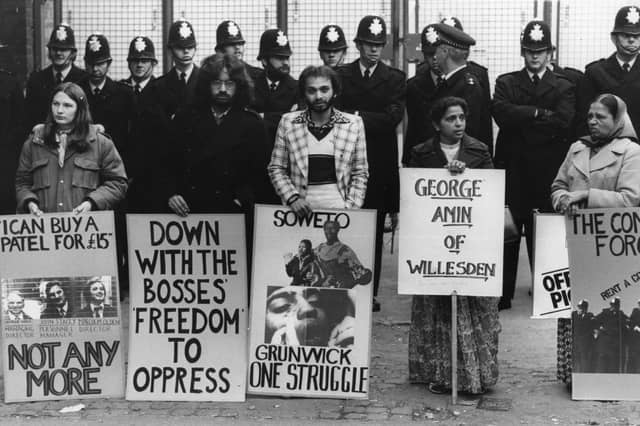
The second chapter is perhaps the most pointed, discussing the strike at the Grunwick photograph developing plant from 1976-78. There are a number of factors here which foreshadow things to come. Firstly, the mail-order service was a different kind of industry to coal, steel or manufacturing. The company was reliant on immigrants for its workforce - many of them were Asians who had been expelled from East Africa, and many of them were women.
What now might be referred to as intersectionality (class, race and gender as imbricated victims of prejudice) was then seen more as a mark of solidarity, given the number of workers who came out in sympathy. It was also a test case for more aggressive government policy – the use of the police, and the media misrepresentation – which served as an overture to the Miners’ Strike. The depiction of lippy, ungrateful workers with bullying unions upsetting a small entrepreneur who was himself of mixed-race set up a series of archetypes. As Gibbs ruefully notes, as well as the Thatcherite prototype, this segues easily into the world of un-unionised Amazon, zero-hours contracts and Ubers. It also is a spark that fizzles towards “British jobs for British workers” and the rise of the UKIP and Reform. (One positive note: the BNP never did that well on the back of it).
Gibbs rightly concentrates on the Right to Buy, and his case history of one Maureen Patterson, a care worker, who bought their property in Amersham Road, London. Marital breakdown and rising mortgage rates meant she lost the house and ended up in a caravan – homeownership to homelessness as Gibbs notes – but would not criticise or repent the decision, recollecting Thatcher being a “lovely guest” and purring “this is not a house but a home”. Thirty years after the Pattersons bought the house for £8,315 at a 40 per cent discount it sold for £180,000. Look at the number of renters and buy-to-lets now. Later chapters cover New Labour (“From Loadsamoney to Mondeo Man”) up to “essential workers” and the gig economy.
The end of the story, perhaps, is Tony Blair saying to conference on the 28 September 1999 that “the class war is over”. Sir Peregrine Worsthorne, editor of the Sunday Telegraph, apparently once quipped, when asked about the class war, that “It’s over. We won”.
An Injury To All: The Unmaking of the British Working Class, by Ewan Gibb, Verso, £25
The Scotsman’s arts newsletter is now sent twice a week - subscribe today
Enjoying the Arts & Culture journalism on scotsman.com? Make it easier to find by selecting us as a preferred Google source
Want the latest Scottish headlines sent directly to your phone? Sign up to our new WhatsApp channel here
Comments
Want to join the conversation? Please or to comment on this article.