
Glasgow International reviews: Jasmine Togo-Brisby | Rehana Zaman | Kate Cooper | Tanoa Sasraku
At a time when Glasgow’s art scene seems to be under attack from all sides, the Glasgow International festival offers a timely reminder of what makes it special, writes Susan Mansfield


Glasgow’s art scene feels like it has taken a pounding in recent months with the closure of CCA, the battle to save Trongate 103 and shrinking budgets meaning fewer exhibitions at the venues managed by Glasgow Life. So the arrival of the Glasgow International festival is all the more welcome: a reminder of how much life there is in the city’s visual art sector, from the grassroots up.
Shetland-born curator Helen Nisbet took over at the helm of GI less than a year ago, and her steadying hand at the tiller is evident. The festival continues to lean in to the things which have always made GI special: the blend of grassroots, national and international shows; the opening up of new (or old) spaces in the city; the broad geographical spread and the egalitarian ethos - everything at GI gets equal billing, from the smallest show to the largest.
Among the bigger shows (if one is allowed to make that distinction) is Jasmine Togo-Brisby’s Liquid Land (★★★★) at GoMA, the Australian artist’s debut show in Europe, commissioned by GI and continuing to run alongside this summer’s Commonwealth Games. This site-specific body of work takes on the architecture of GoMA, as well as the colonial and mercantile history of the building.
In the architecturally grand space of the ground floor gallery, Togo-Brisby constructs a life-size replica of the hut which was her family’s first home in Australia. Originally from the South Sea island of Vanuatu, they were subjects of “blackbirding”: the deceiving or kidnapping of Pacific islanders for forced labour on Australian sugar plantations.
It’s a show where a small number of things resonate powerfully: the hut, which looms large in the space; a glass chandelier hanging low over a tin bath of molasses, and a floor sculpture made of black feathers. There is also a much larger vat of molasses in the entrance hall giving off a faint burnt-sugar scent.
Togo-Brisby leaves plenty of room for each piece to assume its rightful weight. Again and again, I find my thoughts returning to that small bath of molasses in the centre of the hut, in the centre of the room: a small, representative portion of the crop which fuelled hundreds of years of enslavement and exploitation. Australia is implicated in this, but Glasgow is too.

GoMA’s ground floor gallery is a big space, but you could put several of them inside the aircraft hangar that is Kelvin Hall, the former home of the city’s transport museum. Rehana Zaman’s Plantation (★★★★) occupies the warehouse towards the back, an installation focusing on two films about migrant seasonal workers and casual labourers who work on industrial farms in Scotland and Pakistan. At 36 minutes and 53 minutes respectively, played in sequence, this is not a drop-in show.
Zaman has a lingering, quietly intense style of observation, moving almost seamlessly between high-definition digital film and 16mm, with occasional flashes of CGI manipulation where the colours are inverted. Jo Kherray so Khaey, filmed in Punjab, shows an exhausted low-status workforce working in back-breaking conditions for poor pay, on land which is pushed to yield several crops a year. There are occasional moments of lightness which lift the mood, but on the whole it’s tough going.
Soft Fruit, filmed in Angus, is rather different. The international workforce living in static caravans clustered around polytunnels, getting up at 4.30am to pick strawberries, don’t see themselves as slave labourers. Some of those Zaman interviews return year after year to make “good money” which they are “investing” to improve their homes or educate their children back in their own countries. The film holds these tensions and invites us to consider them.
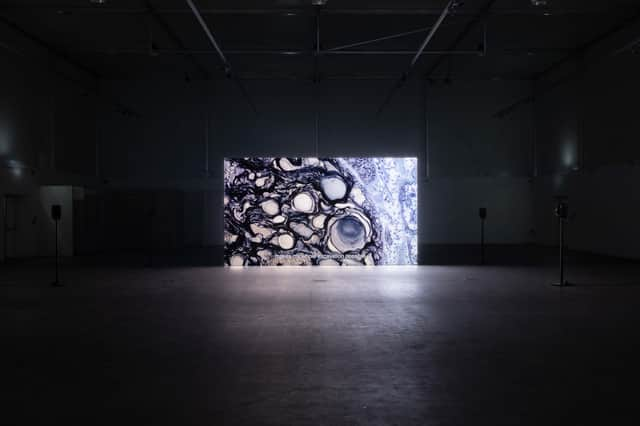
In the Black Box space at Kelvin Hall is another audio-visual piece, Kate Cooper’s Screen Bodies (★★★). From the blurb I read before I went in, it feels heavily burdened by ideas: the body, technology, perception, how bodies are dehumanised, and how all that is reflected in the wider body politic.
Visually, we’re looking at found medical imagery, colourful blobs and shapes which merge and dance without any indication of what they are or whether they are good or bad. The soundtrack by Soraya Lutangu Bonaventure captures several different voices: those of the artist, her six-year-old daughter, a friend who is a pathologist, talking about the mechanics of cancer, a speech by Aliya Rahman, who was detained by ICE in Minneapolis in January, and a further text by writer Rahila Haque.
Again, it’s a long piece and - as with all the other films at GI - there’s no indication of how long. I stuck with it for some time but struggled to see how the visual and audio elements were meant to interact, and how the various thematic strands were meant to fit into a larger argument.
In another big space, the Clydeside Hall next to the Briggait, British artist Tanoa Sasraku presents a group of sculptures, Tropical Hardware (★★★). Sasratu, who graduated from Goldsmiths in 2018, has made flak jackets from layers of paper, stained with UV rays from sunbeds, mimicking the flak jackets worn by British troops on assignment in the Tropics between the 1980s and 2000s.
The layers are clipped together by colourful bulldog clips and the jackets are displayed in crates painted in bright, tropical-looking colours. She has also made glass trinkets containing drops of crude oil. These things are clearly invested with meaning, perhaps personal as well as political, but this is not opened up for the viewer. Beyond understanding what the objects are, it’s difficult to engage with them.
There no such challenge in the space next door with Renèe Helèna Browne’s film, Flat (★★★★). Browne, a graduate of Glasgow School of Art’s MFA programme, stood out on Edinburgh Art Festival’s Platform programme in 2024 when they showed a film about rally car culture in Ireland and their relationship with their mother.
In this film, the background is the “mica scandal” in Donegal, in which hundreds of relatively modern homes have been left crumbling due to defective concrete blocks which contain an unusually high concentration of mica. Browne’s subject is their uncle, a man in his seventies, who, when faced with a crumbling home, decided to build himself a flat inside a barn on his farm.
Helping and observing him over a period of months, Browne records much more than the building project. We hear about his enthusiasm for stars and planets, his rock collection, his explanation of the speed of light. We meet his dog, his cattle, and see him patiently and with great competence create a capsule home for himself with access to electricity, water and oil.
It’s more than “a man, a dog, a house”. It’s a story about resilience, and one man’s response to what life throws at you. At 27 minutes long, this film is no drop-in either, but it’s worth watching through, and you won’t notice the time passing.
Nor will your notice it during A Sensation Never Yet Known, the new film by Glasgow-based Luke Fowler, at the former Florence Street School (★★★★). It continues Fowler’s series of films about contested or overlooked figures from the 1960s and 1970s with a look at Janet Beat, an experimental composer and pioneer of electronic music who is now 88 and living near Glasgow.
He marries Peat’s voice, and a collection of her unreleased music, with beautiful 16mm film made in her home, in the countryside nearby, and in the Royal Scottish Conservatoire where she taught for many years, and in the countryside around her home. It’s fascinating, not only because it’s well made, but because the focus is on a person, a story. In it we discover (because she will surely be new to most of us) a woman who struggled for recognition and opportunities in her work, and whose considerable achievements are now in danger of being forgotten.
Glasgow International runs until 21 June; Jasmine Togo-Brisby until 6 September; Luke Fowler until 18 June, and open by appointment from 22-24 June, see www.glasgowinternational.org
The Scotsman’s arts newsletter is now sent twice a week - subscribe today
Want the latest Scottish headlines sent directly to your phone? Sign up to our new WhatsApp channel here
Comments
Want to join the conversation? Please or to comment on this article.