
Edinburgh Art Festival reviews: Sandra George | Wendy McMurdo

The City Art Centre’s Sandra George retrospective is the first must-see show of the summer, writes Susan Mansfield
Sandra George: Start From the Level, City Art Centre, Edinburgh ★★★★★
Wendy McMurdo: The Digital Mirror, National Galleries Scotland: Portrait, Edinburgh ★★★★
It’s a remarkable story: a cache of 83,000 photographs taken in Edinburgh during the 1980s and 1990s by a Black woman photographer, never exhibited and barely remembered until they were gifted to the charity Craigmillar Now a handful of years ago.
A small selection of Sandra George’s photographs were shown at Glasgow International in 2024 by Jenny Brownrigg, and thanks to the progress made by the group of volunteers at Craigmillar Now who have been cataloguing and digitising the collection, it is now possible to mount a much bigger show, over two floors of the City Art Centre. The 200 images here are still just the tip of an iceberg, but they begin to show us just how remarkable her work is.
George studied photography at Napier University, having grown up in Nottingham, Birmingham and Jamaica. After college, she got a job as a community worker in Edinburgh’s peripheral housing schemes. Her photographs were printed in community publications but were never exhibited or published more widely. She died in 2013 at the age of 57 without ever reaching a wider audience, yet her understanding of herself as a photographer and an artist is indisputable.
The first photographs in the show are journalistic in flavour, documenting protests and events which reflect her activism: women’s rights, nuclear disarmament, a young woman being hauled off by two tall policemen during an anti-National Front demo in Birmingham.
Edinburgh, though, is where she did most of her work, and she portrays a more diverse, multi-racial city than many of us remember from that period: Black people in Festival Square celebrating Nelson Mandela’s release from prison in 1990; Sikh shopkeepers in Restalrig, photographed next to racist graffiti; an actor from a Black theatre cooperative, in full Highland dress, outside the old Traverse Theatre.
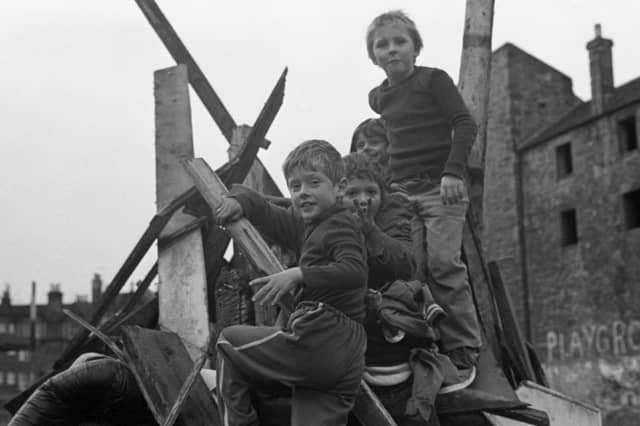
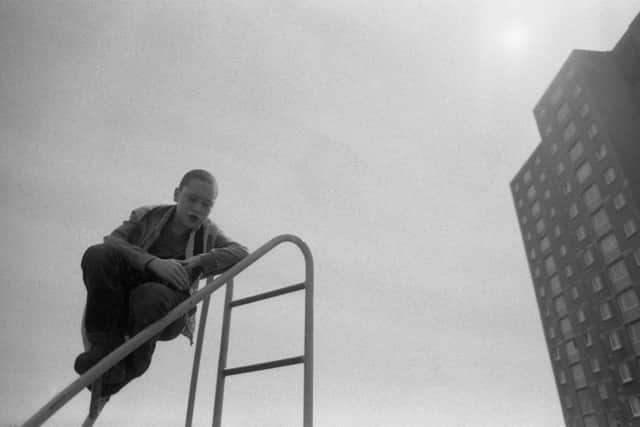
Children were a key subject: clambering and dancing in gym class, boisterous at the school gates. The boys in the playground at Craigmillar School, or defending their makeshift fort on waste ground in Leith have the energy and mischief of Oscar Marzaroli’s Castlemilk Lads. Everywhere there is evidence of George’s keen eye: a lad on a unicycle snapped outside an Adults Only store; a little girl day-dreaming with an open book; a child in a toy car exhibiting an expression of infinite boredom.
The title of the show comes from a note George wrote to herself, discovered by curators Stuart Fallon and Christian Noelle Charles in her Filofax: “Stop making assumptions about people, start from the level where people are based”. Always, she afforded her subjects respect and treated them as people with agency.
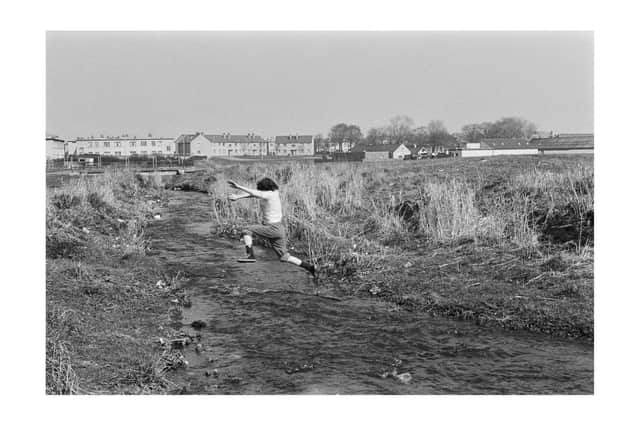
The best of her work is as good as the best of her contemporaries. The two women parked on plastic chairs next to a set of scales in Wester Hailes Shopping Centre is worthy of Martin Parr. When a child in a toy car rides past a man pushing a mower in the opposite direction, she captures the instant when the child looks round quizzically. A boy is caught mid-leap over a burn, the tenements of Bingham in the background, straining forward to cross a distance we can see is a little too far for him.
All of this is a joy, but the most arresting images here, some of the most deliberate and considered, arise when she turns her lens on herself. In one, she is kneeling, camera poised, a baby Tyler no more than a few weeks old snug between her legs. In another, she takes the shot one-handed, using her other hand to hold her squirming toddler. They are intimate shots but they are not private. They are a woman telling us who she is: a mother, a photographer, an artist.

She is invariably stylish, whether in her running gear, thoughtfully tying a shoe, or posing in a dapper waistcoat and pillbox hat. And her son is her subject, from his first days in an incubator through the years of his childhood; while there may be a few too many of these in the show, the best of them are very, very good. Their flat in Bread Street which doubled as her studio and darkroom, comes alive too, its walls decorated with Jackson Pollock paint splatters by mother and son together.
While there is much more to be discovered about George’s work, and it is to be hoped that research will yield more background than we have in these sparse, hard-to-read captions, this exhibition is a gift. It offers us two things: a body of work which captures an Edinburgh largely unseen in photographs, and a sense of the photographer herself: a woman with loads of talent and plenty to say, coming alive in the pictures she captured herself. The first must-see show of the summer has arrived.
Wendy McMurdo’s exhibition, The Digital Mirror, takes up almost where George’s leaves off. This is the biggest show of McMurdo’s photography to date, taking a cross section of her projects from 1995-2018. The two women’s work is very different, but they both address childhood as a key subject.
McMurdo both uses and interrogates digital media. In 1997, in Computer Class, she photographed primary school classrooms in which the computer - evidently a weighty desktop affair - has been digitally removed. Only the attention of the child is left, hands poised above an invisible keyboard. She does something similar with Algorithmic Children in 2015, where the subjects are sprawled on the floor with invisible iPads. The years in between these series brought us home broadband, the smart phone, social media: fruits of an ongoing digital revolution in which these children are natives.
In a way, the digital presence is here in every shot, whether visible or not. Photographs show us children dressing up in robot costumes they have made themselves, acting out imaginary scenes in a drama class, or discovering the world by visiting museums or science centres. But the question behind the images is the same: how is technology changing the way children play and learn?
McMurdo also taps into a rich seam of the uncanny. A little girl dressed as a ghost, hovering in a New Town doorway, perfectly encapsulates the eeriness of childhood, a lineage which runs from from Conan Doyle’s ghost photographs to Stephen King’s Overlook Hotel. In The Somnabulist (1995), two indentical sleepwalkers pass, going in opposite directions. In Helen, Backstage, Merlin Theatre, a child seems to question her own doppelganger. In photographic terms, they reference artists like Susan Hiller or Jeff Wall, but to today’s audience also conjure a world of AI avatars.
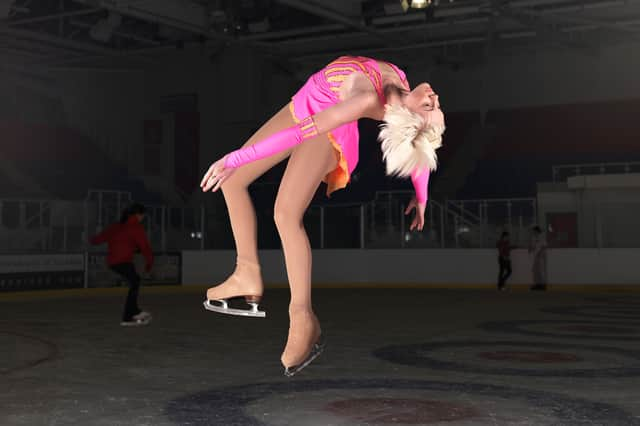
In 2008, McMurdo photographed members of a figure skating club in Dundee who had been used as the models for the Nintendo Wii skating game. Avatar I, an image of a female skater lifted on the shoulders of her partner from which the partner has been digitally removed, is a striking shot which seems to prefigure CGI and AI capabilities.
The newest work in the show is digital animation in which the image itself seems to fracture. In Indeterminate Objects (Classrooms), 2017, commissioned by the Photography Gallery, abstract 3D visualisations float over a classroom table like algorithms given form.
However, the technology has moved on apace since 2017, and the dilemmas faced by young people are more complex than ever. The Digital Mirror poses important questions, but also illustrates the challenges of trying to explore and interrogate a field which is itself developing faster than most of us can keep pace with.
Sandra George: Start From the Level runs until 27 September; Wendy McMurdo: The Digital Mirror until 25 October
The Scotsman’s arts newsletter is now sent twice a week - subscribe today
Want the latest Scottish headlines sent directly to your phone? Sign up to our new WhatsApp channel here
Comments
Want to join the conversation? Please or to comment on this article.