
Đàn Đó with Tom Bancroft, Ali Levack & James Mackay, Glasgow review - 'Scottish and Vietnamese instrumentalists sparking off each other'
This year’s Glasgow Jazz Festival opener might have turned into a cultural collision, but the final standing ovation suggested a communicative triumph, writes Jim Gilchrist
Đàn Đó with Tom Bancroft, Ali Levack & James Mackay, Mackintosh Church Hall ****
This east-meets-west collaboration might have been a cultural collision rather than the intriguing musical colloquy it turned out to be. Opening Glasgow Jazz Festival (which runs until 23 June) following a residency in the Highlands, the Vietnamese ensemble Đàn Đó, comprising a trio on traditional instruments plus saxophonist Quyền Thiện Đắc were joined by drummer Tom Bancroft, piper and whistle player Ali Levack and James Mackay on electric guitar (Scottish saxophonist Sue Mackenzie, had to drop out due to illness).
The home contingent opened, Bancroft’s bodhran then full kit, sonorous guitar and smallpipes loosely shaping a piobaireachd ground, dedicated to the absent Mackenzie. The Vietnamese then worked up a pizzicato groove on jaw harp and tuned percussion before Thiện Đắc’s baritone sax floated in, honking and growling.
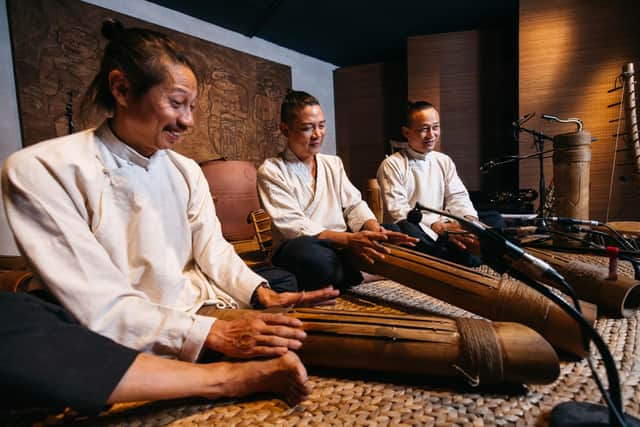

This concatenation of home-grown folk-jazz fusion and incoming jazz-bán đįa – “indigenous jazz” – gelled surprisingly, Scottish and Vietnamese instrumentalists sparking off each other or coalescing, plaintive bamboo flute trading lines with soprano sax or Levack’s whistle. A retreat march led by Border pipes was escorted on its way by diverse Vietnamese instruments with solemn lyricism, while a Mackenzie composition, Kindred, opened with chiming bells and clicking percussion, saxophone flourishes perhaps reflecting the Gaelic psalm-singing which apparently inspired it before horn and flute let rip with free-form blowing.
There were exuberant excursions on western and eastern percussion, Levack’s low whistle improvising breathily before Đàn Đó’s sax and a banjo-like instrument cascaded over drum thunder. The closing number involved eloquently lamenting soprano sax, percussion outbursts and a Vietnamese instrument which produced a near-human wailing, as well as a strident shawm that sparred with Levack’s pipe chanter in a cross-cultural reedy rant. The subsequent standing ovation suggested a communicative triumph.