
Exclusive:From Hibs casual to a sold-out Hydro - the incredible story of bare-knuckle boxing's Leith Warrior
BKFC Championship lands in Scotland for first time and affords chance for sofa installer to turn pro

The hands might tell a story although Lewis Knox will hope they know when to stop blabbing. After all, he doesn't want his tools of the trade to betray him.
These fists helped him survive on Leith’s mean streets. As a former Hibs casual, he once used them to defend his club’s honour.
In a more legitimate context, one less likely to interest the authorities, they are crucial for his current job installing sofas up and down the country. And more pressingly, in Glasgow on Saturday, these hands will be used as weapons with the aim of drawing blood.
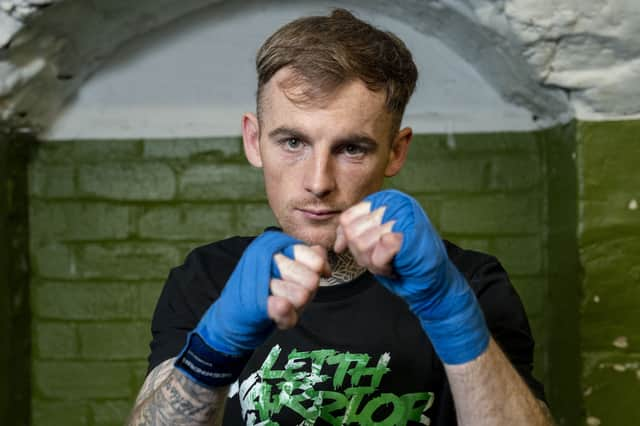

“All legal and above board,” Knox clarifies. Welcome to the world of “BKFC”, which stands for Bare Knuckle Fighting Championship. The promotion, co-owned by controversial UFC star Conor McGregor, hits Scotland for the first time this weekend.
Only the All Blacks’ visit to Murrayfield, Celtic v Kilmarnock and possibly Aberdeen v Hibs will attract a bigger crowd in a sporting context.
Still, it’s guaranteed none of those involved in these fixtures will have spent the start of this week lugging sofas up and down stairwells. “I install them into houses from Berwick-Upon-Tweed to near enough Stonehaven," says Knox. "12-hour shifts, 7 am to 7 pm. Four days on, four days off. But I am still training every night. As well as being a dad of three."
Even the All Blacks, who have been utilising the gym where Knox has been training under the watchful eye of Ali Thomson, might wince at the thought of this schedule. Thomson describes Knox as a "phenomenon". He complains his own arms are aching from doing pads with the focused fighter in the run-up to this weekend.
"People say things are impossible,” ponders Knox. “But you know if you really want it? Things can be done. My mum, my dad, my family. They all support me. Everyone is tuned into it. They all try to help out. This is not an overnight thing, this has been three years in the making to get to where I am now. I have worked so hard."
He was in Fife as recently as Monday delivering sofas but who knows where he will be this time next year? The bare-knuckle scene is taking off, boosted by McGregor's involvement. "I'd like to turn pro," says Knox, 29. Remember that Hearts fan ridiculed for claiming on camera that he’d be willing to have his hands chopped off if it meant his team winning the league?
Knox loves Hibs. He was thrilled by last weekend’s League Cup semi-final win over Hearts at Hampden, which he watched on TV because he was deep in fight camp. However, he can’t afford to strike any bargain involving the prospect of losing his hands. As a bare-knuckle boxer on the cusp of his biggest ever fight, they are, after his three children, among the most precious things on earth to him.
Perhaps a little Atrixo might be in order. They are battered, bruised and a little disfigured. Hardly surprising really, since they are used to pound his opponents. “Bone on bone,” he says. “There is nothing more raw.” He reports that he hasn't broken his hands in his last three fights. "They are solid, like sledgehammers," he says.
Rather than slathering them with hand cream, Knox is considering the old fighters’ trick of sticking his hands into a bucket of sand – or rice. “It strengthens up the skin,” he says.
He broke two knuckles in his very first (official) bare-knuckle fight three years ago this month. Slightly horrifyingly, these knuckles now appear to have disappeared completely. “Yeah, disintegrated,” he says. “Two knuckles have gone, one has dipped (into the hand). As for my pinkie, I can’t stretch it out."
Knox demonstrates this inability to extend his little finger in the café where we are sitting. The Leith Warrior, as he’s known, has ordered a flat white with a shot of caramel (there was still plenty of time to make the required fighting weight of 66 kgs). If not for the damage to his hands, he seems incredibly unwarrior-like.
Softly spoken and trim, almost delicate-looking, the tattoos extending past his collar line on his neck are perhaps the main evidence of a life lived on the edge.
“I always wanted tattoos,” he says. As one suspects is the case with many people, he first succumbed to the needle and ink on holiday in Magaluf.
“A star on my chest and a Hibs tattoo on the back of my calf,” he says. “I thought I had to get serious ones after that. Ones devoted to my gran and many grandad, who both played huge parts in my life from a young age. I also have a gladiator on my arm and neck tattoos…It has become part of the job!”
As for the colours he sports when competing in the circular four-rope ring, which is designed to encourage fast-paced bouts, it wasn’t up for discussion. “Green and white, I always represent where I am from,” he says. “And a Hibs badge on my shorts. I am never not representing Leith.
“I grew up in Leith, a lot of gang culture, an environment of violence as a young boy,” he continues. “You had to be streetwise from a young age I suppose. Leith has its good and bad sides. For me, it’s one of the best places in the world. But it can be one of the worst places in the world.
"Knife crime, drugs. It’s a mix of cultures, backgrounds. I grew up in all of that. But I was never ultra-violent.”
‘Get your dancing shoes on ... we’ve got ourselves a pagger’
His mother, Niki, once ran the Junction bar. Knox enjoys an obvious status in the area. A taxi driver beeps his horn as soon as he steps out of the door of our meeting place on Easter Road. Cross Knoxy and you cross Leith.
He knows people, Irvine Welsh included. The author – a more than decent boxer himself - has been mentoring Knox before his featherweight division fight against Tommy “Chaos” Carus from Liverpool at the OVO Hydro on Saturday night. Welsh has already featured in an Instagram video promoting Knox’s fight, playing the role of his manager.
“Oi, Knoxy!” he calls out after taking a phone call. “Get your dancing shoes on! We’ve got ourselves a pagger.”
Knox v Carus, or the Leith Warrior v Chaos, or indeed Scotland v England, is the third fight of 11 on a bill topped by Sean Weir’s light heavyweight title bout with Leigh Cohoon, a late stand-in for Irishman Conor ‘Da Crook’ Cooke.
Cooke’s team cited concerns about the venue layout and ticketing arrangements for their withdrawal. Some have interpreted this as another way of saying they were worried sectarian/football-related hooliganism – Weir was once a member of the Rangers Riot Crew casuals group - could flare.
Almost 11,000 are expected to converge on the Hydro for the event. BKFC is dedicated to “fighter safety”. According to their official bumph, the organisation prides itself in being “the truest form of bare-knuckle fighting”. Fighters are not allowed to wrap their hands to within one inch of the knuckle. This weekend’s spectacle is the first legally sanctioned and regulated bare knuckle event in Scotland.
For the uninitiated, the fights last for ten two-minute rounds. If there isn’t a knockout, it tends to be fairly obvious who’s won.
“Cuts,” says Knox. “It comes down to facial damage. Because in boxing or any gloved fight, you can punch them ten times with a glove and not make a mark, you can punch them once with a bare knuckle and split someone’s head open.
“It is about getting as much of that in in a short period of time. The first punch usually sets the tone for the fight. It depends on where you catch him, I suppose. It is all about just getting in there and being horrible.”
It’s easy to question the ethics of unpadded pugilism. However, defenders of this ancient and previously underground practice insist it’s a safer, more honest form of boxing. "It is better for the brain, much better," claims Knox. "In boxing you get the double shock with the glove – boom, boom. It rattles the brain. You don’t see the damage facially necessarily. With bare knuckle, bone is hitting bone. That’s it. The facial damage will be shown. Internally your brain is not getting rattled for 12 rounds.
“It is five rounds of two minutes. If you last that, although you might get a few cuts, your brain is fine. To me, my brain feels fine! In my 50s and 60s I will still have a functional brain. I might have a few scars and a few missing teeth but I move pretty well (to avoid the punches). My nose is still straight...”
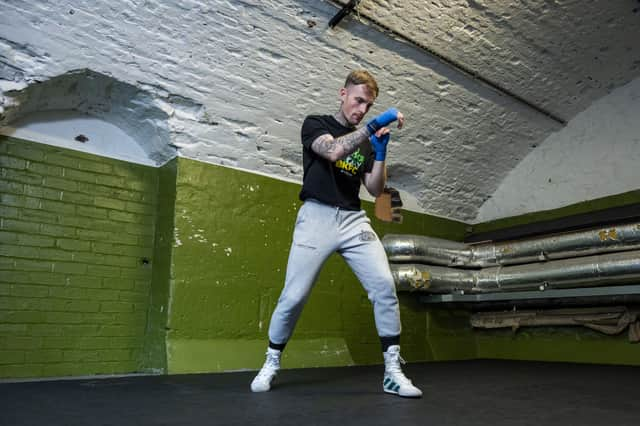
Inside the ring might be a veritable haven as the evening hots up on Saturday. “It is like any combat sport,” says Knox. “The crowd can be unpredictable. A bit like a football crowd. I just hope that because this event is so big for Scotland and so big for the bare-knuckle scene and for lads like myself that nothing serious kicks off. There will be some ‘characters’ there, you always get the odd person. You get that anywhere.”
Knox anticipates an unholy commotion when the first bars of Born Slippy strike up. The Underworld track is his walk on song, unsurprisingly given the Trainspotting connotations. Sunshine on Leith just wouldn’t do it in this context. Fine for after last weekend’s win for Hibs at Hampden against Hearts, but perhaps a little too plaintive, a little too pretty, for a night of good-to-honest testosterone-fuelled violence.
As much as the Easter Road club might wish otherwise, a line – if admittedly indirect - can be drawn between Hibs and Knox’s prowess in the ring.
“Before I got into bare knuckle, I boxed," he says. "But I was also fighting in football as well. I grew up in a place where there was a lot of gang culture, an environment of violence as a young boy. You had to be streetwise from a young age I suppose.”
He ran with the Capital City Service – Hibs casuals – from 17-years-old onwards. “I found it attractive,” he says. “It was something I felt I was missing: being part of a brotherhood, a group.”
The casuals scene, including rival groups such as ASC (Aberdeen Soccer Casuals) and Dundee Utility, seems to belong to another era of Scottish football. But the fights still happen, just further away from stadiums.
“Anywhere there isn’t cameras,” he says. “Back in the 80s and most of the 90s, you had groups of a hundred plus. Since TV took over, groups became smaller, more confined, more secret. You had to move with the times I suppose. You couldn’t wander around in groups of hundreds, you’d be seen by all the cameras.”
It became violence by appointment. “You’d phone and say: ‘Meet you there’. A set meet. Sometimes nothing would ever happen. You’d phone all day and nothing would happen. But you’d still have that day out with your mates.”
The arrangements could be painstaking. “It was all planned out. You needed management skills! A lot went into it. You didn’t just turn up and fight. What time were we fighting, what time were the trains, what pubs to go to? It was a lot of work. I could probably pass a management course now quite easily!”
Unlike some, Knox would always endeavour to go the game. He was and remains a football fan and played at a decent level. His first ambition was to be a professional footballer. He played for Hawick Royal Albert and Coldstream in the East of Scotland league – on the wing, wing-back or full-back and then, latterly, as a sweeper with a reputation for never shirking a tackle.
“I was still involved in the casuals scene, still attracted to it,” he says. “It was not all about violence. It was about being with your mates. We dressed the same, liked the same music. Away days having a laugh. It wasn’t all about fighting.”
But some of it undoubtedly was. He remembers once playing in a Scottish Junior Cup tie for Newcraighall, which had kicked off early. “I then went home and got changed before a fight with Raith Rovers, who were playing a Scottish Cup tie against Hibs,” he says.
“Everyone has got a bit older now. The scene has changed. Six guys v six guys, in a forest somewhere. Last team standing wins. To me that’s not football casuals, because you are away from everything.”
He is not a fan of the more recent Ultras movement, preferring vintage Fila and Ellesse branded gear to black hoodies and balaclavas. He does though understand where the desire to subscribe to the Ultras subculture comes from.
“I am not saying football violence is good,” he says. “But there’s so much more to it. It’s guys looking forward to being with their mates, they maybe need that at the end of the week. It’s a release. It acts as therapy for some people.”
The message is: don’t diss what you’ve never tried. The same could apply to bare-knuckle boxing, which is now edging into the mainstream to the extent that this weekend’s extravaganza has been advertised on the side of buses.
Maybe an invite onto the pitch at Hibs before a game might be forthcoming for Knox – it ought to be if he prevails this weekend, which would mean he is the No. 1 contender for the UK featherweight bare-knuckle title.
His ultimate dream is one likely to give Edinburgh city fathers pause. “My goal, my dream fight, if it wasn't Easter Road, would be on the castle esplanade,” he says. “Outdoors, in the summer. It would have a gladiatorial feel about it, you know? That would just be amazing.”
Comments
Want to join the conversation? Please or to comment on this article.