
Scotland's Italia 90 was rollercoaster ride in finals full of melodrama
We recall Costa Rica humiliation, redemptive glory against Sweden and Brazil heartbreak in a tournament that divides opinion

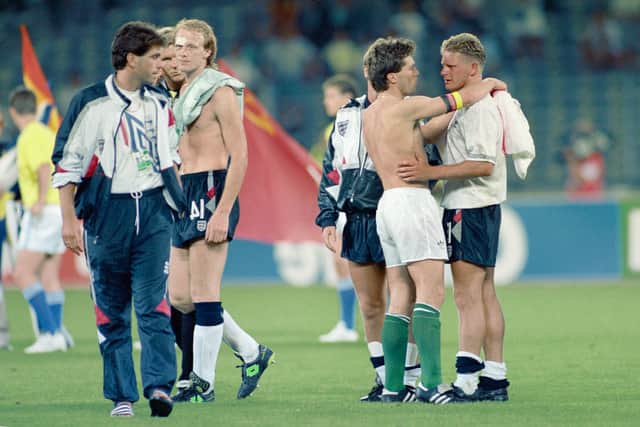
Italia 90 is remembered by football supporters of a certain age as peak World Cup. They think of the melodrama, including Luciano Pavarotti’s swelling soundtrack, Toto Schillaci’s bug-eyed passion, Roger Milla shaking his hips by the corner flag and well, yes, Gazza’s tears.
Many of us experience wet eyes when recalling this high summer of 1990. The world was changing for the better it seemed, in Berlin and elsewhere. Amid the horrors of Heysel, Hillsborough and Bradford, something was brewing within fan culture. The fanzine explosion was football’s equivalent of punk. Got some Letraset and some paper? Now publish a fanzine.
The time was ripe for supporters to start having a say. They were fed up with being penned inside death traps and treated with contempt. Scotland were heading to a World Cup and yet SFA and Scottish Football League officials could not even be sure they’d be returning to the same number of top-flight clubs in the capital city: Hearts chairman Wallace Mercer had caused uproar among fans by attempting to buy Hibs and merge the clubs.

A World Cup in Italy perhaps felt like an escape. There was also the mascot Ciao – a tricolore stickman with a football for its head – and a banging World Cup song for (whisper it) England by New Order.
Football had not yet completely sold out. Tickets were affordable, facilitating a mass Tartan Army migration following the difficulties presented by having to travel to another continent at the previous World Cup. Even now, it’s amazing how many people you meet who were actually at Italia 90.
Others, however, regard this World Cup as among the worst, if not THE worst. There’s no getting away from it. Italia 90 wasn’t always one for the purist. Critics focus on the standard of football, arguing that the group stage game between England and Republic of Ireland, when the official Adidas Etruscas Unico ball was screaming for mercy by the end, was a particular low point in the history of the beautiful game. “No football please, we’re British,” ran the headline in the next day’s Gazetta dello Sport.
In addition to this was the sight of Claudio Caniggia racing away in the opening game of the tournament while being pursued by a death squad of Cameroon defenders before finally being upended in a blur of blond hair, one of his assailant’s boots somewhere back near the halfway line.
While a memorable, perhaps even celebrated, vignette, it summed up the seeming manifesto of so many competing teams: stop the flair players from playing, by any means necessary. With just 2.21 goals per game, it was the lowest scoring World Cup. It did, though, produce the highest number of red cards of any finals to that point. The perceived negativity of teams also triggered the introduction of the backpass rule.
A tournament loved and loathed
So Italia 90 divides opinion, no question. There are those who loved it and those who loathed it. Either way, it proved the same old story for Scotland. There was the early, seemingly contractual form of humiliation, some redemptive glory before the traditional dose of heartbreak, though slightly more drawn out this time.
Scotland had to face Brazil, yet again. World Cup debutants Costa Rica, meanwhile, played the part of Peru. These games bookended a night of nights in Genoa against Sweden when Scotland secured their first World Cup victory since beating New Zealand in 1982. Remarkably, this victory on a muggy Saturday night remains Scotland’s last win at a World Cup finals. This is something Steve Clarke’s side will bid to address at this summer’s tournament.
Clarke will undoubtedly have tapped up Andy Roxburgh, pictured right, his old Scotland youth manager, for some tips. He will presumably also have quipped about being left at home for this World Cup mission after being included in the provisional squad for a pre-tournament trip to Genoa in the Spring.
Roxburgh has since described Clarke’s omission as one of his greatest mistakes although the right-back was struggling to play regularly at the time at Chelsea. Roxburgh seemed satisfied that Aberdeen full-back Stewart McKimmie as well as Richard Gough, inset, and Dave McPherson, both of whom could switch from centre-half, would be sufficient cover for that position.
Scotland ought to have entered Italia 90 with high hopes. After all they were unofficial world champions having beaten an admittedly Diego Maradona-less Argentina – the skipper was on a promotional trip in the Far East – at Hampden in March thanks to McKimmie’s memorable winner.
However, later pre-World Cup friendlies brought defeats at home against East Germany and Egypt and provided a perhaps more accurate picture of where Scotland stood in the football firmament. Even then, playing Costa Rica in the first match was considered A Good Start.
The Scots really ought to have known otherwise. Juan Cayasso scored what proved to be the winning goal four minutes into the second half. Sections of the Scottish press were unforgiving, writing off Scotland’s chances already. “Scotland crashed out of the World Cup having had the skids put under their hopes by a banana republic,” wrote Gerry McNee in the Daily Express. “They might as well go home now and think again.” Mike Aitken was more measured in The Scotsman, mentioning a penalty Scotland should have been given in the first half and praising Costa Rican goalkeeper Luis Conejo, “who had a field day”.
Scotland players who played that day still shake their head at the memory. They were told the goalkeeper was the weak link in team meetings prior to the game. “This might not have been Scotland’s worst performance in the finals, but it was certainly their poorest result,” ventured Aitken.
Scotland had the chance to make amends in the same Luigi Ferraris Stadium in Genoa five days later against Sweden. Just the time for a good old fashioned drinking controversy.
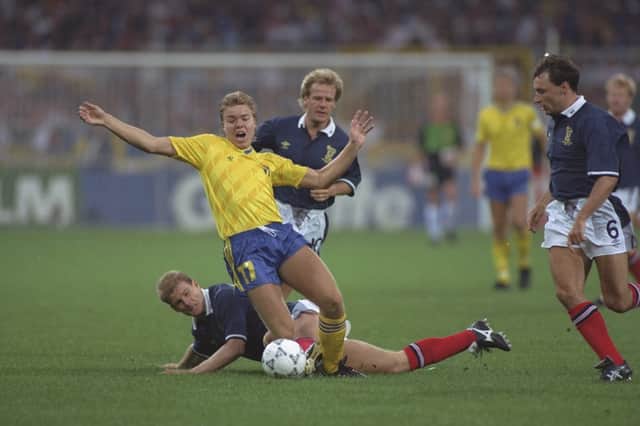
Stories circulated that Mo Johnston and Jim Bett had been spotted carousing in a bar in Rapallo, the resort town where the team were based, the night after the Costa Rica defeat. Condemnation swiftly followed before a charged-up, front-foot performance, in which Johnston scored the all-important second goal in a 2-1 victory, breathed life back into Scotland’s tournament.
With the pressure firmly on they produced what Aitken, The Scotsman’s football correspondent, felt was Scotland’s best-ever finals win – and he was present in Mendoza for the 3-2 win over Holland.
It was only Scotland’s fourth victory in six World Cups over 36 years. Imagine being told at the stadium that night that Scotland would still not have won again as they prepared to contest the 2026 tournament. Imagine being told they would qualify only once more before 2026.
The triumph over a good Sweden side was certainly one for the ages. It meant Scotland still had a chance of qualifying against a very good but hardly vintage Brazil side. They gave as good as they got, only succumbing with eight minutes left when Jim Leighton failed to hold a low shot from Alemao. Gary Gillespie sought to beat Careca to the rebound and the ball squirted out towards the far post and was turned in by Muller.
The sight of a frustrated Leighton kicking a post and droplets of water cascading from the net on a wet night in Turin is still seared in the memory. So too is a prone Johnston clutching his head in disbelief after a late goal-bound effort was somehow tipped over by Claudio Taffarel.
In a novel new cruel twist to Scotland’s World Cup story, they were forced to wait around before it was confirmed they were out. A glimmer of hope remained. Scotland could still progress as one of the four best third-placed teams depending on scorelines the following day.
Among the results extinguishing these faint hopes were old foes Uruguay beating South Korea with a last-minute winner. The back door was slammed shut and Scotland went home to concentrate on a new frontier in the form of qualifying for their first-ever European Championships in Sweden in 1992.
This proved a last hurrah in many respects. The following year an ageing side posted its own death notice on a chastening evening in Lisbon against Portugal when a 5-0 loss – “the night a team died,” as Roxburgh reportedly phrased it – confirmed Scotland could not reach USA ’94. It was a genuine shock to the system after five successive finals appearances.
Comments
Want to join the conversation? Please or to comment on this article.