
Willie Collum tackles Rangers and Celtic controversies plus Hearts incident that was ‘right on the limit’

SFA head of referees examines James Penrice flashpoints and possible Celtic red card
SFA head of referees Willie Collum has backed the controversial decision to award Rangers a penalty for a challenge on James Penrice in their 2-0 victory over St Mirren in Paisley last weekend.
Referee Nick Walsh pointed to the spot in the 17th minute of the Scottish Premiership encounter after Penrice went down in the box under a tackle from St Mirren's Samuel Ramos, with Ryan Naderi converting the kick to open the scoring for Rangers.
The decision drew heavy criticism from pundits and former players, with ex-Celtic striker Chris Sutton remarking that Penrice 'played the ref like a piccolo'.


Collum defended the decision on the SFA's VAR Review show, insisting that there was no "clear and obvious error" for VAR to overturn, while admitting that VAR would not have intervened if Walsh had chosen to play on instead.
"The referee is very close to the incident, the best place you could possibly be, and he talks about the player making contact in a tripping motion," Collum explained. "There is contact at the foot level, and particularly higher up the leg at thigh level.
"People will debate about that contact, but the player takes a huge risk. He goes in, challenges for the ball, doesn't touch the ball, and makes contact with the opponent. As soon as the referee blows the whistle here, we fully support this decision.
"You're right to question, 'is there enough contact?' But as soon as this is given on field, there is no doubt for us then the penalty kick is supported.
"I don't think there is a great deal of contact, but there is contact. Also, I don't think the St Mirren player gets close to the ball. He takes a huge risk. Can we say this is not a foul? No.
"When we talk about the bar and setting a threshold, we often talk about VAR intervention and the appropriateness of whether the VAR would get involved. Here, regardless of the onfield decision, when you look at the footage, it is not one that VAR would touch.
"If a referee here plays on, and the on field description is accurate, then we continue the game. But, in terms of refereeing on field, we don't want VAR to re-referee matches, so we need to allow referees to make decisions. What's clear for us here is the referee is very well positioned, the check is then carried out, is there contact, does the communication from the referee match the images we see, and therefore check complete."
When quizzed over the reaction of Penrice possibly exaggerating the contact, Collum added: "Here the level of contact is judged by the referee to be a foul. As soon as he judges that as a foul then we're not really looking at the reaction of the player. The contact for him is enough for a foul, therefore a penalty is correctly awarded."
Penrice acquitted over high boot challenge
Penrice was also acquitted over his high-boot challenge on Aberdeen's Afeez Aremu in the Premier Sports Cup semi-final. The Rangers left-back stretched for a ball in midfield and caught the Dons midfielder high on the side and ribs with his studs.
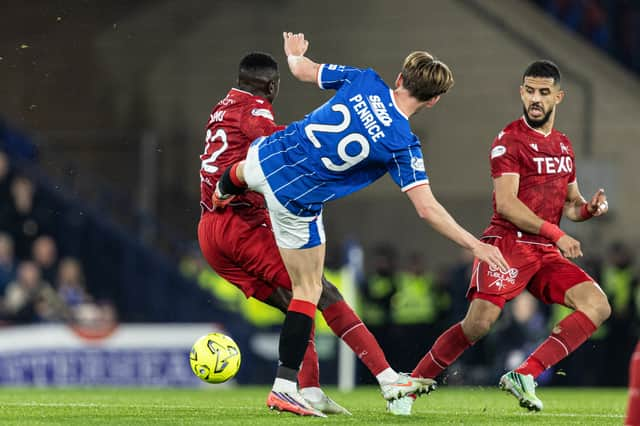
Referee Ryan Lee awarded a free-kick to Aberdeen and opted not to issue any card, describing the challenge as "careless" rather than "reckless", while VAR official John Beaton reviewed the incident but chose not to intervene. Penrice went on to help set up Naderi's winning goal for Rangers.
Collum said: "I was in the VAR centre watching the game and it looked nothing to me on first view. Then when you see the replays you can obviously see there is more to it.
"The referee is caught side-on so he is almost looking through the Aberdeen player when the contact comes. What it's certainly not is careless. The referee describes it as careless, but for us this is a reckless challenge.
"There is an issue here in terms of the height of the challenge, but that's the only criteria for us that's met.
"Lots of media outlets were showing a still image. If you brought the referee to the monitor with a still image of that you would immediately give a red card. But is there excessive force? Is there brutality? For us there is not.
"There is height, but the contact is not forceful, therefore we think it should have been a yellow card."
Possible Celtic red card examined
Collum also examined a challenge by Celtic defender Colby Donovan on Dundee United's Zac Sapsford during the 2-2 draw at Parkhead on October 28.
With Celtic trailing 2-1 moments after United scored twice in quick succession, the 20-year-old right-back lunged into a challenge and caught Sapsford high on the leg. Referee Steven McLean issued a yellow card and VAR official Chris Graham chose not to red card review, allowing Celtic to finish with 11 men and later rescue a point through a Liam Scales equaliser.
Collum argued that the officials got the decision right.
"You can see there is a lot less contact here," he said. "And also the bending of the leg. The leg comes away rather than continuing and extending when the contact is made. It's almost perfect in terms of the process of the check.
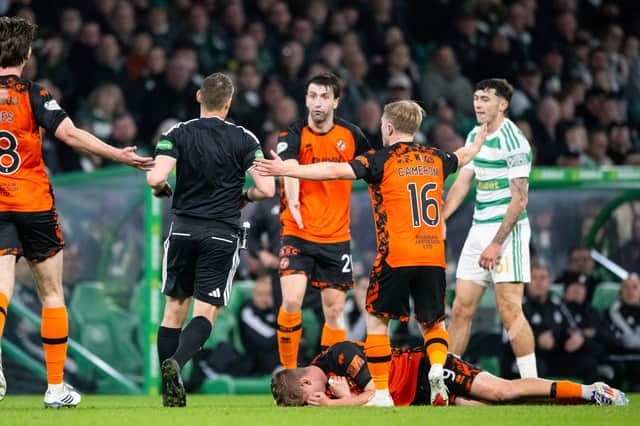
"The on field communication clearly add up to what the pictures show and then the VAR team go through it, they know what the referee's description is, they then explain it, they see what the referee is saying is exactly what they are seeing, therefore it is check complete on a yellow card for a reckless challenge.
"Also, I think the retraction of the leg as well. After winning the ball there is contact but he's trying to withdraw to it. You could easily use criteria here on the height. You could say it's high up the leg therefore you could try and justify a red card.
"But we're also not in the business of finding every detail of trying to red card players. We need to make sure that we meet the criteria. Height is one criteria. You heard good use of criteria here. Excessive force? Brutality? Does it meet those requirements? If not, then the onfield decision is fully supported. It's a glancing contact. For us this is more reckless than dangerous."
Hearts incident ‘right on the limit’
Hearts, meanwhile, may have been fortunate to avoid a red card for Rogers Mato during their 2-0 victory over Motherwell at Fir Park on October 25 in an incident described by Collum as "right on the limit".
Mato caught Motherwell's Jardell Kanga high on the knee with a follow through on an attempted clearance and Collum admitted that if referee Duncan Nicolson has awarded a red card on field, rather than the yellow card that was given, then VAR would have been expected to uphold the sending off.
"I think this is right on the limit," Collum stated. "We've discussed this with the referees. If the referee had given a red card on the field, check complete for us.
"But the referee gives yellow, he sees it, he describes it, the VAR team look, they don't see that it's excessive force or brutality, and for them there is enough to support the yellow card here.
"We don't want to go finding every detail to start giving red cards. You're right to question about consistency and whatever. But I think this is right on the limit.
"I think if this decision is missed on field and the referee gives nothing there is even more scope for going into a more in-depth check, perhaps around serious foul play."
Collum, however, was ultimately satisfied with the conclusion that was reached by the officials.
"I think there is evidence that this is reckless rather than endangering," he added. "We've also taken time to remind the referees, on-off contact, we need to be careful because there will be times where on-off contact does constitute a red. But what we'd be looking for more to take it to the next level as a categorical red card is a push onto that area of the knee, and a continuation of that. When it is rapid like that, sometimes it's more reckless, than it is red."
Comments
Want to join the conversation? Please or to comment on this article.