
Starmer wins historic landslide, Biden drops out and Trump survives assassination bid


New prime minister faced with riots while Grangemouth owners announce oil refinery closure
JULY
Sir Keir Starmer urged the country to “move forward together” after Labour won a historic landslide victory in the general election, with a majority of 174. Rishi Sunak announced he would quit as Tory leader and used his final speech in Downing Street to apologise to the British people and the Conservative Party.
Mr Swinney committed to rethinking the SNP’s approach to independence after a humiliating defeat that saw his party reduced from 48 in 2019 to just nine. Shortly after his victory, Sir Keir met Mr Swinney at Bute House in Edinburgh and vowed to “reset” the relationship between the UK and Scottish governments.
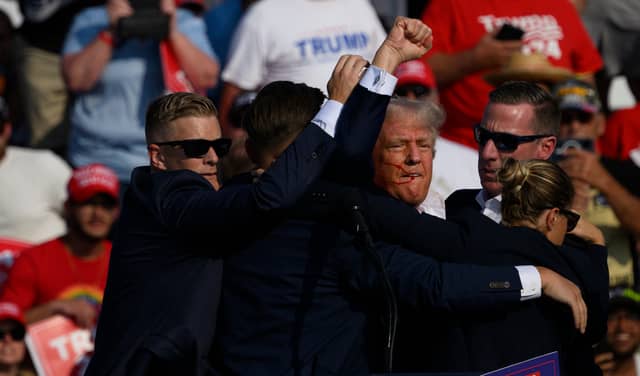
US presidential hopeful Donald Trump survived an assassination attempt during a campaign rally in Pennsylvania. One attendee, Corey Comperatore, 50, was killed and two spectators critically injured after shots were fired. A bloodied Mr Trump, who was shot in the ear, was surrounded by Secret Service agents and then rushed to his vehicle as he pumped his fist in the air in a show of defiance. The gunman, 20-year-old Thomas Matthew Crooks, had gained access to a nearby rooftop while Mr Trump was delivering a speech. He was shot dead.
US President Joe Biden dropped out of the race for the White House, ending his bid for re-election at the Democrat candidate and declaring the decision was “in the best interest of my party and the country". The announcement came after pressure from Mr Biden's Democratic allies to step aside following a disastrous debate against Mr Trump in June that raised doubts about the president's fitness for office. Mr Biden backed vice-president Kamala Harris, the party's instant favourite for the nomination at its August convention in Chicago, to be the new Democratic nominee.
Chancellor Rachel Reeves claimed to have discovered an “unforgivable” £22 billion black hole in the public finances as she hinted at tax rises. She accused her predecessor Jeremy Hunt and the previous government of making unfunded commitments that had been “covered up from the country”, as she defended axing winter fuel payments for most pensioners.
AUGUST
Sir Keir Starmer warned rioting protesters they would “regret” their actions, following scenes of disorder in towns and cities including Hull, Halifax, Liverpool, London, Southport and Rotherham. In a televised address to the nation, the Prime Minister said those involved "are not protesters" and promised the perpetrators of "far right thuggery" would "face the full force of the law". The riots broke out after the killings of three young girls in Southport. False claims had spread online about the suspect, who was 17 at the time and had not been named.
Former first minister Humza Yousaf accused the world’s richest man, Elon Musk, of using his vast wealth “for some of the most wicked evil I’ve seen”. Mr Musk, the owner of X, formerly Twitter, had posted a number of images and memes on the protests and disorder in Britain. Mr Yousaf said the tech billionaire had “amplified” white supremacists and “far-right neo-Nazi conspiracy theories”.
Education secretary Jenny Gilruth said Scottish head teachers would have government backing if they ban mobile phones from their schools, as a long-awaited plan to tackle school violence was unveiled.
The Scottish Government’s external affairs secretary Angus Robertson apologised for meeting an Israeli diplomat after a furious backlash. The meeting with UK Israeli deputy ambassador Daniela Grudsky in Edinburgh led to criticism from a number of Mr Robertson’s colleagues, including the SNP’s Middle East spokesman Brendan O’Hara MP, who claimed it undermined the party’s work in calling for an immediate ceasefire.
Councillors in Edinburgh voted for the city to become the first place in Scotland to impose a tourist tax. Council leaders argued plans could generate up to £50 million of "new money" for the cash-strapped local authority, but opponents warned the move risked putting off visitors.
SEPTEMBER
The UK government suspended around 30 arms export licences to Israel amid concern there was a "clear risk" they could be used in breach of international humanitarian law. Foreign Secretary David Lammy said a government review could not "arbitrate on whether or not Israel has breached international humanitarian law" in Gaza, but ministers have a legal duty to review export licences.
John Swinney shelved a Scottish Government commitment to roll out free school meals to all primary pupils, despite pledging that tackling child poverty was "first and foremost" in his priorities. The First Minister quietly dropped plans to expand "universal" provision to P6 and P7 pupils within the next couple of years as he outlined his Programme for Government, just 24 hours after announcing up to £500 million of cuts.
Petroineos announced it would close Scotland’s only oil refinery at Grangemouth, in a decision described by Mr Swinney as a “significant economic shock” that could lead to the loss of almost 3,000 jobs. The company plans to transform the facility into an import terminal, which requires significantly fewer people to operate than a refinery.
Disgraced former BBC presenter Huw Edwards was spared jail after admitting accessing indecent images of children as young as seven. The 63-year-old previously admitted three charges of "making" indecent photographs after he was sent 41 illegal images by a convicted paedophile over WhatsApp. Edwards was handed six months' imprisonment, suspended for two years, at Westminster Magistrates' Court. The BBC said Edwards had "betrayed not just the BBC, but audiences who put their trust in him".
The Prime Minister told the Labour Party conference in Liverpool that the newly-formed state-owned energy company GB Energy will be based in Aberdeen. Two additional sites will open in Edinburgh and Glasgow, once the company is up and running.
Comments
Want to join the conversation? Please or to comment on this article.