
I've been to nine World Cups and watched Scotland lose their aura but Celtic v Rangers was my worst experience
Author and journalist documents his World Cup experiences in new book

It was his second World Cup, and his first as something more than just a football fan, when Simon Kuper clocked someone being escorted through the media area in Foxborough, where Scotland are due to kick off their World Cup adventure in just under seven weeks’ time.
Kuper, who was studying in Boston at the time, had wangled a summer job as a 'spotter' for ABC Television during the 1994 tournament, which the United States hosted in the days when one country was deemed sufficient. Good gig if you can get it. Although Kuper admits he simply wasn't cut out for this task.
“Some people are ‘super-recognisers’, who can memorise and remember thousands of faces from the briefest glimpse; I am the opposite,” he writes in World Cup Fever, which was published late last year in good time for this summer. The only player he says he could successfully identify was Diego Maradona.


He did, though, notice a white-haired gentleman limping by on one of the days spent hanging around the Foxborough stadium’s broadcast compound. This was someone else he did not recognise, perhaps understandably. Kuper was later informed that the man in question was a Uruguayan journalist with a unique story to tell.
At that point, Diego Lucero was the only person on earth who had attended all 15 World Cup tournaments, starting in his home country in 1930. Aged 24, Kuper decided he wanted to be the next Diego Lucero. He has now attended nine tournaments and counting, seven as a working journalist although he wrote his first piece for the Financial Times, where he still works, during that 1994 World Cup.
In Fever Pitch, Nick Hornby reflects that he has measured out his life in Arsenal fixtures. Kuper says he has done the same with World Cups.
He’s now written a book that documents the World Cups he has experienced so far. It’s every bit as readable as Fever Pitch and may come to rival All Played Out, the outstanding account of Italia ’90 by Pete Davis, among classic works of football literature inspired by the World Cup.
Kuper takes some intriguing detours, including going off in search of the grave of the tournament's founding father, Jules Rimet. Now remembered by many in Britain chiefly because of the “Jules Rimet still gleaming” line from the Three Lions song by Frank Skinner and David Baddiel, he was the French football administrator from a humble background who ascended to the top role at FIFA via a distinguished war record. He won the Croix de Guerre three times.
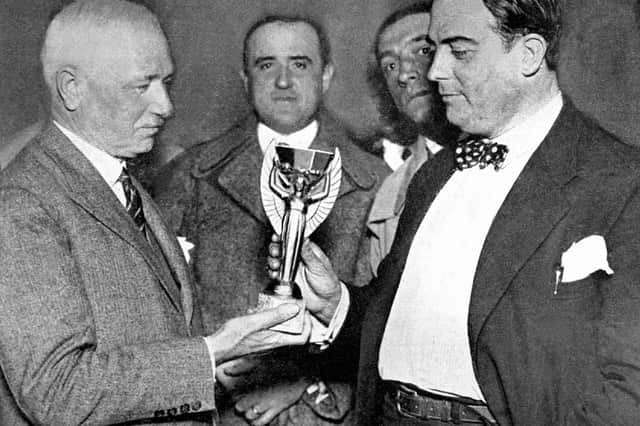
As Kuper writes, the First World War “seems to have remade his world view forever”. Rimet’s lifetime preoccupation became “football and the reconciliation of people”, the title of his forgotten memoirs. Another world war just over 20 years later proved this was harder than it might have seemed. Rimet redoubled his own efforts afterwards. The World Cup returned in 1950 in Brazil, by which time the trophy had been renamed the ‘Coupe Jules Rimet’. “I gave a reading in a bookshop in London and asked, who has heard of Jules Rimet?” says Kuper. “Almost every hand shot up. Then I asked who can tell me any facts about his life? Nobody could. People don’t know him, he’s just a name on the cup.”
That goes for France as well as Britain. Kuper resolved to find his grave, cycling for over an hour from his flat in Paris. "It's not even one of the prominent graveyards in Paris," he says. "There's two cemeteries where the high and mighty get buried. And he's not there. He's out in some suburban cemetery that nobody cares about." The flat tombstone is overgrown with moss. Although Rimet's birth and death dates are legible, there's no mention of any achievements, including starting something that, despite attendant controversies, will dominate the agenda come 11 June.
Back when Scotland still had an aura
We all remember our first World Cup. Kuper’s was 1978, watching as an eight-year-old in the Dutch university town of Leiden (born in Uganda to South African parents, he spent the first few years of his life in London before his father’s job meant a relocation). He followed the Oranje (Dutch national team), and still does.
One of his first World Cup games in the flesh was Costa Rica v Scotland at Italia 90. By now a student at Oxford, a friend secured tickets – not that it was hard in a tournament he remembers for its half-full stadiums – because his dad worked for a drinks company. “I didn’t really care much about the England v Scotland rivalry, because I am a Holland fan, but my friends did,” Kuper recalls. “They were very excited to see Scotland lose against what at the time was regarded as a nobody country – I don’t think Costa Rica had featured in a World Cup before. This is when Scotland still had this aura as a football country. We also saw Rod Stewart, who was sitting near us, so that was very exciting.”
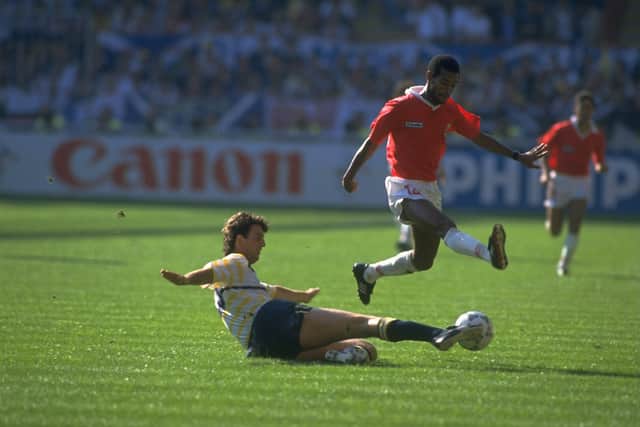
Kuper was at the game which will stand as Scotland’s last World Cup match for another seven weeks or so – Morocco v Scotland at France ’98. He recalls the journey back after the game, rattling along in a train carriage with admirably upbeat members of the Tartan Army. The scene tapped into what World Cups can be, for players as well as fans.
“I think the World Cup for players is close to a fairytale,” says Kuper. At clubs, many players are in it for the money. They are going to move to another club, very few players care about their club, and the coach is just some bloke who will stick around for a year. There is no attachment. The World Cup is different. In the World Cup the players are all playing for the team they support, or at least almost all of them. They feel the World Cup is highest, even the ones who are multi-millionaires. The World Cup has a special meaning for them over and above club football. You see they care more, they throw themselves into tackles they would not attempt in club football. The players at World Cups are actually more like us than the players in club football.”
Unhappiest football match experience
As someone who has covered football worldwide, he is often asked where the best atmosphere is. A couple of touchstones are usually mentioned. Is it Boca Juniors in Argentina, and their famous Bombonera stadium, or an Old Firm match in Glasgow?
Not the latter, he stresses. He found it uncomfortable in the extreme. “I actually found it the worst atmosphere,” he says. “It’s not my kind of football. I don’t like that hatred, the simmering sense that violence can be released at any moment. I know people describe it as a type of passion. But it does not appeal to me at all. I don’t think I ever felt as unhappy at a football match as I did then.”
The game was at Parkhead in the early 1990s, Celtic winning 2-1. The match anchors the last chapter of his 1994 book Football Against the Enemy, now regarded as a classic. Orion are publishing an updated “classic edition” this month.
It’s fascinating to re-read the concluding Old Firm chapter because nothing has really changed in over 30 years. Clashes between the team come around as regularly as ever. There’s one next weekend. There were a couple last month. One of them included a pitch invasion.
It's refreshing to get an outsider’s view on a saga many make the mistake of presuming holds the world in thrall. Kuper quickly punctures this conceit. "The Old Firm game was a bigger international phenomenon in the 1990s than it is now," he says. "Just like Scottish football has been downgraded, nobody I know talks about it. You might see TV images of that pitch invasion you mentioned because it is so spectacular. But people talk about it as much as they talk about the Cypriot league.”
Ouch. Even this season, when Hearts are making such a spirited stab at altering the course of history? Kuper admits he was surprised to see Hearts leading the table. “And then I saw the Tony Bloom involvement and it all began to make sense. He also has a club in Belgium (Union Saint-Gilloise) who are also about to win the league again. Maybe that kind of data analysis is more potent in smaller leagues like Belgium and Scotland. It’s easy to find undervalued players who can be best in those leagues.”
This is the sort of topic another Kuper book, co-authored with Stefan Szymanski, covers. Soccernomics is also being republished in time for the World Cup as the planet prepares to go football crazy, again. It makes quite a hat-trick.
_page-0001.jpeg?crop=3:2,smart&trim=&width=640&quality=65)
World Cup Fever by Simon Kuper (Profile Books – paperback out in May £11.99)
Football Against the Enemy (Orion Publishing – new edition out 30 April, £12.99)
Soccernomics by Simon Kuper and Stefan Szymanski (HarperSport – updated edition out in May £12.99)
Comments
Want to join the conversation? Please or to comment on this article.