
Scottish action to save critically endangered Greenland geese facing population decline

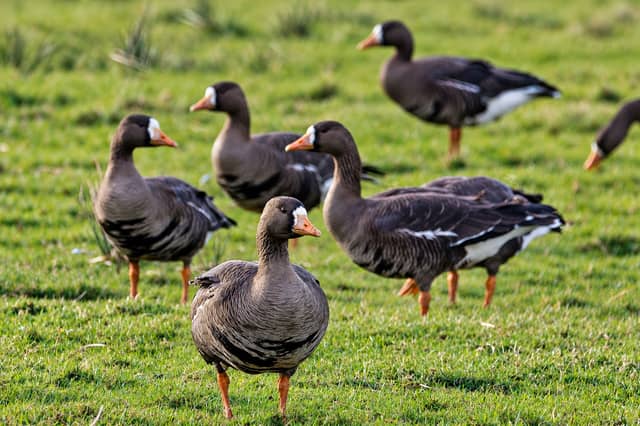

The population has declined from 36,000 in the late 1990s, to just under 15,000 in 2026.
Steps to help halt the decline of the global population of Greenland white-fronted geese have been set out today by Scotand’s natural heritage body.
NatureScot say a large proportion of the population of this critically endangered species winters on Hebridean islands and in the west of Scotland, roosting on peatland areas and feeding on grassland nearby. But there are significant concerns for its future as the population has declined from 36,000 in the late 1990s, to just under 15,000 in 2026.
The main drivers of the decline are thought to be climate change affecting breeding grounds in Greenland and illegal hunting in Iceland. While these factors cannot be controlled in Scotland, actions taken here may help to offset the impacts by supporting adult survival and fitness.
This involves reducing disturbance and avoiding “inadvertent mortality” or accidental deaths as much as possible to give the geese the best chance at migration and breeding.
Actions to be taken in Scotland include reviewing and, where possible, expanding undisturbed feeding areas. Improving roosting habitat through peatland restoration, and feeding grounds through environmental schemes, will also be supported.
These actions will complement the legal protections that are already in place for the species in Scotland, where they are fully protected and there is no hunting.
There are also multiple protected areas which support the population, with any development nearby requiring an impact assessment for the species.
Read more: Viking gene expert: 'Shockingly high' number of people from Lewis carry high cholesterol gene
A conservation plan shows that flocks wintering in the south and west (especially in Ireland) are declining faster than those further north (primarily in Scotland and the north).
Rae McKenzie, NatureScot Goose Policy Manager, said: “Each year, thousands of Greenland white-fronted geese make the long journey from their breeding grounds in Greenland to shelter for the winter in the north and west of Scotland.
“Sadly, over recent decades, the numbers arriving on our shores have drastically reduced.
“While we can’t control many of the factors behind this decline, Scotland does play an important role in the conservation of these geese.
“By increasing action here through, for example, targeting peatland restoration where it can be of most help to the species, and ensuring they remain undisturbed as much as possible, we can help play a role in halting the decline of this charismatic goose.”
An International Single Species Action Plan (ISSAP) is in place and a recent Conservation Brief has been updated and highlights the concerns and actions that are needed to halt and reverse the decline.
The Conservation Brief identifies the main drivers of population decline as the impact of climate change on the breeding grounds in west Greenland and illegal hunting of the geese on the staging areas in Iceland.
The brief states that whilst wintering “Range States” such as Scotland, cannot directly address those key pressures, they can try to offset them by increasing adult survival and fitness in the non-breeding season as well as – critically – maintaining range.
It states that’s that - as well as working to ensure geese and not killed by injury or accident, conservation work in Scotland should be focused on trying to enhance the body condition of the protected birds.
This is seen as the key factor that influences their timely ability to migrate and optimises potential to reproduce.
The brief says that in Scotland we must give particular focus to “reducing or eliminating all forms of disturbance that may constrain optimal feeding, including but not restricted to, hunting, recreational, and development activity”.
There has been a schemes in place in feeding areas across Islay and Kintyre since 2000 which works to ensure undisturbed feeding.
This scheme supports a significant number of the Scottish wintering birds.
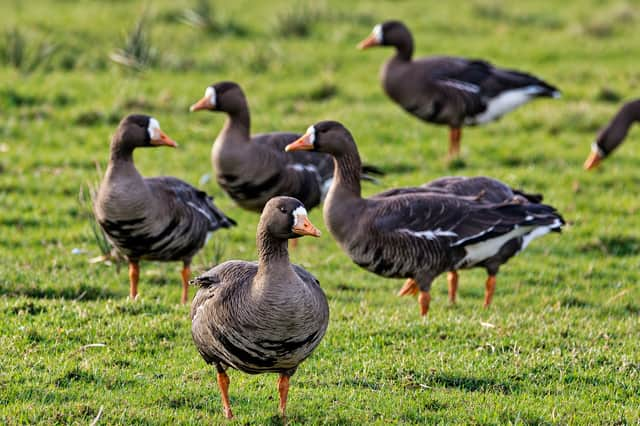
NatureScot says it is reviewing goose schemes to “simplify and streamline delivery”.
The review work will take into account that support for provision of undisturbed feeding areas for Greenland white-fronted geese is a high priority in schemes currently supporting the birds. It may also consider extending other scheme areas which may support the geese, where practical, to provide additional areas of undisturbed feeding.
There are already a number of legal protections in Scotland for the endangered Greenland white-fronted geese.
Hunting the birds is illegal in Scotland but NatureScot say they will work with British Association for Shooting and Conservation (BASC) to highlight the concerns around the declining population as well as the need to ensure that accidental shooting does not take place and to encourage the prompt reporting if it does.
NatureScot says applications to control the birds are highly unlikely to pass licensing tests to prevent agricultural damage due to conservation status of the geese. The only licences in place are for air safety reasons, which cover a wide range of bird species, but there are no returns indicating that geese are shot under recent licences.
There also protected areas - Sites of Special Scientific Interest (SSSIs) and Special Protected Areas (SPAs) - which serve to enhance conditions for the geese. SPAs trigger appropriate assessments of projects and plans which might impact on them and Operations Requiring Consent lists regulate activities on SSSIs.
A SPA Review identified a number of recommendations in relation to geese SPA provision and NatureScot said it is currently working with the Scottish Government on the way forward. Any future designations will likely be part of a wider programme and as a result of Ministerial direction.
The geese are currently taken into account in assessment of applications either at site (SPA) or wider countryside level but the current status of the population will be highlighted to the relevant planning authorities by staff providing advice on development control consultations. Significant pressure already exists in some areas and NatureScot responses will include required mitigation and objections where necessary.
Comments
Want to join the conversation? Please or to comment on this article.