
Police Scotland's Chief Constable Jo Farrell warns of losing nearly 1,000 officers with force at 'crossroads'
Warning of drastic fall in Police Scotland’s workforce if ‘flat cash’ deal is approved

Policing in Scotland is at a “crossroads”, with the force facing the prospect of shedding almost 1,000 officers if it only receives a flat cash funding deal in the upcoming budget, the nation’s most senior officer has warned.
Chief Constable Jo Farrell said her force required nearly £105 million extra simply to “stand still”. She called for “urgent decisions” to address the levels of threat, harm and vulnerability the force is seeing.
In a stark warning of the pressing need to address Police Scotland’s budgetary needs, Ms Farrell also stressed that existing pressure on its performance and staff might “strain” the public’s confidence in its ability to prevent and investigate crimes.
Opposition parties urged SNP ministers not to ignore the Chief Constable, claiming public safety was at risk.
Addressing Holyrood’s criminal justice committee on Wednesday, Ms Farrell said the force required £79.7m in additional revenue funding to cover its recent pay award offer, non-pay inflation and other “unavoidable costs”, together with £25.2m in funding for additional National Insurance contributions, as well as reform and modernisation.
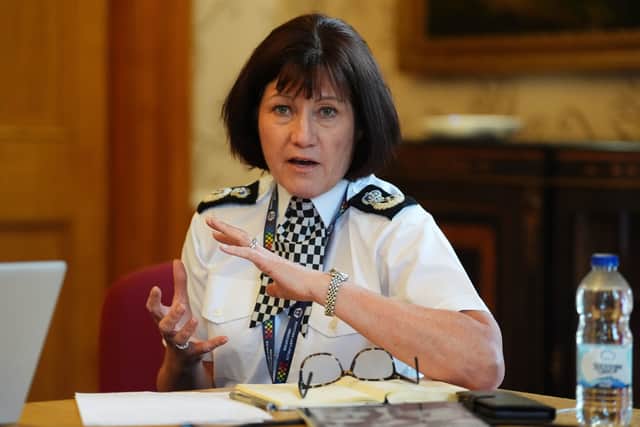

Any allocation below those figures, she said, would mean the force’s workforce would “shrink further,” and eventually lead to the lowest number of officers since its inception.
The force points out that as a result of the funding allocations from the Scottish Government to policing since 2013, around £300m has been removed from Police Scotland’s annual cost base compared to legacy arrangements.
Ms Farrell told MSPs: “A flat cash funding allocation for 2026/27 cannot be delivered. We would immediately stop recruitment to reduce workforce numbers through retirement and resignation. However, this would not achieve the savings required.”
The most recent Scottish Government statistics show there were 16,441 full-time equivalent police officers in Scotland as of the end of September. However, Ms Farrell said that a flat cash deal would result in a sharp fall in numbers.
“This attrition would further reduce officer numbers to fewer than 15,500 by March 2027, with a significant reduction in visible policing, prevention work, delays in responding to calls from the public and a severe impact on our ability to respond to major events,” she said. “Difficult decisions will be required. A minimum of a £104.9m uplift in cash terms enables us to stand still.”
In the event of the worst-case scenario coming to pass, there would be no compulsory redundancies, which the force has ruled out. Instead the reduction in officer numbers would come about via a “significant slowdown” in officer recruitment.
Ms Farrell said since the inception of the single national force 12 years ago, it now had to contend with 900 fewer officers and 700 fewer members of staff. She asked members of the Scottish Parliament committee to consider “how much the world has changed”, not only in that time, but over the past year.
The Chief Constable told the pre-budget scrutiny hearing that “continuous reform” had become the “new normal for Police Scotland”. She described how the force was cutting bureaucracy and using technology, including AI, to deliver “best value” and redirect resources to frontline services. But, she told the committee, the force needed some of the £2.5 billion savings achieved via reform to be reinvested back into policing.
In a wide-ranging evidence session, Ms Farrell, who was appointed to the top job at Police Scotland in June 2023, also expanded on the fast moving challenges faced by the force as it seeks to prevent crime and keep people safe.
She said the threats it dealt with had changed significantly amid greater use of technology by criminals, and a marked increase in the number of protests taking place throughout the country. Such protests, she said, had doubled from around 1,000 to 2,000 in the space of just three years.
Responding to a question from the committee convener, SNP MSP Audrey Nicoll, Ms Farrell said: “We’re seeing a rapid change in the way in which crime is committed, both in terms of its complexity, its diversification and its reach beyond Scotland, the UK, Europe and the world, and increasingly, how young people are being targeted within that.”
The 57 year-old pointed to a surge in the number of online abuse cases it deals with involving children. Ms Farrell said while there were just over 700 such notifications regarding “suspicions, information and intelligence” around such incidents, that number has jumped to nearly 1,500 in the space of just 12 months.
“I want to strengthen our response to digitally enabled and globally connected crime to target sex offenders, organised criminals, and extremists who are radicalising, recruiting, exploiting, and abusing our children, and bringing illegal drugs and violence to the streets of Scotland,” she said.
“It is a crossroads, not a crisis. But decisions must be taken now to enable policing to deliver fully and at the pace needed on our vision of safer communities, less crime, supported victims and a thriving workforce.”
Such warnings are also laid out in the force’s written submissions to the committee. Those submissions point to “clear indications” the “rapidly intensifying” operational environment in which police work is being done is placing its reduced workforce under pressure, with performance “straining”.
“These factors have informed the Chief Constable’s professional view that urgent support is required to strengthen frontline services,” the submissions state.
It notes that in 2024/25, there was a total of 7,159 recorded assaults against officers and staff - an average of 20 incidents a day - with assaults up 6.3 per cent year on year,
The document also states the force’s management information for the period April to June 2025 indicates a year-on-year increase in overall recorded crime. Analysis suggests AI will be increasingly used to generate images of child sexual abuse, other non-consensual sexual images and fraud and disinformation campaigns supported by “deepfake technology.”
Scottish Conservative shadow justice secretary Liam Kerr said the address by Ms Farrell to the committee made clear the need to prioritise the force’s needs in the budget settlement.
“This stark warning from Police Scotland’s top boss cannot be ignored by SNP ministers,” he said. “The sustained budget cuts from the nationalists mean officer numbers are already at woefully low levels and the force can ill-afford to lose anymore.
“A lack of police presence in our communities puts public safety at risk and allows criminals to go unpunished. The SNP cannot keep turning a blind eye to the major challenges facing Police Scotland and ensure that frontline policing efforts are prioritised in any budget agreement.”
Scottish Labour’s justice spokesperson Pauline McNeill said: “The SNP have shamefully allowed police numbers to be cut to the bone, with fewer officers now than when Police Scotland was created in 2013. Negligent decisions by ministers ever since then have left people feeling less safe in their communities and hard-working officers and staff feeling burned out.
“The Chief Constable could not be clearer about the impact that ministers’ failure to give Police Scotland the funding it desperately needs would have. A Scottish Labour government will support policing and make sure our country has the police officers it needs to keep our communities safe.”
A Scottish Government spokesperson said: “Our police perform a vital role keeping Scotland’s communities safe, which is why we have invested a record £1.64 billion for policing in 2025-26. Our funding has enabled Police Scotland to take on more recruits in 2024-25 than at any time since 2013, with more intakes planned throughout 2025/26.
“Scotland continues to have more police officers per capita than England and Wales and this continues to be a safe place to live, with recorded crime falling by more than half since 1991.
“We will continue to work with Police Scotland and the Scottish Police Authority to understand their 2026-27 budget requirements. Decisions on the Scottish Budget will be laid out on 13 January 2026.”