
Exclusive:UK offshore energy network a 'frontline target' that needs extra security - Offshore Energies UK chief
Warning that oil, gas and windfarm installations under threat from both physical and cyber attacks

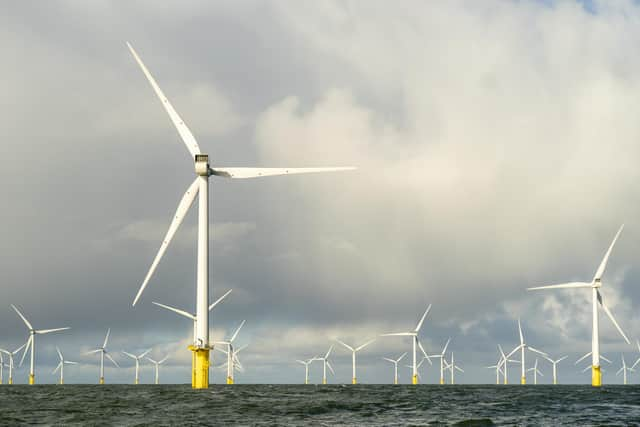
Security must be stepped up to protect the UK’s offshore oil, gas and windfarm network which is becoming a “frontline target”, an industry chief has urged.
The warning from Offshore Energies UK (OEUK) came days after Russian submarines were revealed to have conducted a month-long “covert” operation on cables and pipelines in UK waters in the North Atlantic.

OEUK director of energy operations Mark Wilson, writing in The Scotsman, said: “In an era of heightened geopolitical tension, critical infrastructure is no longer a background concern.”
He said what it boiled down to was: “Could we keep the lights on if someone tried to stop us?”
Mr Wilson said: “Global events are showing energy infrastructure must be regarded as a strategic focus of international security, and the UK must step up and secure its homegrown energy assets.
“It is becoming a frontline target of both physical and cyber threats in an increasingly ‘hybrid’ warfare environment where disruption can be engineered without a single shot being fired.”
Speaking ahead of the OEUK’s security and resilience conference in Aberdeen on April 22, the former Royal Electrical and Mechanical Engineers army major said: “The point is not to stoke fear, it is to normalise preparedness.
“Offshore infrastructure is geographically exposed, technically complex and operationally interdependent.
“A malicious actor does not need to destroy an installation to create chaos.
“Disabled communications, compromised operational technology, or targeted misinformation can be enough to slow production, raise costs and rattle confidence.”
The UK’s offshore energy network comprises 283 oil and gas fields and 2,800 wind turbines connected by thousands of miles of pipelines and interconnectors linked to six terminals.
Mr Wilson said the need for better data sharing, which had been highlighted at last year’s conference, “should now be treated as a national priority”.
He said: “The offshore energy industry is highly regulated and already works closely with public authorities, but deliberate disruption is a different category of risk.
“It demands trusted channels for timely intelligence, consistent reporting standards, and the confidence to share near-misses and emerging indicators without fear of reputational penalty.
“We should strengthen information-sharing arrangements so that operators and the supply chain can act on the same threat picture.
“In addition, we must invest in giving people the right skills with exercises that turn policy into muscle memory.”
The UK government’s Department of Energy Security and Net Zero said it collaborated with subsea and offshore owners, operators and regulators on information sharing, enhancing the UK’s monitoring and detection capabilities and exercising with partners to bolster resilience.
Its spokesperson said: “We work closely with stakeholders, including OEUK, to protect vital offshore and subsea energy infrastructure against a range of threats.
“Events in the Middle East are another reminder that we need to get off the fossil fuel rollercoaster and onto clean, homegrown power that we control, for the UK’s energy security.”
UK Defence Secretary John Healey announced details of the Russian operation on Thursday in which it had sent an Akula class submarine as a diversionary tactic, allowing two Gugi spy submarines to carry out surveillance of the UK’s undersea cables, which carry more than 90 per cent of its internet traffic.
It is understood the attack submarine left UK waters and returned to Russia but the two surveillance submarines remained.
The Royal Navy deployed frigate HMS St Albans, fuel tanker RFA Tidespring, and anti-submarine Merlin helicopters to track all three submarines.
Other nations, including Norway, were also involved in the surveillance operation.
Moscow state news agency Tass denied the claims and reported that the Russia embassy in London had said the country was “not threatening underwater infrastructure, which is truly critical to the UK”.
Meanwhile, First Minister John Swinney has said he is concerned the UK Government “doesn’t have the capability” to deal with the Russian threat in the North Atlantic.
He said he has had no briefing on the threat from the UK Government, and has made his “frustration” at the lack of cooperation between the two governments on this issue clear.
Mr Swinney said he is “very concerned” about Russia’s presence in the North Atlantic, as the subsea infrastructure is “vital to our interests”.
Speaking during a campaign visit in Inverness, Mr Swinney said: “I am very concerned about the presence of Russian vessels in the North Atlantic.
“There is significant communication and energy infrastructure that is vital to our interests that need to be protected from threats levelled by the actions of the Russian navy who can damage the infrastructure of our country.”
He said he has had “no briefing from the UK Government on this threat”, but has asked for better cooperation between the two governments on defence.
Mr Swinney said: “I’ve made it clear my frustration at the level of interaction between the Scottish and UK governments on the issue of national security.
“I benefit from individual briefings which I am grateful for, but there needs to be more partnership and more dialogue.
“Look at the Bella-1 tanker - it didn’t take long for an issue in the high seas to come to the Moray Firth.”
In January, the Russian-flagged oil tanker, previously known as Bella 1 and now named Marinera, was seized by the US south of Iceland before sailing it to the coast of Moray, east of Inverness.
The captain and first officer of the tanker were later taken out of UK territory by the US Coastguard. Mr Swinney said at the time the Scottish Government was told about their removal only after the US had done so.
Angela Constance, Scotland’s Justice Secretary, said the situation had shown a lack of respect for “Scottish jurisdiction and Scots law”.
Mr Swinney added: “I am concerned the UK Government doesn’t have the capacity to deal with the threat in the North Atlantic. We should be investing in protecting our infrastructure rather than in nuclear weapons we can’t use and which are prohibitively expensive.”
Elsewhere, defence minister Luke Pollard said declassifying covert Russian activities in the Atlantic helped deter attacks on undersea cables.
Mr Pollard said such public declarations prevent Vladimir Putin from denying responsibility when Russian vessels destroy undersea cables or pipelines.
He said: “We have taken the decision to declassify covert Russian activities that Putin wanted to be kept secret.
“It’s key to his hybrid warfare – not just in the Atlantic but in the Baltic Sea as well – that when Russians disrupt undersea cables or pipelines, they deny that they’ve done it.
“By declaring the Russian activity, putting it in the public domain, we’re denying their deniability, as the military phrase goes for it.
“What that means is Putin can’t say it wasn’t him, and that’s precisely why we’ve done it – to reduce his options to say that we see your activity, we’re calling it out.”
Sir Keir Starmer announced last month that Britain’s commandos would be able to board and halt Moscow’s shadow fleet vessels as they ferried oil to support its war in Ukraine through UK waters. None have been seized so far.
Comments
Want to join the conversation? Please or to comment on this article.