
Swinney under fire from Greens over 'disastrous' oil and gas shift

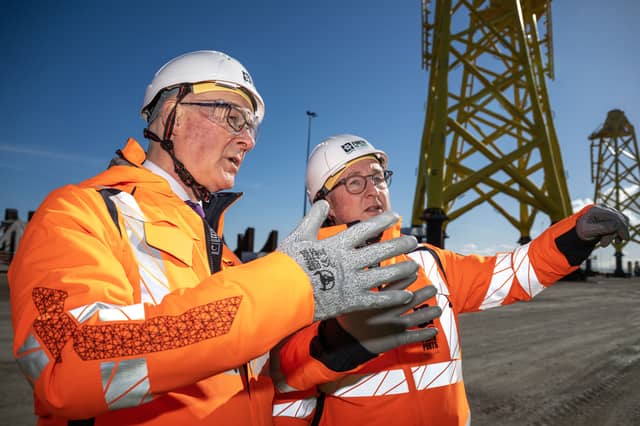

The First Minister was criticised after signalling a change in position on North Sea development
John Swinney has insisted he is “deadly serious about tackling the climate crisis” after coming under fire from the Greens for shifting the SNP's position on oil and gas.
Green co-leader Ross Greer accused the First Minister of ”creaking open the door” to major developments such as Rosebank and Jackdaw in the North Sea. He said new fields would be a "catastrophe" for Scotland and the wider planet.
It comes after Mr Swinney said the war in Iran had changed the "dynamics" of the debate around oil and gas.
Decisions over North Sea licensing are reserved to the UK government, but industry insiders say rhetoric north of the Border still has an impact on investment. The First Minister recently called for power over energy to be transferred to Holyrood.
During an event held by the Holyrood Sources podcast in Edinburgh on Wednesday evening, he was asked whether he would back plans to develop the huge Rosebank oil field off Shetland and the Jackdaw gas field 150 miles east of Aberdeen.
Mr Swinney said a climate compatibility test would need to be met, but added: “I think the thing that's changed is the geopolitical situation that is surrounding us just now, and the huge volatility that we're now dealing with.”
He said there is now “much greater uncertainty about energy security as a result of what I would consider to be an illegal intervention in Iran”, adding: “So I think the dynamics of that change as a consequence.”
The comments marked a clear departure from the position taken by his predecessors, Nicola Sturgeon and Humza Yousaf.
Launching his party’s campaign in Leith, Mr Greer attacked the shift.
"Five years ago, we had Greens in government and in Nicola Sturgeon, a first minister who was opposed to new oil and gas fields in the North Sea,” he told activists.
“How far has the Scottish government fallen from that position? And yet again last night, the First Minister opened the door further to Jackdaw, to Rosebank, to those new fields. What a catastrophe that would be not just for Scotland but for our planet."
Speaking to journalists later, he added: "Clearly, the SNP are trying to ride both horses on this. Nicola Sturgeon built up credibility with people across the country who are deeply concerned about the climate emergency. She moved their position to one that opposed Rosebank and Jackdaw and new oil and gas fields in the North Sea.
"John Swinney has dropped that position. They no longer oppose them, and he is increasingly creaking the door open to outright support for them. I think voters who for the last decade supported the SNP because they saw them as a party serious about the climate will be pretty deeply disappointed by that."
Mr Greer continued: "The First Minister doubling down on oil and gas is a disaster for Scotland's economy in the long-term."
He implied the issue could be a deal-breaker in the event of any formal post-election pact between the Greens and the SNP.
"We don't talk in the language of red lines,” he said. “But clearly, the Greens would only be part of a government that was serious about tackling the climate emergency."
Speaking to the media during a visit to Forth Ports at Leith Docks, Mr Swinney refused to confirm whether the SNP had dropped its presumption against new exploration for oil and gas.
However, he repeated his argument that energy security had become a "more significant" issue, while also insisting: “We are deadly serious about tackling the climate crisis in the Scottish government.”
David Whitehouse, chief executive of offshore trade body OEUK, said: "We urgently need greater supplies of secure, domestically produced energy including oil and gas, which will remain a critical part of the UK energy system and economy for decades.
“As demand rises and electricity use accelerates, weakening domestic supply would only increase our reliance on imported LNG, leaving consumers more exposed to global volatility and higher emissions.
“Recent events have shown how quickly energy markets can tighten and how easily cargoes can be diverted away from the UK when other buyers bid higher. Energy security means backing homegrown oil and gas alongside renewables."
Comments
Want to join the conversation? Please or to comment on this article.