
Readers' Letters: Zero Emission Vehicle targets are too ambitious
The drive towards electric vehicles for all is moving too quickly, says reader
Jason McCall, MD of Greenwheel Electric, argues in Scotland on Sunday (23 August) that the Zero Emission Vehicle (ZEV) Mandate must stay in place although the majority of the public think it is wrong. Mr McCall is wrong too.
The ZEV Mandate requires car makers to sell at least 33 per cent of new cars as battery-powered ones this year, rising each year to 80 per cent by 2030 and 100 per cent by 2035. Every petrol or diesel car sold above that target will land the manufacturer with a fine of £12,000, while each van sold above target attracts a £15,000 penalty. This is Soviet economics in action where producers are told what to produce regardless of supply and demand, and market conditions which are in continuous flux.
Furthermore, as the Chinese control battery production and the raw materials mined for it, it's an open goal for Chinese companies to undercut European production. While the EU has imposed tariffs on Chinese imports the UK, for reasons unfathomable, has chosen to allow them free access to our markets, and even subsidises them, and Nissan Sunderland will soon assemble Chinese cars at its Washington plant.
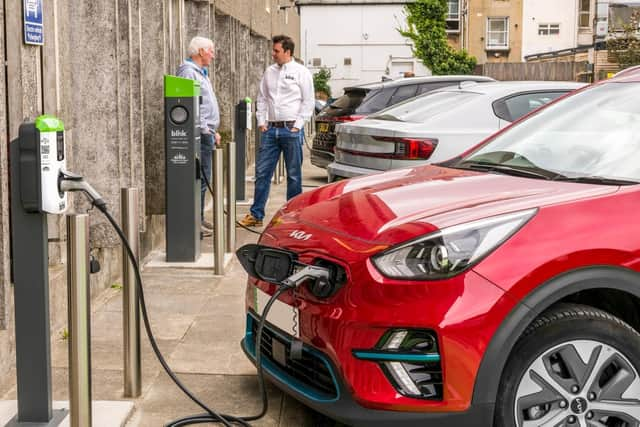

Talking of EV subsidies, these are eyewatering. They include the DRIVE35 Automotive Innovation Grants Scheme at £375 billion, DRIVE35 Automotive Transformation Grants at £1.54bn, DRIVE35 Scale Up Grants at £1.54bn and Zero Emission Truck and Van Grants at £1.7bn.
In addition to that, the government has belatedly realised that falling revenue from petrol and diesel forecourt sales (52.95p per litre plus 20 per cent VAT) will leave a huge hole in the their tax take and are introducing in 2028 a 3p per mile tax on EVs and a 1.5p per mile tax for PHEV's, in addition to the cost of charging which can be up to 70p/kWh. This is particularly unfair for plug-in hybrid owners because most of the time they are running on petrol on which they have already paid tax.
I'm not taking a pop at electric cars. I think that for certain motorists they make a lot of sense. But it's horses for courses. For many they don't make any kind of sense at all. While battery powered cars have their advantages – the electric motor is a wonderful thing – they have their disadvantages.
The government has a ZEV Mandate review consultation open to 23 October for owners of petrol and diesel cars and vans to have their say. I should add that the Society of Motor Manufacturers & Traders have also criticised the mandate, saying “regulatory targets are now running ahead of demand”.
William Loneskie, Oxton, Lauder, Scottish Borders
Drain on system
Wilma Shaw's letter regarding the increased prevalence of flooding (22 August), citing the state of the drainage system as a cause, misses one important point. Look around any housing area and what do you see – acres and acres of garden paved over to accommodate cars.
After rainfall, water would normally percolate downwards into the soil to be gradually returned to rivers or the drainage system, so reducing the likelihood of flooding. Now it quickly flows into the street to overwhelm a drainage system not designed to remove huge volumes of water in the shortest time.
Many of these housing properties have a garage which is used for storage of anything but cars. Therein lies the problem – people and their cars.
Jim McHugh, Hamilton, South Lanarkshire
Hydrogen bombs
It is common practice for anti-nuclear protagonists to demand OTT safety measures for new plant – and then complain about the cost and delay (George Morton, Letters, 22 August).
For example Hinkley Point C has had to have a special design of water intake that will not capture fish – at an added cost of near £1bn and, of course, delay. Oddly enough, no such demand is made for wind turbines which surely everyone is now aware kill many birds. The Hinkley plant may indeed reach the horrifying cost of £50bn – but it will produce the same output as at least two generations of 1,000 large wind turbines plus back-up batteries, plus a huge increase in the distribution network, and lets not ignore the horrendous volume of non-recyclable waste we will be passing on to our descendants.
Finally, it is worth mentioning that surveys show nuclear is by far the safest per unit of energy produced whereas wind is the worst. Hydrogen has, as far as I am aware, not yet been included (with near 40 years experience of using it I am sure that it won't score well!)
A McCormick, Terregles, Dumfries
Been quangoed?
“Nothing to see here” pervades the public sector (Editorial, 22 August) because we can’t see the wood for the trees! To paraphrase, we can’t see the good for the quangos. There is a lot of good in the public sector and having worked in the NHS for most of my adult working life I hate to see it criticised. I hate it even more when the criticism is apt.
We have been well and truly quangoed in Scotland, with over 130 of the pesky things – they are a metaphorical cloud of midges!
I live in the Western Isles and I wonder if the island local authorities generally should be used as a prototype, pilot, proof of concept or whatever, where all local functions are subsumed under the one entity. For example, do we need a Local Authority, Health Board, and an Integrated Joint Board for a relatively small population on an archipelago on the edge of the Atlantic? Do we need NatureScot making decisions for the Western Isles?
We need democratic structures that are big enough for the big things and small enough for the small things. When it comes to health and social care that might mean recognising that there is a spectrum of provision required which could be managed by a Local Authority at one end and an NHS Britain at the other.
Let’s have the local and national conversation. After all, what “quango” more wrong?
(Dr) Steven William Welsh, Stornoway, Western Isles
Write to The Scotsman
We welcome your thoughts – NO letters submitted elsewhere, please. Write to [email protected] including name, address and phone number – we won't print full details. Keep letters under 300 words, and in the body of the email – no attachments – and avoid 'Letters to the Editor/Readers’ Letters' or similar in your subject line. If referring to an article, include date, page number and heading. No poems.
Comments
Want to join the conversation? Please or to comment on this article.