
Readers' Letters: Scotland cannot afford to neglect its own literary heritage
A recent University of Edinburgh graduate asks: what value does Scotland place upon its cultural history?
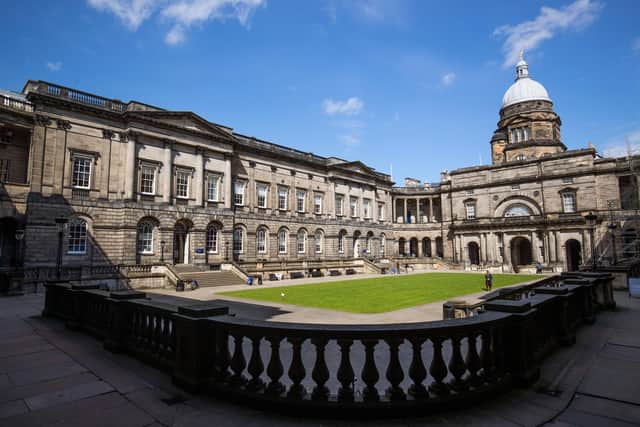
The University of Edinburgh's decision to withdraw specialist degree pathways in Scottish Literature and Celtic Studies raises a question extending far beyond university finances: what value does Scotland place upon its own cultural inheritance?
As a recent graduate of Celtic and English Literature at Edinburgh, I find the implications deeply troubling. One of the greatest privileges of studying Celtic literature was discovering a Scotland whose cultural history extends far beyond its relationship with England. Through its languages, literature and mythology, Scotland is connected to Ireland, the Isle of Man, Brittany and the wider Celtic world by traditions that long predate the Union.
These are not merely romantic historical associations. They form part of Scotland’s distinctive cultural inheritance, revealing centuries of literary exchange, shared traditions and evolving identities. The same is true of Scottish literature, whose extraordinary tradition has helped shape the country's understanding of itself.

There is a particular irony in seeing dedicated degree pathways withdrawn at Edinburgh whilst Celtic Studies is recognised as a serious field of scholarship at other internationally prestigious institutions such as Harvard and Trinity College Dublin. Both of them recognise the importance of studying the languages, literature and histories of the Celtic world.
Whilst it is encouraging that these traditions command international respect, should Scotland become increasingly reliant upon institutions elsewhere to preserve and interpret its own cultural inheritance? If we diminish opportunities to study our history and literature at home, we risk surrendering some of our ability to tell our own story.
This matters beyond academia. Gaelic and Scottish cultural identity have become entangled with contemporary constitutional politics, yet this heritage belongs neither to the SNP nor to any particular vision of Scotland’s future. Understanding Scotland’s distinctive linguistic and literary history should transcend party politics.
Nor should we overlook the dangers of allowing cultural heritage to become detached from serious historical understanding. At a time when certain Celtic symbols have been appropriated by far-right movements, rigorous scholarship is essential to resisting the distortion of these traditions into simplistic and exclusionary narratives.
Universities face difficult financial decisions, but the worth of a nation’s literary inheritance cannot be measured solely through enrolment figures. Scotland cannot continue to celebrate its cultural distinctiveness whilst allowing the opportunities to understand, preserve and interpret it to diminish.
Emily Fox, Edinburgh
Poll vault
Jenny Gilruth has said that a new opinion poll has put the SNP “in the most powerful position in Westminster in our history” (Scotsman, 15 October). I disagree. On 28 March 1979 the SNP voted to support a motion of no confidence in the Labour government tabled by Margaret Thatcher, which she won by a single vote, ushering in a Tory government for the next 18 years.
As for a new opinion poll giving Yes 52 per cent, I clearly remember one in 2014 that gave the same result on 7 September, and another that gave an eight-point lead for Yes on 13 September.
We all know what happened on the 18th.
Hugh Pennington, Aberdeen
No interference
Stephen Flynn is right to call on Andy Burnham to “bring it on” and “let the people of Scotland decide [our own future]”.
However it is not enough to demand referendum powers. Burnham must also be told in no uncertain terms not to interfere and not to allow Westminster to interfere in the process; no repeat of the lies, threats and false promises that came from the south in 2014.
When the time comes we must secure international observers to ensure that the Scottish electorate makes our own decision free from manipulation from outside our country.
If Burnham thinks our independence is any concern of his then what greater evidence do we need to know that we are indeed under the control of a colonial power and that it is right and proper for us to cut the ties that bind us to this toxic union.
Ni Holmes, St Andrews, Fife
What’s new?
What is new about this year’s SNP conference? Absolutely nothing. The agenda is all about “independence” because the SNP just cannot talk about anything else without staring at an abysmal performance.
The Scottish NHS keeps recording record problems, especially in A&E waiting times but everywhere else too. The drug problem solved? No, it is getting worse. Homelessness improving? No. The economy growing? No. Prison service working smoothly? No.Transportation problems solved? No.
If the SNP can only talk about independence it is patently obvious that nothing else is working but, to make matters worse, independence will not work either as there is no concrete plan as to how to either achieve this or implement it. Isn't it actually time Scots rewarded the SNP for all its “successes” with a P45?
Gerald Edwards, Glasgow
Unlocking growth
It is welcome that Jill Stephenson (Letters, 15 October) at least is prepared to ask the question of how “to create growth in Scotland comparable with that of more prosperous countries in Europe”?
With growth effectively stagnant across the UK while public services cry out for more money it makes sense to debate what is the best route forward in a fast-changing and politically volatile world. Obvious keys to greater growth are astute investment in exploiting existing resources and creative flexibility in targeting new markets for goods and services. The success of this approach is evidenced over the last decade in small countries such as Denmark and Estonia, but also in larger countries (by population) such as Poland, which, with infrastructure investment supported by the EU, is projected to soon outgrow the UK in per capita GDP. We do not even have to look abroad for evidence of the advantages of greater economic focus on early backing of new technologies and support services in Scotland, in spite of varying commitments from successive Westminster governments.
The world is rapidly changing and in the immortal words of Winnie Ewing “Scotland wants to get on”. Ambitiously riding the tides of change is what will bring prosperity to our people and our communities, not desperately clinging to a lost Empire and an economy focused on London’s financial services.
Stan Grodynski, Longniddry, East Lothian
Get drilling
I cannot speak from a position of knowledge about the oil and gas industries, but from a commonsense point of view it seems to me that the arguments against further drilling in the North Sea are alarmist, and probably deliberately misleading.
I cannot believe that any industry or individual who is not currently using fossil fuel will make the decision to do so, or that existing consumption will sky-rocket, because Rosebank and/or Jackdaw come on stream. No one disputes that fossil fuels will be required for many years to come and it makes sense to have secure sources wherever possible, rather than rely upon costly imports from foreign countries that may not always be friendly.
There is absolutely no reason why allowing more drilling in the North Sea should inhibit the development of renewable off-shore energy, but if the lack of progress on floating wind developments is anything to go by we may have a long wait for that. Until then, make use of the resources we have.
Graham M McLeod, Kinross
Making waves
Have tidal energy enthusiasts Archibald Lawrie and Ken Gow (Letters, 8 October) ever paused to ponder why there are only a handful of such projects operational throughout Europe, most of them right here in Scotland, coincidentally?
The reason is that the siting of this type of power station requires a highly specific combination of geographical and tidal conditions which rarely exists.
Other drawbacks are high construction and maintenance costs, destructive impacts on marine ecosystems and (like wind farms) they provide only intermittent electricity generation.
So much for Mr Lawrie’s misguided desire that “Each of our coastal cities should have its own individual power source…reaping power from the coming and going of the tides.”
He also expresses a fond hope that tidal barrages and underwater turbines would somehow be immune from Russian drone, missile and submarine attacks.
Enough wishful thinking on energy security. Start drilling the Rosebank and Jackdaw fields and build small modular reactors to keep the lights on in these uncertain times, before it’s too late.
Martin O’Gorman, Edinburgh
Democratic deficit
How refreshing it was to read the first three letters in Wednesday’s Letters to the Editor section. They nailed many people’s concerns.
Politicians continue to operate with impunity to further their blinkered view, paying little or no heed to democracy or to serving the people. I would go further and say parliament collectively has done likewise for the last ten years. A democratic deficit indeed.
P Miller, Lincoln, East Midlands
Write to The Scotsman
We welcome your thoughts – NO letters submitted elsewhere, please. Write to [email protected] including name, address and phone number – we won't print full details. Keep letters under 300 words, and in the body of the email – no attachments – and avoid 'Letters to the Editor/Readers’ Letters' or similar in your subject line. If referring to an article, include date, page number and heading. No poems or open letters.
Comments
Want to join the conversation? Please or to comment on this article.