
Readers' letters: Rachel Reeves has declared war on the most vulnerable in society
A reader brands Rachel Reeves’ welfare cuts immoral and depraved
Back in 2013, Rachel Reeves boasted that the British Unionist Labour Party would inflict more pain and suffering on the sick and disabled than the Tories. Now she has kept her word.
Her Spring Statement was an abomination of immoral depravity, seldom seen since the 19th century. It was a declaration of war on the most vulnerable in society.
The figures are shocking. £6.4 billion is being stolen from the disabled. An impact assessment commissioned by the government shows that up to 3.2 million families will lose an average of £1,750 per year. This will plunge 250,000 people into poverty, including 50,000 children.
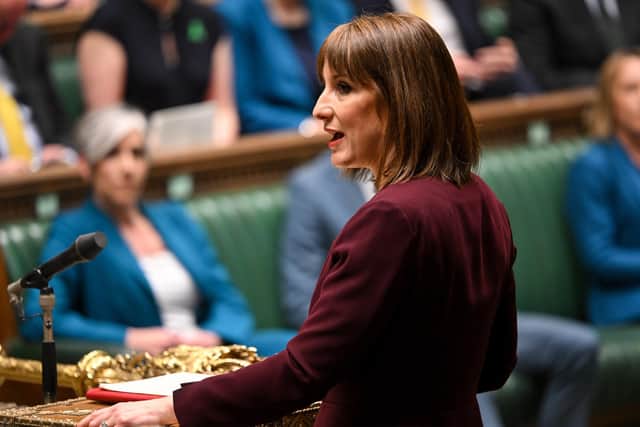

Reeves has once again harped on about achieving “growth”. This is impossible with her discredited approach. Quite simply, an economy reliant on aggregate demand cannot grow if the purchasing power of consumers is deliberately suppressed.
Missing from the conversation is the role played by Brexit in the UK’s economic decline. This has been a disaster, as bad as all the warnings foretold.
Reeves and her boss, Starmer, are fully aware of the misery, pain, and suffering they are about to inflict. They simply do not care – just as they do not care about the genocide in Gaza.
What matters to Westminster is war with Russia. Reeves has handed over an additional £2bn to the already bloated war budget. Labour has begun the militarisation of the UK economy. This is being achieved through the dismantling of public education, the welfare state, and the NHS. Such an agenda is unachievable through the normal democratic process.
Neoliberal propagandists always claim there is no money for decent pay rises, the NHS, libraries, children’s education, or a host of other public services. Yet, when corrupt banks need bailing out or a war needs funding, unlimited taxpayer money is miraculously found.
Alan Hinnrichs, Dundee
No ‘Change’
Rachel Reeves in her statement to Parliament said “the people of Britain will be watching”, and I can assure her that, the people of Britain will be listening also and taking note of the disgraceful attack on the disabled and sick by her Labour government.
Not only will Ms Reeves’ Spring Statement impact on many benefit claimants, the Scottish Block Grant will be seriously impacted, as has been highlighted by the Fraser of Allander Institute. Interestingly the debate that followed the Chancellor’s statement in the House of Commons, was deafened by the lack of Scottish Labour MPs, 37 in number, standing up for their constituents and for Scotland. Voters in Scotland were convinced by Labour’s campaign slogan to vote for “Change”. Well they certainly have change, but at what cost and to whom ?
In light of the impact highlighted, can Scotland afford to continue in this damaging union, a union of unequals, a union which deliberately attacks pensioners (winter fuel allowance and Waspi Women), those with more than two children (the benefit cap) and now the disabled.
Catriona C Clark, Banknock, Falkirk
Stride steps up
The most impressive thing about Rachel Reeves’ emergency budget was nothing Ms Reeves said, but was in fact the brilliant speech by the shadow chancellor Mel Stride.
Mr Stride correctly summed up Ms Reeves as “the architect of her own misfortune” by talking Britain down last year, confecting the smokescreen of the supposed £22bn black hole, increasing employers’ national insurance contributions, and punishing farmers and pensioners, and the small businesses which are the backbone of the economy.
Mr Stride pointed out that when the Conservatives left office last year inflation was on target at two per cent and the UK economy was growing at the fastest rate in the G7, whereas now the economy is in a perilous state. Now, he said: “The forecast for growth is down, the forecasts for borrowing costs and inflation are up, and business confidence has been smashed into a million pieces.”
The speech is available in Hansard and on YouTube, where it is well worth watching for its oratory and passion.
William Loneskie, Lauder, Scottish Borders
Tax rise necessary
Spending three per cent or four per cent of GDP on military needs must mean higher tax. Or do we ask the Russians to wait until we’re ready?
The good news is the extra spending goes into the economy, so long as UK production matches requirements.
Tim Cox, Bern, Switzerland
Denial of reality
Gerard Edwards claims “The day of reckoning is fast approaching for the SNP” (Letters, 26 March). In fact, he and the rest of Scotland in Union’s supporters have been claiming this in the letter pages of The Scotsman for the last 15 years without a single credible shred of evidence to back up their cloud dream wishes dressed up as facts.
Despite the whole Salmond vs Sturgeon airing of party washing so filthy the combined talents of Ariel, Bold, Fairy, Persil and Surf couldn't come up with a new improved formula to get out those stubborn stains, all polls indicate that come the next Holyrood elections, the SNP will cake walk it again, simply because the alternatives to a disillusioned electorate feel ten times worse – the oldest story of electoral politics.
So when the next elections come along and the inevitable happens, the question we’ll all be asking Mr Edwards and his ilk will be “feeling stupid yet?” Probably not – in the age of Woke and Trump (two cheeks of the same backside), everyone seems entitled to exist in their own Cloud Cuckoo Land reality without ridicule or censure, which perhaps explains the utter mess the world has gotten itself into of late.
Mark Boyle, Johnstone, Renfrewshire
Key questions
As is usual from Ian Moir, he asks the questions that politicians and the climate apostles would rather avoid. (Letters, 27 March) He points out that Carbon Capture and Storage plants (CCS) planned for the UK will gobble up huge amounts of electricity and increase the already high price of electricity of 27p a unit.
Electricity is at present four times the price of gas yet politicians seem determined to ban gas boilers and gas hobs and also force us to buy mega-expensive heat pumps. Whatever happened to the cheap, reliable electricity we were promised from wind and solar when this net zero nonsense started? The answer, my friend, is blowin’ in the wind.
Clark Cross, Linlithgow, West Lothian
H bomb
We are regularly warned about scam emails and telephone calls. I have received the usual claims that I have a virus on my computer. Often, it helps to take half an hour of their time pretending to follow their instructions before exclaiming that you now know what the problem is and when they ask you to explain, tell them that you haven’t actaully got a computer. That really riles them!
The email scams are often detected because of mistakes made by the perpetrator, such as misspellings and basic mistakes. This has now taken a further step with letters being sent in the post, which attempt to persuade the public that they have inherited millions of dollars (it’s always dollars), or that a bank manager has “discovered” a large amount of money which, for unexplained reasons they wish to share with the recipient, rather than just grabbing it for themselves.
There are also other emails which purport to come from banks, warning the recipient about scams, while being a scam themselves. It is basic mistakes which are the dead give-away, but now, they have gone one step further. This morning, on the radio, no less, I heard an advertisement which purported to come from HMRC. However, the give-away that it was fraudulent was that the voice-over speaker didn't know how to pronounce “aitch” and called it “Haitch” MRC. There should be a public warning about this.
Andrew HN Gray, Edinburgh
Democratic EU
In response to Tim Flinn (Letters, 26 March) and his unsubstantiated claims about the EU, it ought to be clear that Westminster rule cannot be called democratic in any modern sense of the word. Perhaps it was fitting 300 years ago.
Today we have a UK government with an overwhelming majority down to about a third of the vote at the last election, with two-thirds of the electorate voting for other parties than the government. The second chamber is not even elected, with some members sitting or absent for life.
Contrary to what Mr Flinn says, the EU is governed by the rule of law agreed in international treaties. The EU parliamentarians (MEPs) are elected democratically in every member country, with smaller countries having a proportionally larger number of MEPs.
The ruling Council of Ministers has a representative from the democratically elected government of each member state.Clearly the EU is democratic to its core, and though the EU Commission is unelected, which Brexit supporters are often keen to highlight, it is simply because it is the civil service of the EU, and civil servants are appointed.
Democracy is not an easy form of government and the EU is not different in that respect, but let us be fair and admit that the EU is more democratic than the UK.
Importantly, any member nation is free to leave if they so wish. Nevertheless, it is now clear that no other country wants to leave the EU, having witnessed the self-sabotage of Brexit.
Peter Glissov, Edinburgh
Write to The Scotsman
We welcome your thoughts – NO letters submitted elsewhere, please. Write to [email protected] including name, address and phone number – we won't print full details. Keep letters under 300 words, with no attachments, and avoid 'Letters to the Editor/Readers’ Letters' or similar in your subject line – be specific. If referring to an article, include date, page number and heading.
Comments
Want to join the conversation? Please or to comment on this article.