
Readers’ letters: Nicola Sturgeon's final speech was hypocritical
A reader is unimpressed with the former first minister’s last address to the Scottish Parliament
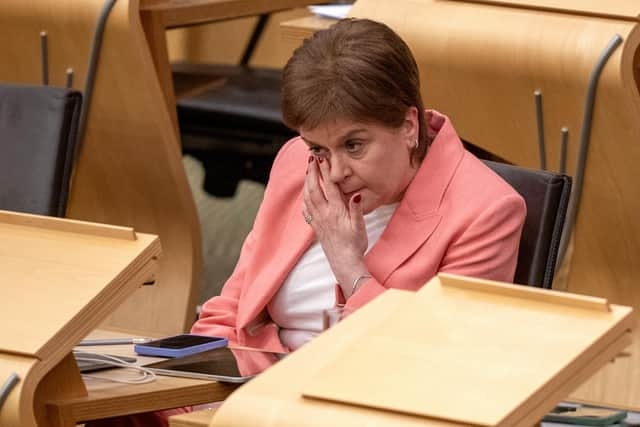
It was hard to listen to the “valedictory” speech given by Nicola Sturgeon in the Scottish Parliament (your report, 20 March) without the feeling of hypocrisy rising to the surface quite quickly.
Her comment around “opponents need not be enemies” highlights this. The same Nicola Sturgeon, when in office holding the highest position in the land, declared in October 2022 that “I detest Tories and everything they stand for”. The same Nicola Sturgeon who commented in January 2023 on those opposed to her failed Gender Recognition Bill that they were “transphobic, deeply misogynistic, often transphobic, possibly some of them racist”.
It is not in doubt that she leaves a “legacy” as one of the most divisive, controlling and secretive politicians of the devolved era, and dare I say the Scottish Parliament will be a better place without her.

Richard Allison, Edinburgh
Plain old Malcolm
Reform’s conference at a Renfrewshire country club (your report, 20 March) was an appropriate venue for an organisation drowning in lavish donations from tax exiles and billionaires from all over the world but, obviously, not the UK. That said, some will be desperately heading back to “broken Britain” for safety as it’s getting rather hot in their domiciles of choice thanks to Reform and Nigel Farage’s political hero Donald Trump and his little adventure in the Middle East.
After a few of defections from the Conservative Party, Reform’s leader in Scotland emerged. “Baron Offord of Garvel”, a distinguished and, I’m sure, well deserved title bestowed by the equally distinguished Boris Johnson for services to something or other, has been jettisoned. He now prefers “plain old Malcolm from Greenock” according to a colourful and expensively-produced Reform leaflet that dropped through my letterbox recently.
It seems Reform wish to be all things to all people. The “party of the people” on the one hand and the preferred government for the super-rich, failed Tories and tax exiles on the other.
Plain old Malcolm promises to cut taxes if he becomes First Minister along with getting rid of “strangers” – in a transformative and innovative use of Reform language – then everything will run like clockwork. Simple as that.
Plain old Malcolm from Greenock deserves a knighthood for this.
D Mitchell, Doune, Stirling
Breaking mould
The two-party system appears to be at an end in the UK so why can’t the one-party system in Scotland “suffer” the same fate?
The SNP seems to think it has a divine right to rule Scotland yet in almost two decades of power little has improved and a lot has got worse. Scotland really needs a different approach.
The Reform UK party is offering one such angle which has the merit of being practical. Scotland’s other “populist” party that offers an alternative is the Greens, but this party has actually had a trial run under Nicola Sturgeon and failed miserably because its input was far too extreme.
Reform is also painted as “extreme” by the left but in reality is a lot more based on common sense. Holyrood is failing because it is far too far to the left. It is about time Scotland woke up and shifted to the right. A Conservative/Reform government would be a breath of fresh air.
Gerald Edwards, Glasgow
Religious tolerance
Reform UK chief Nigel Farage wants to ban all mass religious observances in public (your report, 20 March) to defend Judeo-Christian principles which built “our nation”.
Am I missing something? People like Billy Graham and various Popes have religious gatherings. Recent Popes have been decent men who care about the poor.
There isn’t so much religion about the place nowadays. But there is a firm democratic principle called religious freedom. The Moderators of the Church of Scotland don’t do outdoor rallies very much, but are they to be banned before they try it? The free churches too, and the Archbishop of Canterbury?
The key to all this is a Muslim rally in London which offended the Chief Patriot of our Times. But what nation can he mean? He is an English politician and made his odd remarks at a meeting in Scotland. Nothing wrong with that, but the UK has four nations.
Was any nation built upon Judeo-Christian principles? St Columba of Iona was at work around the same time as as St Augustine of Canterbury. Their missions were contemporary with the early stirrings of national identity, but those nations were different things in different places.
The Judeo part of Christian heritage didn’t protect actual Israelites. Come the 11th century, England’s new Norman King, founder of abbeys by the hundred, celebrated by massacring the Jews of York.
Enlightenment was in the air in 1707 and 1800 when the United Kingdom was constructed. Enlightenment meant and means tolerance and democracy. Now convince me that it’s enlightened to ban Muslims from holding a festival of prayers.
The Enlightenment was a great time for science, which is precisely about truth and reveals the endless power of truth: “The truth will set you free.” Keir Hardy? Erasmus? Adam Smith? None of those. Jesus said that, or so it says in the Gospel according to St John.
Tim Cox, Bern, Switzerland
We’re doomed!
This week’s First Minister’s Questions was a perfect representation of Honest John Swinney at his delusional best, deflecting straight questions with contempt and total disdain.
My voting paper arrived today – filling me with dread on a scale I have never felt before. I fear we are, in the words of Private Frazer, “doomed”!
David Millar, Lauder, Scottish Borders
Sinking ship
Listening to the reports on the overcrowding in Scottish prisons and the need to now release short-term prisoners after 30 per cent of their sentences, why am I picturing a man with a bucket throwing water overboard while sitting in a boat with a hole in it?
The SNP are just emptying water out of a sinking boat with no idea how to fix it.
Jane Lax, Aberlour, Moray
History repeating
After the welcome result in the recent vote on so‑called assisted dying, I am deeply concerned about the direction this debate is taking. The language now used so casually – “death with dignity”, “ending suffering”, “compassion”, “choice” – carries unsettling echoes of a period in history we should approach with extreme caution.
A 1933 report in The New York Times described early proposals in Germany to allow doctors to end the lives of those labelled “incurable”.
At the time, religious leaders in Germany warned that such ideas violated the sanctity of human life and risked opening the door to grave abuses.
Their fears were tragically justified. What began as a supposedly humane, tightly regulated measure soon evolved into a state‑driven programme of eugenics and mass killing. What is most striking about that early rhetoric is how benign it sounded. It was presented as mercy. It was presented as progress. It was presented as a way to relieve burdens – on families, on institutions, on society.
That is precisely what made it so dangerous. When a culture starts to classify certain lives as less worthy, or certain people as burdens to be managed rather than human beings deserving of care, the descent becomes far steeper than anyone wishes to admit.
Today, we are hearing disturbingly similar arguments: that some lives are no longer “meaningful”, that dependence diminishes dignity, that the compassionate response is to facilitate death rather than support life. In practice, these policies disproportionately affect the elderly, the disabled, the isolated, and those who feel they have become a financial or emotional burden.
Have we really absorbed the lessons of the past, or are we preparing to repeat the same moral errors under softer language and modern branding?
The warning from the 1930s is not that we stand on the brink of identical horrors. It is that the erosion of respect for human life never begins with horrors. It begins with idea- ideas that sound compassionate, ideas that promise relief, ideas that quietly redefine killing as care.
Once those ideas take hold, the boundaries of what is considered “acceptable” shift with alarming ease.
Martin Conroy, Cockburnspath, Scottish Borders
Full of wind
Alex Orr (Letters, 19 March) writes: “A faster transition away from gas-powered electricity, with the price of electricity set by cheaper and less volatile renewable energy rather than by highly expensive gas, would cut household energy bills.” He demonises gas but unreliable wind and solar could only produce 40.9 per cent of our consumption in the last 12 months.
Mr Orr is barking up the wrong wind pylon when he states that renewable electricity would “cut household bills”. He did not mention the nasty words “wind subsidies”. The strike price of wind electricity may appear cheaper than gas electricity but then there are all the sneaky hidden add-ons. UK electricity prices were amongst the lowest in Europe but no longer and UK industry pays at least 50 per cent more than most of the rest of Europe. Why? It’s the cost of the hidden wind subsidies added to UK electricity bills. The Contracts for Difference subsidy has now passed £10 billion and Constraint Payments £2bn.
Clark Cross, Linlithgow, West Lothian
Write to The Scotsman
We welcome your thoughts – NO letters submitted elsewhere, please. Write to [email protected] including name, address and phone number – we won’t print full details. Keep letters under 300 words, and in the body of the email – no attachments – and avoid ‘Letters to the Editor/Readers’ Letters’ or similar in your subject line. If referring to an article, include date, page number and heading. No poems.
Comments
Want to join the conversation? Please or to comment on this article.