
Readers' letters: It's time to make short-term lets pay council tax
A reader says short-term lets should be classed as second homes
To help raise additional council revenue towards the upkeep of roads/infrastructure and the provision of much-needed social housing, the Scottish government removed the freeze on council tax and recently passed legislation allowing councils to charge unlimited premiums on second homes. As a result, councils hiked standard council tax by up to 10 per cent and imposed additional premiums on second homes of up to 500 per cent.
However, many people do not realise that short-term lets (STLs) are not classed as second homes despite them being residential properties, with their guests making use of local roads and facilities. Indeed, the majority of STLs do not fall within the scope of council tax and most qualify for 100 per cent relief on their non-domestic business rates.
Consequently, most STL operators contribute nothing towards the upkeep of the roads and council facilities on which their guests rely. Every other homeowner is effectively subsidising these commercial enterprises, which drives up council tax bills across the board and fuels unreasonable premiums on traditional second homes.
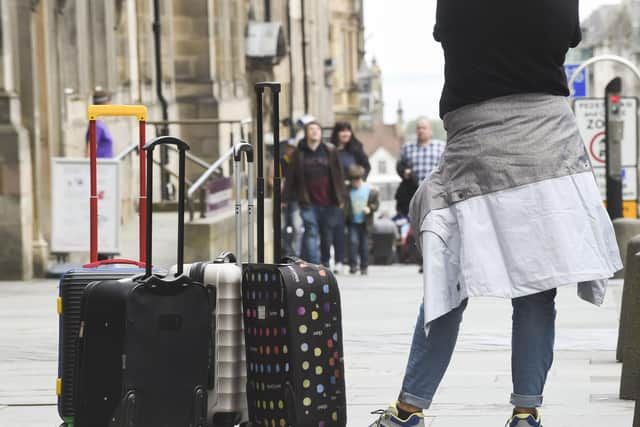

Whilst councils clearly require additional revenue streams, the current situation does not seem fair. The Scottish government could create a more equitable system for all home owners by bringing STLs into the council tax framework on a par with second homes, both being charged a reasonable rate.
Ellen Stewart, Aberdeen
Island patients
I was pleased to see you reporting on the issue of travel for island patients and the fact that some are now declining appointments because they cannot afford the costs involved (Scotsman, 21 November). This clearly should not happen.
I served on the Western Isles Health Board from 2007 until 2017. Now, as then, I am frequently told of wonderful work being carried out by the staff of the WIHB and their associates in our mainland hospitals. We are delighted that in many cases now CT and MRI scans can be given locally, which is very reassuring and reduces travel and accommodation costs and trauma. Always the concerns emerge when patients are expected to travel off island.
In my initial years on WIHB all travel and accommodation costs were covered by the NHS nationally. Then the NHS decided to allocate a travel and subsistence fund to NHS Western Isles.
I recall the then Director of Finance expressing real concern that the amount allocated would not cover the costs as she knew them. Nonetheless the Scottish government allocated a sum of money and ever since over-enthusiastic Medical Directors have caused many people to have had very upsetting experiences.
The costs were always a factor, and they frequently were associated with patient escorts. One example will assist. The woman of an elderly couple was diagnosed with breast cancer and was expected to go to the mainland for treatment. Her husband applied to accompany her (they went everywhere together). He was denied. He was heartbroken. We protested against the decision and it was eventually reversed but the damage was done.
During the time that I was being treated for prostate cancer in 2010 the treatment I had locally and in Inverness was first class. The overnight allowance was £60 then. It has remained the same for 16 years. The notion that the Western Isles Health Board might increase the amount, given its restricted budget, seems unlikely.
I am sure the present board would increase the allowance had it the resource to do so. The responsibility remains with the Scottish government. It should restore the agreement where the costs of travel and accommodation are paid by the NHS nationally. People in the islands should not be penalised because of where they stay.
Angus McCormack, Sandwick, Isle of Lewis
Rising prices
The UK-EU agri-food deal confirmed at last week’s Brussels summit has been welcomed for cutting the Brexit red tape that has hit our food exporters. That benefit is real. But the Prime Minister’s claim that it will ease food prices deserves scrutiny.
The problem is not what we sell to Europe, but what we buy from the rest of the world. In return for dropping most checks on EU trade, the UK will align with EU rules on non-EU imports, bringing new certification requirements and more inspections, including on goods not currently checked. In effect, produce from outside Europe will be checked as if it were heading on to the EU, even if it never leaves the UK.
That matters because around half of the UK’s fresh produce comes from outside the EU. The Fresh Produce Consortium estimates the changes could add more than £300 million in costs, which it warns will ultimately reach shoppers, and all this for supply chains that already achieve over 99.5 per cent compliance.
The rules do not take effect until mid-2027, so ministers still have time to press for a proportionate approach. Otherwise, a deal sold as lowering food prices could end up raising them.
Alex Orr, Edinburgh
Fools rush in
Andy Burnham, a Prime Minister “selected” for the position in a very unorthodox way, feels he is smarter than all the other politicians at Westminster, past and present. He has simply dismissed criticism from no less than six former Prime Ministers over his undemocratic headlong rush to cosy up to a failing European Union. The “wisdom of the elders”is being casually cast aside.
There is another phrase that resonates here: “Fools rush in.” In the few short weeks Mr Burnham has been in power he has made many mistakes and backtracked several times. Even his EU bonus “price cuts” for our shopping basket statement from a mere few days ago has been replaced with the meaningless statement of now “reducing pressure on prices”. Andy Burnham is out of his depth and he goes deeper down with every passing day.
The UK is in a crisis and so is Scotland with the very alarming revelations concerning our NHS. Neither governments have the leadership qualities needed to see a successful way out. Batten down the hatches.
Gerald Edwards, Glasgow
Unwelcome gifts
Reading of the negotiations sparked by the government’s desire for a “reset” with the EU there has come to my mind the old saying “Timeo Danaos et dona ferentes” (I fear the Greeks even when they come bearing gifts). Not that the EU is offering much.
Its aim seemss to be to rig things to its advantage, as you might expect when the UK is the suppliant.
S Beck, Edinburgh
EU extremism
It is clear our easy-talking Prime Minister has bitten off more than he can chew in our relationship with the EU. So desperate was he for a deal that the planned reset agreement points to a likely capitulation on student fees, costing us thereby millions of pounds per year.
Burnham has rushed in to change things for the better and made them worse. This is despite advice from Remain-supporting David Cameron and Theresa May, who experienced from the deep end what was involved in negotiation with the inflexible EU, and also from one-time European enthusiast Tony Blair, who has recognised that the EU has changed to an extent that rejoining is against Britain’s interest. There is also the scepticism of many present-day cabinet members including John Healey as well as Red Wall Labour MPs.
Burnham’s assumption is that public attitudes to rejoining the EU have changed. Polls, however, have only expressed majority dissatisfaction with how Brexit has been carried out rather than an enthusiasm for the EU as such.
Once the public become aware what is involved in again surrendering our sovereignty and the cost of that surrender there is no hope of their backing a return to to what they rejected in 2016, more especially as the EU since then has become far more subject to the influences of political extremes in the likes of France, Germany and Italy.
Alan D Jackson, Aberdeen
Price cap blow
At the height of Scottish winter pressure on households, Ofgem’s confirmation of a further rise in the energy price cap to 26 per cent should end any remaining fairy tales about “cheap” electricity.
For years, Ed Miliband and others have invited the public to believe that more renewables would naturally mean lower bills. Yet in Scotland, where fuel poverty remains a national scandal, many households know otherwise. What they face is not cheap power, but cold homes, hard choices and energy bills that remain stubbornly high.
The problem is the repeated attempt to confuse headline renewable strike prices with the true cost of electricity. Consumers are not simply paying for expensive offshore wind at sea. They are also paying for grid expansion, balancing costs, backup capacity and the specialist equipment needed to keep a renewables-heavy system stable when supply is intermittent and often far from where power is needed.
Holyrood, meanwhile, cannot go on posing as a bystander. Scottish ministers speak repeatedly about renewable leadership, but are far quieter about the eye-wateringly expensive floating offshore wind to which they are so misguidedly wedded and the wider system costs ultimately borne by households.
For all the talk of a cheaper future, too many Scots are being asked to pay more for the privilege of believing in it.
Eileen West, Banchory, Aberdeenshire
Write to The Scotsman
We welcome your thoughts – NO letters submitted elsewhere, please. Write to [email protected] including name, address and phone number – we won’t print full details. Keep letters under 300 words, and in the body of the email – no attachments – and avoid ‘Letters to the Editor/Readers’ Letters’ or similar in your subject line. If referring to an article, include date, page number and heading. No poems.
Comments
Want to join the conversation? Please or to comment on this article.