
Readers' Letters: Dial down the war rhetoric before it's too late
It could be argued that membership of Nato makes Scotland less safe, a reader says
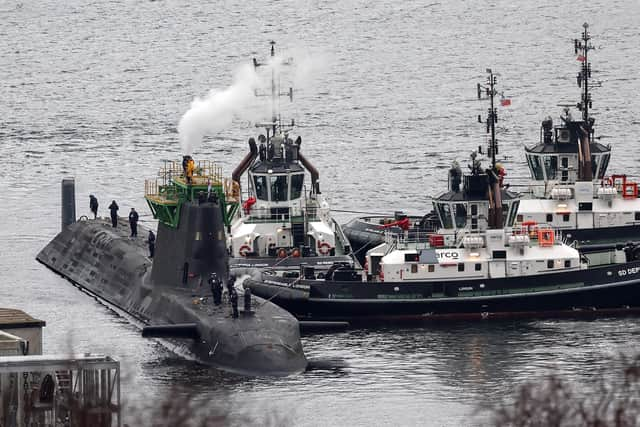
In your editorial of 27 November you write that the nuclear submarine base at Faslane protects Scotland, the UK and “all of free Europe”. But the fact is that in event of war Faslane and its nuclear missile stores would likely become a priority target for Russia.
Nuclear fallout would spread across Scotland, given that the prevailing winds are westerly. Far from improving Scotland’s security, it can equally be argued that our membership of Nato makes us less safe.
An argument can be made for Scottish neutrality after independence with a navy to protect our 11,600-mile coastline, something thanks to the parlous state of the Royal Navy we do not have today, rather than preparing for a war with Russia, a war which need not happen.

People are tired of the same old clichés: we need to prepare for war to keep the peace; attack is the best method of defence; Trident is our first line of defence; better to fight the Russians in Ukraine than at the English Channel; nuclear weapons have kept the peace for 80 years, etc.
Instead of talking up the prospect for war we should be talking up the prospect for peace. President Trump’s meeting with President Putin and President Xi, where reduction in the world’s nuclear armaments was proposed, shows the way forward. As President Trump said, there can be no winners in a nuclear war. Yet we seem to have lunatics in Europe in charge who are escalating the war in Ukraine with plans to blockade Kaliningrad, which Russia has said repeatedly it would regard as a declaration of war.
Almost daily we are warned about the need to prepare for war with Russia – an unnecessary war towards which we seem inexorably to be moving. There isn’t a party or politician prepared to put their head above the parapet and say: “Let’s dial down the rhetoric and see if we can solve this conflict by diplomatic means.”
William Loneskie, Lauder, Scottish Borders
Decentralise power
Before the 1975 reorganisation of local government Scotland had 477 local authorities with varying functions and of varying sizes. These councils were replaced by a two-tier system of 65 local authorities. In the 1996 reorganisation of local government, the 65 local authorities were replaced by the current system of 32 multi-functional councils.
Over that whole period from 1975 to the present day, many locally accountable services have been gradually removed, fully or partially, from local government to centrally-controlled quangos. These include further education colleges, tourism, economic development, social housing, water and sewage, environmental protection, fire and rescue and the police.
Additionally, and crucially, the influence of local authorities over their finances has been gravely weakened. In the 1970s, 50 per cent of council revenue was raised directly by them through local taxes and other, smaller, income streams and 50 per cent from was derived from central government. Those proportions are now 10 per cent and 90 per cent respectively.
Only when real power is returned to local communities are the best decisions made by and for those communities. The last thing that local authorities need is a spurious, disruptive and expensive major reorganisation.
What is fundamentally needed is a new contract between the Scottish government and Scotland’s existing 32 local authorities which, year on year, would include realistic financing arrangements with reasonable certainty and thereby revitalise the delivery of essential public services.
The opportunity should be grasped to enhance the role of community councils by empowering them to deliver several local services such as the maintenance of small cemeteries, park and amenity spaces and minor roads; the administration of Common Good Funds; street naming; local holiday dates; town twinning; ceremonial matters and grants to local organisations
Surely, the primary consideration in any review of local government should be to find new ways of spreading influence and power as widely as possible to ensure a vibrant and decentralised democracy based on broad participation.
The astonishingly sparse outline proposals of this inept SNP government suggest a substantial movement in the opposite direction.
Graham Garvie, Peebles, Scottish Borders
University funding
University funding from the Scottish government to compensate for Scottish students paying no fees is far less than the cost of educating them.
Perhaps we should not be surprised – most academics supported ‘No’ in the 2014 referendum. But the situation today is not that different from Margaret Thatcher’s time when she hammered higher education. It should also be remembered that she came to power thanks to the SNP, who held the balance of power at Westminster and used it to join with the Tories to bring down the Callaghan government.
The balance of power argument has resurfaced. But “those who cannot remember the past are condemned to repeat it”.
Hugh Pennington, Aberdeen
Swinney’s gong
It comes to something when one of the most ineffective and incompetent political leaders in John Swinney can be voted “Politician of the Year”, taking into account his catastrophic failures across all areas of domestic policy.
One can only draw a comparison perhaps if, for example, Mickey Mouse won the most popular character in Disneyland!
Richard Allison, Edinburgh
Gas disconnect
It is easy to understand that gas prices have an impact on electricity prices when we need gas-fired power stations to back up other energy sources when they do not provide sufficient power to meet demand. However, wind prices have not increased, solar prices have not increased, hydro-power prices have not increased and nuclear power prices have not increased. It brings into question why the ‘backup solution’ of gas, where prices have risen significantly, has resulted in such a massive 26 per cent increase in electricity prices from 1 January.
The time surely has come to disconnect electricity prices from the price of gas such that the backup solution only affects electricity prices to the extent it depends on them?
This connection with the price of gas, combined with our near-lunacy in driving forward net zero when we have made such progress already will only increase inflation, kill off manufacturing and leave people poorer. Slowing down the drive to net zero will have a much better impact than Labour’s £100 ‘give-away’ which the rest of us must pay for. Time for a rethink on the speed at which we progress to net zero as a country.
And let’s challenge the Energy Secretary’s comment that approving Rosebank for drilling would have no impact on oil prices as these are set by the market. I have news for her. When market supply increases and demand remains constant, prices fall. Drilling in Rosebank will maintain jobs and skills as we transition to net zero, will increase tax revenue, and supply oil into the international market, thereby increasing energy security and helping stabilise prices. There has been far too much prevarication. Drill, please drill.
Brian Barbour, Haddington, East Lothian
Shocking statistics
On Radio 4’s World at One yesterday Labour MP Fleur Anderson, one of the signatories of the letter to Andy Burnham demanding Rosebank’s cancellation claimed – correctly – that, in its 25-year life it would emit 250m tonnes of emissions including, extraction, production, transportation and consumption.
Total emissions from all fossil fuels and industry is around 38bn tonnes per year, equating to almost one trillion (one thousand billion) tonnes over 25 years. Rosebank's 250m tonnes is one four thousandths of that. Or to put it another way, this is one fortieth of the UK's already miniscule contribution of 1 per cent to global warming. Why are these people never challenged on their hugely exaggerated "shock horror" statistics?
Allan Sutherland, Stonehaven, Aberdeenshire
Gender beliefs
The employment tribunal ruling that Manchester City Council unlawfully discriminated against its equality, diversity and inclusion manager because of her gender-critical beliefs, unfairly dismissing her, will be of interest to employees who hold similar beliefs.
Employment Judge Joanne Dunlop found that criticism of a protected belief can be legitimate in a way that criticism of other protected characteristics under the Equality Act 2010, such as sexual orientation, would not be. Protection from discrimination on grounds of belief does not place the belief itself beyond legitimate scrutiny.
This distinction is particularly important for same-sex-attracted employees for whom biological sex is fundamental to understanding and expressing their sexual orientation. They may reasonably wish to question aspects of gender identity beliefs, particularly where these have implications for how homosexuality is understood and addressed in the workplace.
Such questioning need not be incompatible with respecting the dignity and rights of trans-identifying people, just as questioning religious doctrines need not imply a lack of respect for those who hold religious beliefs.
One hopes the judgment will see employers reflect on the extent to which their equality policies, staff training and workplace cultures accommodate differing lawfully held perspectives on sex and gender.
Brian Forsyth, Edinburgh
Write to The Scotsman
We welcome your thoughts – NO letters submitted elsewhere, please. Write to [email protected] including name, address and phone number – we won’t print full details. Keep letters under 300 words, and in the body of the email – no attachments – and avoid ‘Letters to the Editor/Readers’ Letters’ or similar in your subject line. If referring to an article, include date, page number and heading. No poems.
Comments
Want to join the conversation? Please or to comment on this article.