
Readers Letters: Clearing Faslane of UK's nuclear deterrent would make Scotland less safe
Scotland refusing to host Trident weapons would not make Scotland safe, say readers
Grant Frazer's promise of an all-smiling Utopia for a Scotland clear of nuclear weapons is really rather sad (Letters, 17 February).
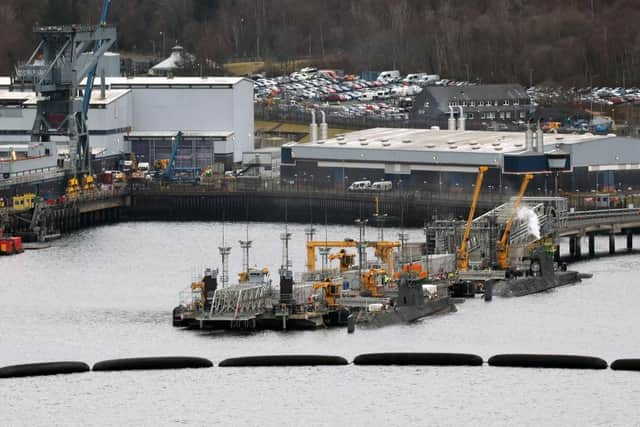
The Faslane facility provides 6,500 direct well-paid jobs and, according to the local authority there are a further 4,500 who benefit to some extent. Current plans are to extend the facility by another 2,000 direct jobs.
To state that Faslane alone would make Scotland a target is really simplistic – wouldn't the Clyde shipyard building new military vessels for the UK and others be a more likely one? Does Mr Frazer want to close that as well?

A McCormick, Terregles, Dumfries
Remember Ukraine
Grant Frazer's reiteration of the mantra of the SNP-Far Left with regard to the operation of the UK’s nuclear arms remains total nonsense. In intercontinental ballistic missile terms, his “20 miles from Glasgow” is but a grain of sand.
Of course the UK relies on our allies, the USA, to supply the missiles for our submarines. How could it be otherwise? That is what allies do. In every other sense, the nuclear deterrent that has kept Scotland and the rest of the UK safe for 80 years is entirely independent.
Finally, has no-one told Mr Frazer what happened to Ukraine when it unilaterally gave up its nuclear deterrent?
Alexander McKay, Edinburgh
Half-baked
Grant Frazer writes: “Clearly, only with independence will Scotland be able to remove nuclear weapons and become a country where the smiles of the young and old bring joy and happiness to all its people” (Letters, 17 February).
What utter balderdash. Independent or not, Scotland would be annihilated along with all its neighbours in a nuclear war. But such is the infantile thinking of the separatist movement.
It is this mindset which drives the Scottish government to splash out on unsustainable social welfare payments and universal freebies, reported by The Scotsman’s front page headline as “SNP policies of free tuition and benefits ‘at risk’ as funding falls” (17 February).
Be it recycling schemes, building ferries or changing genders, none of the nationalists’ half-baked policies ever survive collisions with reality for very long.
Martin O’Gorman, Edinburgh
Guard staff
A female prison guard has been arrested and charged for allegedly having an inappropriate relationship with a prisoner in Barlinnie (your report, 17 February).
There have been numerous similar incidents over the years, as well as sexual assaults and inappropriate behaviour. There have also been thousands of cases of physical assault in prisons by prisoners on prisoners over the last five years. More worrying is that last year there were 350 cases of prisoners assaulting male and female prison officers.
Women are physically weaker than men. Surely it is time to only allow women prison officers in female prisons and only have male officers in male prisons.
Clark Cross, Linlithgow, West Lothian
New mandate
Labour's U-turn on the local council elections in England could have huge consequences. The possibility of a complete collapse in Labour support is tangible.
Prime Minister Keir Starmer would be in an untenable position but would the entire Labour government not be on very thin electoral ice too? A complete loss of public confidence, in a democracy, ought to result in a general election to seek a new mandate.
Can Labour possibly refuse this “request”? If the results all across the country are universally bad then Labour cannot shelter behind the mandate given in 2024 and trashed by Labour ever since. With power comes responsibility.
Gerald Edwards, Glasgow
Drive safely
While idling my time in the doctor’s surgery this morning a publication on the counter caught my eye titled “Worried about Someone’s Driving?”.
Being of a more mature age and remembering a recent government “discussion” regarding older drivers and a possible need to resit the driving test on a regular basis, I thought that this publication might provide some more information on the thoughts of our government on this subject.
As to be expected, it skirted around the issue of unsafe driving but gave sage advice on how to broach the subject with someone who perhaps was a danger to other road users, and indeed, themselves.
Of interest to me, however, was the statistic that 23 per cent of all road fatalities and serious injury were attributed to those aged over 60. In comparison, research indicated only 18 per cent of serious road traffic fatalities and injuries were by those in the 17-24 age bracket, which left 57 per cent down to the 24-60 age bracket.
Now, I’m not suggesting that the more mature driver should not require a medical MOT as they age. Quite the reverse in fact and checks on vision, cognitive ability and reactions should be a regular feature as we age because these will fade as we get older. These should be carried out by our doctor, probably annually, and copies of the results provided when applying for licence renewal.
However, I suggest that a full driving test for those with years of driving experience would add little to safety whereas a personal health MOT would.
T Lewis, Coylton, Ayrshire
Without peers
That fundamental change is needed regarding the House of Lords is nowhere more clear than with their treatment of the assisted dying bill.
Implementing a secure, online universal voter consultation system for the UK is essential to modernise democracy and bridge the widening gap between representatives and the electorate. By providing real-time, aggregated data on voter sentiment for every proposed bill, MPs could make informed decisions that accurately reflect public opinion, enhancing legitimacy and accountability. This direct consultation mechanism would ensures voters have a voice beyond general elections, fostering engagement and restoring trust in the legislative process. While ensuring robust cybersecurity is paramount, technology allows for efficient, transparent, and widespread participation, transforming the current, often detached, political system into a dynamic, responsive democracy where legislation is truly guided by the will of the people, not just party allegiance.
Doug Clark, Currie, Edinburgh
Price blows
It was unfortunate that Professor Roy Thompson (Letters, 17 February) did not provide any solution as to how the lights will stay on in Scotland when the wind fails to blow.
At Westminster, Energy Secretary Ed Miliband has adopted a plan to utilise gas turbine and nuclear plant to provide power when dunkelflaute weather conditions occur yet, to date, there has been a deafening silence from First Minister John Swinney as to how the Scottish grid will meet such a challenge.
After all, electricity at £216 per MWhour is a price that Scots cannot afford!
Ian Moir, Castle Douglas, Dumfries & Galloway
Eye off the ball
All Scottish Labour leader Anas Sarwar “can do is keep campaigning on devolved issues and hope his audience is able to filter competing messages”. That is the contrary conclusion from Brian Wilson (Perspective, 14 February).
I am not sure Mr Wilson realises that Scottish Labour has been consistently polling under 20 per cent since September while Reform has claimed second place behind a rock steady 35 per cent vote share for the SNP. Something major had to change but Mr Sarwar has put his ambitions before loyalty to his Westminster leader, by calling for him to go. This is an act of political desperation, not a consequence of “naive and disrespectful” behaviour by the UK party going for success over the five-year term, as Mr Wilson claims.
Polls rarely lie and Mr Wilson is wrong to claim Anas Sarwar has been doing as much as he “humanly could to recover the position”. Sarwar has summarily failed to land a shot at John Swinney’s government recently. Blaming that on Keir Starmer’s leadership is like Swinney castigating Westminster for all Scotland’s ills. Who did Sarwar think could do a better leadership job and how did he expect to run a campaign with the UK party distracted and sidelined in a leadership election?
Mr Sarwar is left looking disloyal and isolated while Reform are picking up the pieces, yet Mr Wilson makes no mention of them. If Labour had their share of the vote too they would be well ahead now, but instead Labour voters have been switching to Reform in droves. Sarwar has completely taken its eye off the ball and left himself needing a miracle.
Neil Anderson, Edinburgh
Happy days
The interesting article on the new veterinary service in Tiree (“Scottish island community opens UK first non-profit, community-owned vet”, 17 February), which deserves every success, reminded me of our delightful family holiday there in a croft in the north coast hamlet of Vaul in 1951. The cows fed on the beach seaweed – with slightly unwelcome effects on our digestions, but fortunately only for the first couple of days!
Full board for six of us for two weeks cost £42 – presumably a worthwhile extra to the crofters’ regular income.
John Birkett, St Andrews, Fife
Write to The Scotsman
We welcome your thoughts – NO letters submitted elsewhere, please. Write to [email protected] including name, address and phone number – we won't print full details. Keep letters under 300 words, with no attachments, and avoid 'Letters to the Editor/Readers’ Letters' or similar in your subject line – be specific. If referring to an article, include date, page number and heading. And please do ensure any names mentioned are correct.
Comments
Want to join the conversation? Please or to comment on this article.