
Readers' letters: Assisted death is a gift of life, of choice, and of control
A correspondent whom the CPS decided not to prosecute for assisting a suicide says her terminally ill husband died without without fear, suffering or pain – and that everybody deserves the same chance
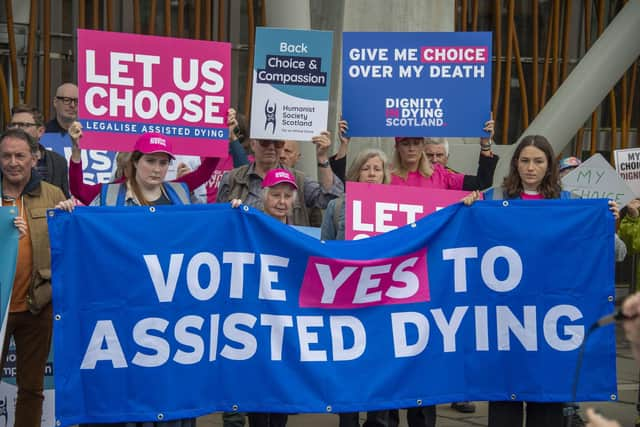
There is one vital point that is being missed in the intense discussions taking place in the run-up to the MSP vote in two weeks on the Assisted Dying Bill. The gift of life.
I have seen the difference choice makes to a dying person; I have lived it and witnessed the gift that the possibility of a death without trauma gives.
My husband made the journey to Switzerland in December 2024. Once he had been accepted by Dignitas his life changed from fear to love of the time he had left. My husband’s mental and emotional state lifted, he began to live life, to go out with friends, to fulfil his bucket list, to watch the sunset with a smile and look forward to the next day. But most importantly, he lived every day instead of existing in misery with fear as his constant companion.

Antony suffered with Motor Neurone Disease, and when I say suffered, he truly did. His last days would likely have included being locked into a body unable to function, move or communicate, whilst his brain remained active, and likely choking to death. My husband lived consumed by fear of how he would die.
Terminally ill people don’t want to die. My husband didn’t want to leave our world, but he had no choice. MND had the control. Believe me when I say an assisted death is a gift of life, of choice, and of control.
I have watched it, I have lived it, I held him in my arms whilst he peacefully drifted to sleep to meet his God. I held him as his heart stopped beating, he died in silence, in calm, without suffering, without pain.
This is a gift modern science can offer people: the chance to live what time is left without dread. Right now, that gift is only available to those who can afford it. I urge members of the Scottish Parliament to give everyone the same choice my husband was lucky enough to have, the gift of life before the inevitable end.
Louise Shackleton, On behalf of Friends at the End (FATE), Edinburgh
Palliative care
A well-established principle in medicine is that a doctor needs to practice a skill repeatedly, ideally many times daily, to achieve the best results. This is true especially for terminal care where palliative care specialists/consultants are essential to achieve optimal results Only palliative care specialists have the right experience to optimally combine and juggle the various drug treatment options (and their doses) in each individual in the same way as, in a simpler example, a Michelin-star chef is best to combine the right amount of the right ingredients to produce the optimal product.
Sadly, however, we do not fund nearly enough palliative care specialists to look after every terminal care patient, which is largely why poor deaths occur and why there is a clamour for assisted dying. It is really a shameful example of “putting the cart before the horse” to fund assisted dying instead of more palliative care specialists. Perhaps a palliative care referral should be mandated before each request for assisted dying, although this would still first require a large new investment in palliative care specialists.
Allan Struthers MD, Newport-on-Tay, Fife
Resolute Starmer
Donald Trump has said he “is not happy” with our Prime Minister and stated that “this is not Winston Churchill we are dealing with”. Sir Keir Starmer does not claim to be Churchill but he has been as resolute as the great man in defending Britain’s interests. It is not in the national interest to join America in bombing Iran. This is an illegal unprovoked war of aggression and it has already killed over a thousand civilians. It has resulted in a huge economic shock, with tankers unable to pass through the Gulf of Oman, and will likely restart Islamic terrorist activity against the West. Already it has resulted on an attack on RAF Akrotiri.
President Trump’s problem is that he thinks he is a great president when he is not. His imposition of tariffs on most of the world has destabilised international trade. He claimed before his election that under his administration there would be “no more wars” but he has ordered the bombing of numerous countries. He covets Greenland and Canada as new American states. He is an extreme narcissist who constantly refers to his “greatness” and who wants his name emblazed on everything he can. He is also a vengeful man who takes umbrage at anyone who contradicts him.
American commentators have speculated for some time now about Trump’s state of mind. The longer he remains in power surrounded by his chosen acolytes, the more dangerous the world will become.
William Loneskie, Lauder, Scottish Borders
History lessons
The question of how well modern leaders measure up to their historical predecessors isn’t an easy one to answer. However, the public’s gauge changes over time and it’s doubtful how compatible a Churchillian figure could be with the requirements of the modern electorate. Thus it’s probably just as well that Sir Keir is no Churchill, though it’s arguably regrettable that President Trump is no FDR.
R A Wallace, Kincardine, Fife
No Churchill indeed
Donald Trump was “very surprised” that the UK government was “very uncooperative” by not giving permission for the use of UK bases including that “stupid island” of Diego Garcia, complaining that Keir Starmer is “not Winston Churchill”. The special relationship is at a new low, Trump is unpopular here and the public are against operation Epic Fury. Starmer will nonetheless want to mend what Trump called a ruined relationship despite a conflict primed by Israeli aggression. As in Gaza, Israel is acting with impunity, hitting schools and hospitals. Trump views this as good over evil but it’s already a power vacuum similar to Iraq and Libya, which resulted in civil wars.
Iran has escalated the conflict across the region and, for the first time since the Falklands War more than 40 years ago, UK territory was attacked and hit by a foreign state. While two drones were shot down, one hit RAF Akrotiri. If the RAF can’t intercept drones what hope against ballistic missiles? Starmer is sending a guided missile destroyer – a modern gunboat. Churchill would have sent that weeks ago, and have an evacuation plan for 300,000 UK nationals in the Gulf, not a BA flight.
Neil Anderson, Edinburgh
Special Relationship
Eighty years ago today, 5 March 1946, Sir Winston Churchill delivered his historic address at Westminster College, Fulton, Missouri and coined the phrase “special relationship” referring to the alliance between Great Britain and the United States. Were we living in happier times, we would likely mark today with a celebration.
The Special Relationship is central to the Five Eyes, the Anglosphere intelligence alliance that includes Canada, Australia and New Zealand. It is also very important to HM Armed Forces, particularly the Royal Navy and Royal Marines and their operations with the US Navy and US Marine Corps.
The Special Relationship will surely endure so that our great nations may trump any malign adversary. The UK’s safety and security depend on it more than many Britons realise – the protection of sea trade is essential for our island nation’s survival and prosperity.
I will raise a glass tonight to our great ally, as I will in four months’ time, for America 250, the semiquincentennial on 4 July.
Lester May (Lieutenant Commander, Royal Navy – retired), London
Regime changes
Brian Monteith points out that Iran “has been shown to be behind social media campaigns sowing division in our country so that Scotland might secede” (Perspective, 3 March). Like Scottish nationalists, many totalitarian states worldwide pray fervently for the UK’s demise.
There are interesting parallels between the Iranian government and the separatist movement here. Neither of them like America, Israel or Britain. Both are constrained by fanatical ideologies, one being fundamentalist Shi’a Islam, the other Scottish exceptionalism.
Anti-wealth, anti-business, anti-growth SNP/Green and Alba politicians have no more grasp of economics than those elderly clerics running the show in Tehran, whose wisdom has brought their oil-rich nation to the verge of financial collapse.
Unfortunately, other things they have in common are that each has succeeded in radicalising a significant minority of their respective populations with false promises, face divided oppositions and have been wrecking the countries they claim to love for far too long.
Martin O’Gorman, Edinburgh
Costa bravo!
One is becoming cheesed-off with all this criticism about our readiness, or not, for war.
Following a recent delightful trip to Costa Rica I ask why do we bother with armed forces at all? Costa Rica, half the size of Scotland, abolished theirs in 1948 and it has never looked back. The huge savings have enabled that nation to benefit from an excellent cradle-to-grave national health service, together with an education system that is not only universal, but so effective that foreign digital investors are queueing up to take advantage of its happy, motivated and skilled people and invest. Pineapples may still be the top income earner, but not for much longer.
Having no arms or ambitions it has no enemies. Its police service is quite capable of maintaining law and order in a nation content to be well served by its politicians. Imagine that!
Lessons to be learned? Or ignored?
Tim Flinn, Edinburgh
Write to The Scotsman
We welcome your thoughts – NO letters submitted elsewhere, please. Write to [email protected] including name, address and phone number – we won't print full details. Keep letters under 300 words, and in the body of the email - no attachments - and avoid 'Letters to the Editor/Readers’ Letters' or similar in your subject line – be specific. If referring to an article, include date, page number and heading. And please do ensure any names mentioned are correct.
Comments
Want to join the conversation? Please or to comment on this article.