
Why that desperate call from your daughter may have been a cybercriminal using AI – Ronald Hepburn
Make the AI industry answer for how its products are used and the safeguards would follow quickly, argues Ronald Hepburn
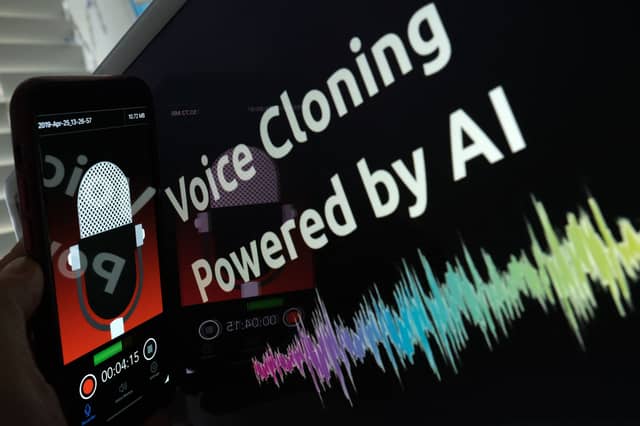

The phone rings. It’s your daughter, and she’s frightened. She has been in an accident, she has borrowed a stranger’s phone and she needs money now. The voice is hers. The panic is hers. It’s not her at all.
Cloning a voice now takes seconds of audio – and scammers have access to vast troves of recordings. Trade association UK Finance records £1.28 billion stolen through payment fraud in 2025, across more than four million cases. The Home Office puts the full cost of fraud in England and Wales at more than £14 billion a year. Artificial intelligence lets criminals target thousands of people at once. They need only one to bite.
My landline rarely rings now unless it’s a scammer. When a woman called recently saying she was from HMRC, I suggested, politely, that if she really was, she would know to call my accountant. She was a tax inspector; I will need to apologise. Today we have less and less reason to trust anything we see or hear – unless it is in person.
AI set to exploit human instincts
So here’s a prediction. AI will be used for all the worst things humans do – fraud, blackmail, theft, sexual exploitation, warfare and weapon design. And it will keep getting better at them, aiming to harness our human instincts to protect our love ones, trust people we know and believe what we see and hear.
The industry already has its defence ready, borrowed from the gun lobby. Guns don’t kill people; people kill people. The labs build the tool. What happens once it leaves the lab is someone else’s fault.
But the tools are already in the wrong hands. OpenAI and Microsoft have named hackers linked to the Russian, Chinese, Iranian and North Korean states who used their models. The heads of MI5, MI6 and GCHQ have reportedly told the cabinet that AI is the biggest security issue it faces.
‘A 50 per cent chance we all die’
Meanwhile, as their systems approach superintelligence, the companies warn they will no longer be able to control them. Geoffrey Irving, until recently chief scientist at Britain’s AI Security Institute, wrote in Time this month that there is “about a 50 per cent chance we all die” because of smarter-than-human AI.
He also says our actions over the next two to ten years will decide the outcome. Losing control is a choice. A product its makers cannot control is a product nobody can blame them for. That’s exactly why they must be blamed.
READ MORE: Why we must resist AI's attempts to control our language (and how AI rewrote this article)
There is a simple test of how much control is really possible. Make the makers liable. After the 2008 crash, Britain made senior bankers personally accountable for failures on their watch, and boardroom behaviour changed almost overnight. The Online Safety Act now makes tech executives criminally liable in certain circumstances. Put AI companies, and the named people who run them, on the hook for the foreseeable criminal use of their products, and I suspect the guardrails would appear within months.
The industry promises cures for cancer, new vaccines and lives of leisure for all. I’d like to see that future. It will come sooner from companies that must answer for their products than those that shrug and say the customer pulled the trigger.
Ronald Hepburn is a director of the EDDS Institute, which evaluates AI and digital technologies in schools
Comments
Want to join the conversation? Please or to comment on this article.