
Why John Swinney is wrong to say Reform can be locked out of Scottish politics
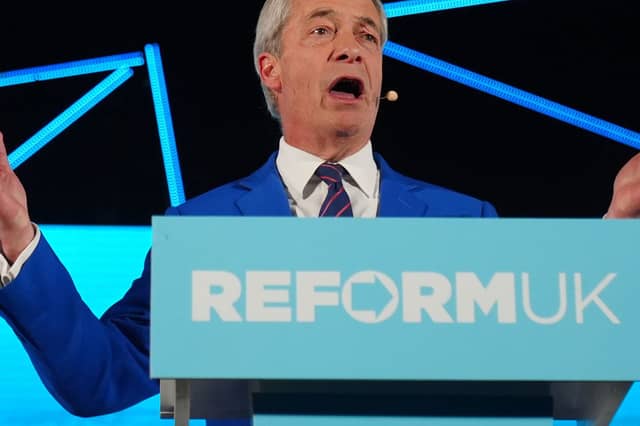

There is more than a hint of irony to the argument made by John Swinney
“Independence will 'lock Nigel Farage out' of Scottish politics, John Swinney claims”
So blared the headlines of a raft of news articles this week, following the SNP leader’s Holyrood campaign launch.
It is easy to see why the First Minister would want to draw a connection between Scottish independence and giving the boot to Nigel Farage and the Reform Party. Swinney’s cohorts have marched up and down the hill for the independence campaign to diminishing returns for years; the 2024 election was a disaster for the nationalists, in no small part because they lacked a plausible bogeyman with which to motivate SNP activists; Farage is the natural candidate to fill that role.
For all the understandable temptation of framing independence as the way to be rid of Nigel Farage, however, John Swinney is wrong. Reform’s brand of right wing politics cannot and will not be locked out of Scottish politics, whether or not we remain within the United Kingdom.
There is, one might suggest, more than a hint of irony to the case made by John Swinney. One point on which both the First Minister and Nigel Farage can agree is that the way to make your country better off is to expunge the wrong sort of people from it.
It is a classic nationalist answer to any given political challenge: build up a border and you can keep out your problems. That is a reassuringly simple solution – but a wrong one.
The problem, after all, is not Nigel Farage in of himself. He is their most successful figurehead within the UK, and not without his personal controversies, to say nothing of his Scottish lieutenant, Lord Offord – he of the now-infamous sense of humour. It is not Farage as a personality that we should be concerned about, however, but the ideas that he and his supporters espouse – and you cannot build a border against ideas.
Those ideas and values will exist in Scotland whatever our relationship with the rest of the UK. They exist here now; they will remain here in the future.
After all, Nigel Farage may have been the poster boy of Brexit in 2016, but almost 40 per cent of Scots agreed with him – including a similar proportion of SNP supporters. The Remain side won handily here but we are still talking about essentially two Leave-voting Scots for every three Remainers.
Or take the touch-paper issue for the far right: immigration. Survey analysis by Sir John Curtice in 2024 found that almost identical proportions of Scottish and English people agreed that immigration is good for our economy, and that it enriches our culture. If there is a difference in political values here it hardly seems decisive.
Even if we ignore that evidence and hold tightly to the hope that, for whatever reason, Scots are, on some level, more left-wing or liberal than our cousins in England or Wales or Northern Ireland currently, it would be dangerous to assume that we always will be.
The SNP often holds up our Nordic neighbours as the model for our post-independence future – particularly wealthy, modern, successful Denmark. Set aside for a moment the fact that Denmark already has one of the most aggressive anti-immigration policies in Europe, driven by a lurch to the right in recent years. The Danes went to the polls just this week and gave the ruling centre-left Social Democrats their worst result in a century – with the far right more than tripling their number of seats. If that is our model then it hardly suggests we will be immune to the allure of far-right ideas or far right parties in the years to come.
All this is before we get into the possible consequences of independence itself on Scottish politics. Far right movements the world over have been fuelled by economic hardship and left-behind communities. If Scotland’s departure from the United Kingdom leads to both significant economic disruption and the end to the fiscal transfers that help us pay for our more generous public services – as mainstream economists agree – on what basis do we suppose we would be invulnerable to rising political resentment?
Flattering though it might be to imagine, there is no hidden particle within Scots that makes us magically immune to the appeal of the far right – any more than there is some innate trait that would make the English or the Danes or our American cousins more susceptible to these political movements.
The trouble with nationalism in general – whether of the Swinney or the Farage variety – is that it sees identity as the dividing line of our politics, rather than ideas – but it is ideas that win arguments and solve our problems. Without that “magic particle” to inoculate us from bad ideas, we have to do the work ourselves.
That work is hard, and does not stop. It could be tempting to follow John Swinney’s lead and imagine that some dramatic political amputation would end the threat for good –but you are unlikely to lock them out of our politics by deepening the hardship on which they thrive.
There is no magic answer to defeating them. We do not succeed by pulling up the drawbridge, but by winning in the battle of ideas. If we build up our walls, pull up that drawbridge, and “lock” Nigel Farage out of our politics by leaving the UK, when we turn around, we will have the same challenges facing us – and the same ideas to defeat.
William Deans is Chief of Staff to Alistair Carmichael MP, and holds an MSc in Nationalism and Ethnic Conflict
Comments
Want to join the conversation? Please or to comment on this article.