
Why it’s clear Vladimir Putin failed to learn from Scotland’s greatest military disaster – Iain MacGregor
The fundamental errors made by Vladimir Putin and King James IV were psychological, not military
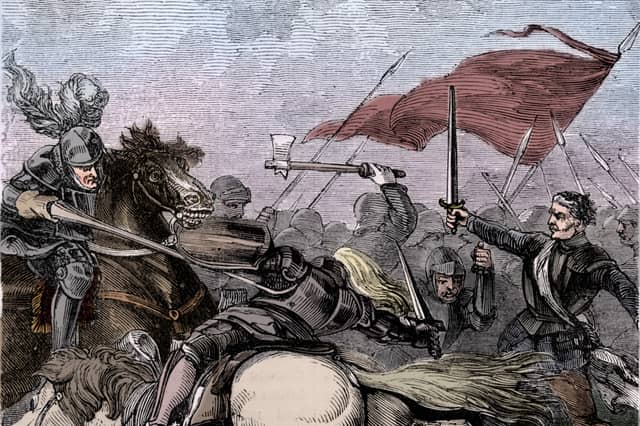

When King James IV crossed the River Tweed in 1513 at the head of a 30,000-strong Scottish army, he believed he was marching towards one of his country’s greatest victories. Instead, he was leading it to one of its greatest disasters.
More than five centuries later, the Russian dictator Vladimir Putin arguably made a similar calculation when he ordered Russian forces into Ukraine. Most comparisons with the current war look to Napoleon Bonaparte's retreat from Moscow or Adolf Hitler's invasion of the Soviet Union. Yet a more revealing parallel may lie much closer to home.
In both James IV’s and Putin’s case, a powerful ruler convinced himself he had identified the perfect moment to strike. However, in both cases, their invasions were founded on a profound misreading of the nation they attacked. Military ambition collided with political reality, producing consequences very different from those expected.
King James's decision was not the act of a reckless adventurer. On paper, his plans looked rational. England's Henry VIII was campaigning in France, leaving the government in the hands of his queen, Catherine of Aragon. Bound by the Auld Alliance and eager to support France, James saw an opportunity to strike while England appeared distracted and exposed.
READ MORE: How Scotland invented X-rated rap battles and King James IV was a huge fan – Susan Morrison
Initial Scottish success, then catastrophe
Scotland assembled one of the largest and best-equipped armies in its history, complete with modern French artillery. The logic of the campaign seemed compelling to a monarch well versed in military tactics. Yet it unravelled with remarkable speed.
Having crossed the border, James initially appeared to have judged the situation correctly. Scottish forces seized key border strongholds, including Norham Castle, and occupied a strong defensive position on Flodden Edge.
However, rather than forcing the English to attack on unfavourable ground or withdrawing with his gains, James allowed himself to be manoeuvred into battle by an English army of roughly 26,000 men under Thomas Howard, Earl of Surrey. On September 9, 1513, the two armies clashed near Branxton Hill.
As the Scots advanced downhill, their formations became disordered in muddy ground. Their long pikes, so effective on level terrain, proved unwieldy in close combat, while English billmen hacked their way into the Scottish ranks.
By nightfall the invasion had ended in catastrophe. James lay dead, the last British monarch to die in battle, alongside an archbishop, two bishops, 12 earls, 14 lords of parliament and an estimated 5,000 to 10,000 Scottish soldiers. No defeat in Scottish history inflicted a greater loss upon the nation's political and military leadership in a single day.
Putin’s misplaced confidence
Fast forward half a millennium and, like James in 1513, Putin entered Ukraine convinced that military superiority would compensate for any political risk. When Russian forces crossed Ukraine’s borders in February 2022, the Kremlin anticipated a rapid victory.
Nearly 200,000 troops were committed to the invasion’s opening phase, supported by thousands of tanks and armoured vehicles, extensive artillery, precision missiles and one of the world's largest air forces.
Russian planners appear to have expected Ukraine's government to collapse and believed many Ukrainians would remain passive or welcome Russian rule. Given the disparity in military strength, the assumption didn’t seem unreasonable.
As with James IV, the invasion was launched not because success seemed uncertain, but because it appeared almost guaranteed. Yet events would unfold very differently from the assumptions made in Moscow.
The deeper similarity between Flodden and Ukraine lies not in military manoeuvres but in political misjudgment. James believed England was vulnerable because its king was absent. Putin believed Ukraine was an artificial state, divided by language, region and politics, whose government would crumble.
Invasions galvanised local resistance
Both men saw weaknesses that undoubtedly existed. Neither properly understood the strength of the national sentiment their invasions would provoke. In 1513, news of the Scottish advance galvanised resistance across England, helping to unite the kingdom in defence of the realm.
In 2022, Ukrainians who differed in language, politics and outlook rallied around their state’s survival. Hundreds of thousands volunteered for military service, while millions supported the war effort through fundraising, logistics and civil resistance.
Far from exposing division, the invasion strengthened national cohesion. The fundamental error in both cases was not military but psychological: a failure to grasp what people will endure when confronted by an external threat.
Underpinning both campaigns was another enduring feature of military history: the tendency of powerful leaders to surround themselves with assumptions rather than reality. James was encouraged by favourable circumstances, diplomatic commitments and confidence in his army.
Putin appears to have received intelligence assessments that dramatically underestimated both Ukrainian resistance and the willingness of Western nations to support Kyiv. The details differ, but the pattern is familiar. As leaders accumulate power, they often become less likely to hear unwelcome truths.
A timeless truth
In researching my new book, I can see history's greatest military disasters are frequently preceded by a narrowing of vision, in which evidence that challenges existing beliefs is ignored while information that reinforces them is embraced. By the time armies cross borders, the decisive mistakes have often already been made.
“Our awin dear king has slain, the flower of all chivalry,” lamented the poet William Dunbar after Flodden. More than five centuries later, the battle remains one of the defining moments in Scotland's story. It is remembered not merely because a king died, but because of the shattering of much of the nation's leadership in a single afternoon.
Yet Flodden's relevance extends far beyond the history of these islands. At its heart, the disaster demonstrates a timeless truth about warfare. The greatest danger facing leaders is not necessarily a lack of military strength, but the conviction that strength alone will determine the outcome. James learned that lesson in 1513. Putin is still learning it today.
Iain MacGregor, a fellow of the Royal Historical Society, is author of Battle: The Moments that Transformed Warfare from Ancient Greece to Ukraine
Comments
Want to join the conversation? Please or to comment on this article.