
Why demolishing Jimmy Savile’s old cottage in Glencoe will help us celebrate its other famous occupant



An outbuilding where the late, great Hamish MacInnes invented life-saving mountaineering equipment is to be named Hamish House in his honour
On Tuesday, Highland Council gave permission for the Glencoe cottage owned previously by Jimmy Savile to be knocked down. It will make a positive change. The redevelopment of this site has the potential to oust a lingering spectre from a gloomy stretch of the A82.
There is precedent for knocking down buildings associated with murderers and paedophiles. The rubble is broken down as far as possible to detract ghoulish souvenir hunters from fetishising the site itself. Ian Huntley’s Soham home was demolished and covered in grass, Fred and Rosemary West’s layered with concrete, it being thought that nothing could peaceably fill such spaces.
The important distinction is that none of Saville’s reported crimes actually took place at Glencoe; for this reason, it has previously been argued the cottage should be saved. But, with fears he may have abused up to 1,000 children, the cottage has lain empty since it was last sold in 2013, a receptacle for the negative feelings reflected in its vandalism.
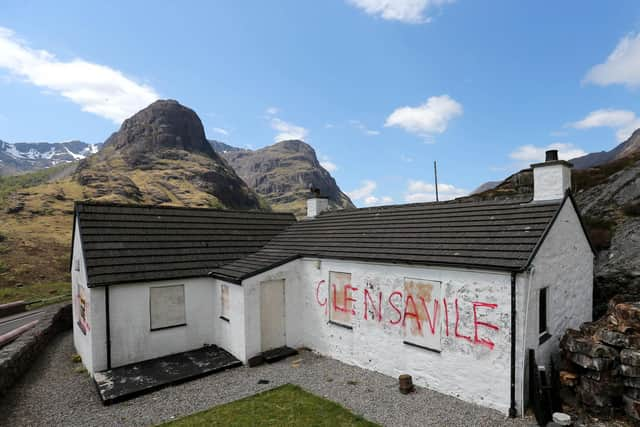
One of the few houses dotting this strip of the A82, overlooking the road, it was a conspicuous location for a celebrity home, one featured in Louis Theroux’s documentary about Savile. There are stories, perhaps some of them urban legends, of Saville wearing a kilt in town to speak to tourists and jogging along the roadside in trademark lurid tracksuit as though he had right of way.
A chance to move on
Frozen in time with these associations, the cottage, called Allt-na-Reigh, has come to stand as a kind of anti-memorial to a man who faced neither trial nor punishment for his crimes while alive. An empty house once owned by an evil man is a landmark nobody wants on their travels.
Demolition will let the place breathe, move on, and come to mean something else again. Rather than pretending nothing was ever there, private redevelopment plans refer to the longer, richer history of the site as the home of Scottish climber and inventor Hamish MacInnes, who lived there in the mid-20th century while becoming a pioneer of modern Scottish mountain rescue.

Although some objected to the contemporary, glass-clad style, plans have been approved by the council for a four-bedroom, one-and-a-half storey house with a two-storey rear section – an ancillary building where MacInnes worked on his inventions, which is to be named Hamish House.
As well as engineering an eponymous mountain rescue aid still used today, the MacInnes stretcher, he designed the first climbing axe in Britain to have a non-wooden shaft. Before this invention, MacInnes had already had a storied life climbing, summiting the Matterhorn before the age of 16 and making a near-attempt at Everest, when he was 23, before Edmund Hillary and Tenzing Norgay reached it.
Ice-climbing deaths
Later he climbed Mont Blanc with a brain fracture sustained from a falling rock. These experiences were formative to his involvement in mountain rescue associations and the dozens of books and handbooks he authored. As his 2020 obituary in The Scotsman put it, "no one man has done more to help put in place the network of emergency response efforts designed to keep climbers from harm’s way, and it seems that MacInnes took just as much pleasure in helping to rescue people as he did in making record-breaking ascents”.
In April of 1959, a few years before his axe invention, MacInnes was part of an evening search effort for two missing climbers who failed to return to base camp from Ben Nevis. Their bodies were found two days later roped together at the foot of Zero Gully, one of the mountain’s most challenging ice faces on the North-East. The Scottish Mountain Rescue Accident Reports record the reason for their fall: "Leader fell from 3rd pitch and dragged others down. Both their axes snapped off and stumps were still embedded in the snow."
The all-metal MacInnes Massey axe was later designed by MacInnes in his Glencoe workshop with steel supplied from Manchester, and according to the Scottish Mountain Heritage Collection, “one soon fell into the hands of the legendary Glasgow-based Creag Dubh Mountaineering Club, who quickly dubbed the rather heavy hammer version 'the Message' as it battered the commonly used soft steel pitons of the era so badly, that in Glasgow parlance ‘they got the message’."
A landmark ascent of Ben Nevis
In MacInnes’s sights was Zero Gully, an icy, avalanche prone climb he’d attempted seven times before succeeding. Published by the Scottish Mountaineering Press on their website is an excerpt from the book One Man’s Legacy: Tom Patey, by Mike Dixon, which describes MacInnes bringing his new axe to a climbing party about to set out. “There was a dramatic entrance late on Saturday evening by Hamish MacInnes, who had rushed over from the Steall Hut in Glen Nevis when he heard of the personnel gathered and the goals they had in mind. MacInnes’s experience stretched from Scotland to the Alps, New Zealand and the Himalaya, and that weekend he had with him The Message, the first all-metal shafted ice hammer, which he had recently invented.” Over several days, waiting for flurries of snow to die down, the party of climbers were the first to complete the first Grade V route on Ben Nevis.
It’s a pity Hamish House will not be a visitor’s centre, perfectly sited en route to the most challenging climbing spots of Scotland to underline the message that the peaks are severe and equipment is needed. But the greenlit demolition of the trashed cottage alone will flood the scene with such welcome light. Particular to this specific place among the jagged peaks is a clear link between Scotland’s ancient landscape and invention, engineering and ingenuity.
Comments
Want to join the conversation? Please or to comment on this article.