
Why are drivers being paid £7.6 billion to buy petrol cars? – Matt Galvin
With sales of electric cars in European countries like Norway, Germany and France at higher levels than in the UK, now is not the time for governments to water down the zero-emission vehicle mandate
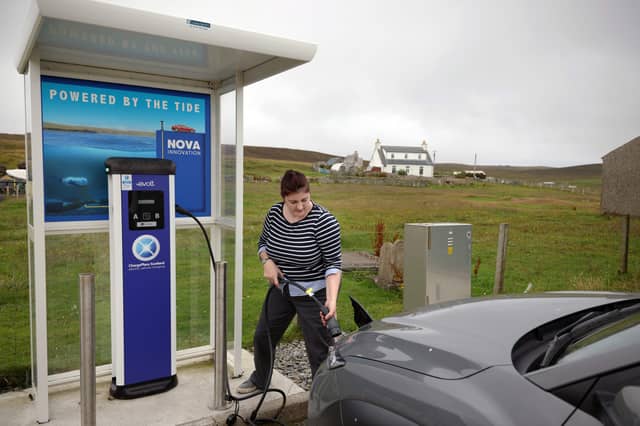

If we’re all supposed to be switching to electric cars, why are carmakers spending so much to get Scots into petrol and diesel ones?
The clean transport campaign group Transport & Environment found that, in the year to July, manufacturers offered £7.6 billion in discounts on petrol, diesel, and hybrid cars across the UK. Support for electric cars, including the UK government’s grant, came to just £3.1bn.
Carmakers complain that rules requiring them to sell more electric cars force them to discount those cars. Yet they spent more than twice as much keeping drivers on petrol. I sell only electric cars, so weigh my view accordingly.
But those rules – the zero-emission vehicle mandate – are now under review, and the outcome matters to every Scottish household. It also matters to anyone concerned about the climate emergency: transport is Scotland’s largest source of greenhouse gases.
The mandate requires a rising share of each carmaker’s sales to be electric. It isn’t just Westminster’s: it was agreed with the devolved governments, and the Scottish government is part of a UK-wide review that could cut the 2030 target from 80 per cent electric sales to 60 per cent or lower. Comments close on Friday. Holyrood has a real say and should use it.
READ MORE: The future is electric: Why the energy transition is about making progress, not sacrifices
How electric cars cut petrol prices
Carmakers put their money where they expect to make it. For many brands, petrol and diesel cars are still more profitable, and a big discount on a petrol SUV is a bet that ministers will relax the rules. Every government wobble makes that bet look smarter. Firm rules do the opposite: the discounts and newest models follow electric cars.
Weaken the rules and Britain slips down the queue for carmakers’ newest electric models. Fewer models, less competition, higher prices.
Scotland has more to lose than most. Island drivers already pay some of the highest pump prices in the UK. With oil back above $100 a barrel, families have been reminded that fuel prices are set by conflict in the Middle East, not Scotland.
Every electric car cuts oil demand for good. Together, they ease pump prices for those still reliant on petrol and diesel, from hauliers to rural drivers, and reduce the need for costly help like the fuel duty cut.
UK car factories risk getting stuck in slow lane
The market is ready. A record 99,201 fully electric cars were registered in September, 28.3 per cent of new car sales, ahead of what the rules effectively require.
Our neighbours are further ahead. In September, electric cars took 98.8 per cent of new car sales in Norway, 88.8 per cent in Denmark, 42 per cent in France and 34.5 per cent in Germany.
That matters: nearly eight in ten UK-built cars are exported. If Britain slows down, the switch happens without us, leaving our factories building petrol and diesel cars that fewer and fewer motorists want.
So, my ask of Scottish ministers is straightforward: use your seat at the table. Keep the targets on course, don’t let cars that burn petrol and diesel count as zero-emission, and don’t reopen the rules in two years. Give carmakers the certainty to put their discounts behind the cars Scotland needs.
Do that, and carmakers will stop paying Scots to buy petrol – and start paying them to switch.
Matt Galvin is managing director of carmaker Polestar UK
Comments
Want to join the conversation? Please or to comment on this article.