
Violence, swearing and 'broken' schools: The horrifying reasons why Scottish teacher is leaving to work abroad
While most children are ‘fine’, a minority of badly behaviour pupils are ‘killing education in Scotland’, according to a teacher who plans to move overseas for work

In another time, in another place, I was 23 and starting my career in teaching. A few months in, I was on lunch duty, and a boy did something wrong, I can’t remember what. I reprimanded him and he got angry and told me to f*** off.
This was a first for me and it only happened twice more in 38 years – well, to my face. I sought advice from a senior member of staff, who took the boy away. He told me later that the headmaster – after the boy admitted it – had suspended him for the rest of the week. He returned with an abject letter of apology for me, countersigned, of course, as this was 1980, by his parents.
But my story today isn’t about me, it’s about a 26-year-old teacher – let’s call him Ben – teaching PE in a state school in the Lothians in 2025. Ben always wanted to be a PE teacher (as my late grandmother would have said “it’s a guid thing we’re a’ different”) and he did his degree at Moray House with a load of other fit and healthy young people who were committed to improving the terrible health outcomes Scotland faces.
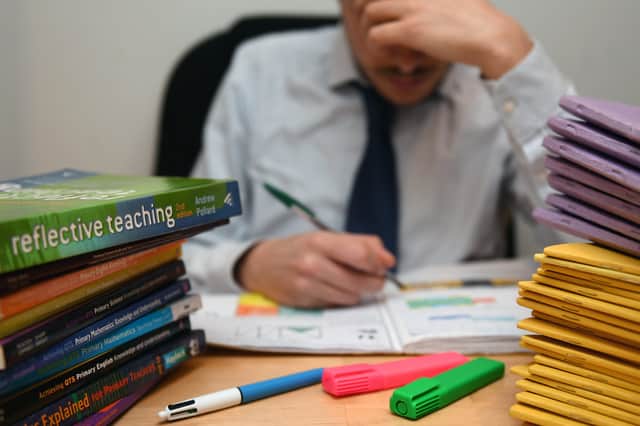

End of his tether
He did his probationary year at a state school near Stirling – “I loved it” – supported by a great faculty head. He then got a job back in the Lothians which he had for three years. But he’s stopped now; he’s not going back; he’s going to work abroad.
He knows the situation in some schools is better, but he’s at the end of his tether with Scottish education. Here are some of the things he told me during a two-hour conversation this week.
It’s PE, of course, which comes with the particular challenges of changing rooms, which he described as “awful places”. There are issues of kit, hygiene, ventilation, and the tensions associated with adolescents undressing in front of each other.
In his school, they are very short of changing space, so sometimes older kids change with younger kids. There is bullying. PE is taught in classes of 30, which seemed unbelievable to me but apparently it’s standard practice.
The smartphone problem
Let’s talk about phones. The kids “constantly take them out”. When that happens, the protocol is that the young person is given a warning. The second time, the offence is logged in the register.
For a third offence, the theoretical way forward – in the middle of teaching the other 29 in the class how to say, play volleyball – is to contact the member of the senior leadership team (SLT) who is on duty to support staff in disciplinary situations (instead, of course, of getting on with their promoted responsibility).
Ben said that most teachers never do the third step – otherwise the SLT would spend all their time dealing with this relatively trivial offence, as opposed to the more serious things like fights in the classroom.
When there is an actual fight, senior management comes and deals with it “as they see fit”. “The child can be back in your class by the end of the lesson, even if they’ve sworn at the teacher as he tried to stop the fight.”
The process of ‘restorative practice’ is being abused, Ben told me. “The intention was that it should happen when the child had calmed down, maybe a day or two later. Now, these conversations happen instantly. If you say sorry you’re back immediately.” Ben argued that this practice “spreads bad behaviour… the middle-of-the-road kids see that nothing happens so they start behaving badly.” We are “pulling them downwards”.
‘Struggling, drowning’
Absenteeism is huge. ‘High-tariff kids’ – that is the ones who, for one reason or another, are the most difficult – “rock up to class to find out what’s going on and either stay or leave” depending on whether they decide “badminton’s f***ing boring”, often accompanied by their full-time teaching assistant, who stays with them to try to prevent them from absconding from school completely.
Senior leadership is “struggling” and “drowning”, following a bad inspection report. This was how Ben summed up the current situation: “What the staff want is in conflict with what the Scottish Government and the council wants, and school management is squashed in the middle. It’s a brave head teacher who will say ‘sod you’ to the council and do it their way.”
We also talked about parents (”you only see the parents of the good kids”); the PE curriculum (”do people really care about ‘levels’ in health and well-being – nobody knows what they mean!”); about vaping; about vandalised toilets; about uniform (”rules are there but nobody pays attention”) etc.
Teachers questioning their career choice
Ben still loved the idea of teaching PE – the job he was trained to do – but added that what he will remember from his time in the school is vapes and swearing and violence and broken management. We are in, he told me, “a spiral of descent for Scotland’s teachers” even when “most kids are fine – it’s the minority which is killing education in Scotland”.
So Ben is going to teach abroad. “All my friends are questioning whether they want to carry on, particularly the ones stuck in temporary posts. Do you stick at it or change career?”
As a head teacher, it made me proud when young people said they wanted to be teachers; we need our brightest and best students to see teaching in our schools as an aspiration. But hey ho – Ben, so full of hope and energy and decency back when he started, eventually got to the point where he wouldn’t say anything to a child who told him to f*** off.
Something needs to be done before all our young teachers leave Scotland.
Cameron Wyllie is a former head teacher. He writes a blog called A House in Joppa and is the author of a book called Is There A Pigeon in the Room? My Life in Schools