
Tiny number of people who choose assisted dying shows it's no 'panacea'
Assisted dying has always got more attention than the phenomenon rightly warrants, based on the numbers likely to use it
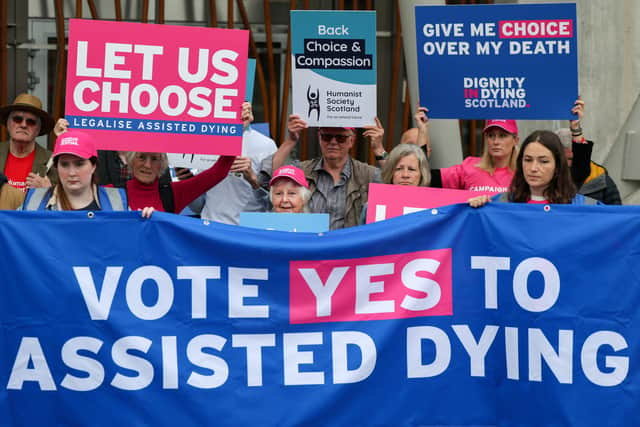
The assisted dying debate in Scotland has been running for many decades, but its latest chapter has been particularly acrimonious and heated. I write this as someone who has been studying the debate for 20 years.
However, one thing that both proponents and opponents of the Assisted Dying Bill at Holyrood do appear to agree on is that more investment is needed in end-of-life care. There has also been broad agreement that, as a society, we need to have more informed conversations about what it means to die well.
In the words of Neil Gray MSP, “irrespective of the outcome of this vote, we must use the momentum to ensure that Scotland is a place in which we can have open, honest and supportive conversations about living and dying well”.
Conversations about dying
Assisted dying as a debating topic has always taken up far more airtime, column inches and, nowadays, social media posts, than the phenomenon rightly warrants if we simply look at the numbers.
In jurisdictions which have passed assisted dying laws with equivalent eligibility criteria to those proposed for Scotland – a terminal illness and self-administration of the lethal dose – less than 1 per cent of those dying each year make use of the legislation. In California, for example, it is 0.3 per cent. As a proportion of the approximately 62,000 Scots who died last year, this would equate to very small numbers in the grand scheme of end-of-life care.
It is perhaps better to see the true impact of the legislation through its effect on conversations. In jurisdictions which have legalised assisted dying, more people discuss the option with their doctor than make an application, and more people make an application than ever ingest the lethal drugs. ‘Euthanasia talk’ can be a way of discussing end-of-life concerns and wishes more generally.
Up and down the country right now, the news stories about assisted dying are initiating conversations amongst families and friends, and there is the hope that these discussions might spill over into talking about other end-of-life scenarios.
Perhaps at a certain point in time, the controversies and heightened passions on display in the assisted dying debate might convert into a more measured and broader spectrum conversation about dying in general.
False impression
But it is also possible that assisted dying might end up being seen as the panacea for all the problems of dying in the 21st century. If the law is passed, it might give the false impression to individuals contemplating their own or a family member’s demise that they no longer need to worry about what will happen to them at the end of their life. Instead, they may imagine that if things get too bad they can apply, via the new legislation, to bring their suffering to a swift end.
But while assisted dying may start a conversation about end-of-life choices, it does not provide a realistic answer to the questions such conversations are likely to raise. In fact, the current debate has revealed considerable public and political misconceptions about what the end of a life in Scotland is like right now, as well as projected trends for the decades ahead.
The profile of dying is changing. It now takes far longer to die than ever before in human history. It may happen over many months and even years. This means people are living longer in a terminal state – in poor and declining health, and with a declining quality of life and an increasing burden of symptoms.
Some people who experience this may want to bring an end to this period of time sooner and they may actively apply for assisted dying and may be willing to self-ingest the lethal medication. But many will not have this option or will not want it.
Frailty and cognitive decline
People are dying at increasingly older ages and the proportion of those with complex symptoms of frailty and cognitive decline is also increasing. Assisted dying is never going to be an option for the current 10 per cent of people dying of dementia because they will not fulfil the mental capacity requirement laid out in the bill being discussed in the Scottish Parliament.
What about older people dying of frailty who retain mental capacity? Currently, frail older people living with multiple diseases are rarely told in any explicit way that their condition is ‘terminal’. They would therefore be unaware that they were even in a position to request assisted dying.
While many people will never be in a position to request it because of the nature of their illness, many others will simply not choose to make use of any new legislation. They would prefer to live on until natural death or to defer medical decisions to others.
All in all, assisted dying is not the panacea for all the problems associated with the end of people’s lives and will only ever be just one part of our national story about end-of-life care – and a small part at that. More reckoning with the reality of contemporary dying is needed across the board.
This debate should be the starting point, not the end point, of sensible political discussions about how we can reorganise our health and social care system so that it is fit for the growing number of dying Scots and the illnesses they will be dying of.
Dr Naomi Richards is director of the End of Life Studies Group at the University of Glasgow and has researched assisted dying on and off for 20 years. She is a senior lecturer and a social anthropologist by training.
Comments
Want to join the conversation? Please or to comment on this article.