
The shot in the dark in July 1940 that robbed Edinburgh of one of its finest police officers
In July 1940, Assistant Chief Constable Robert Thomson, the rising star of Scottish policing, was being driven into central Edinburgh to co-ordinate civil defence teams during a night-time air raid when a drunken RAF sergeant decided to set up his own roadblock
July 1940 was probably the darkest month in this country’s history. With only military reverses to count in the Second World War, Britain stood on the brink of invasion. The Battle of Britain had just begun. It was to be a brilliant victory, but at the time it seemed like a desperate defensive struggle.
Eastern Scotland was on the front line. Within easy reach of Luftwaffe bombers and with shallow sloping beaches, we were considered a prime invasion site.
But, contrary to popular myth, we had not been caught napping. From the mid-1930s, defence plans had been drawn up with numerous anti-aircraft batteries around Edinburgh and two Spitfires squadrons nearby.
The man chosen to lead on civil defence was Edinburgh Assistant Chief Constable, Robert Thomson. At only 39, he was the rising star of Scottish policing.

False alarms and accidents
Intelligent and a brilliant organiser, he had the people skills that allowed him to bring a host of different groups together – police, special constabulary, firefighters, ambulance, salvage squads, and air-raid wardens. It was a brilliant effort by Thomson and his team and, amid growing air-raid warnings, it needed to be.
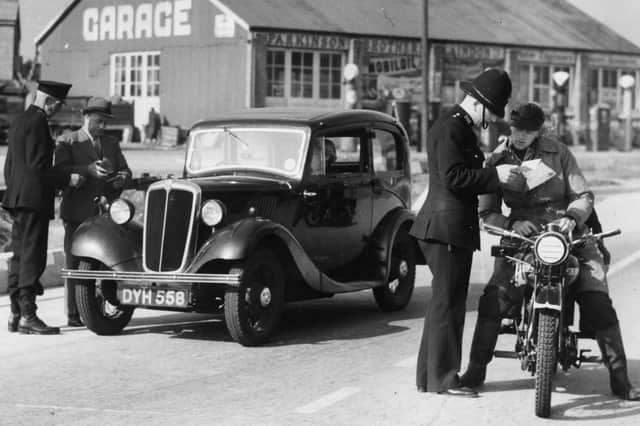
The rigorously enforced blackout caused problems. With no street lighting and vehicles only allowed tiny ‘slit ‘ headlights, accidents and injuries were common. With tensions high, there were numerous false alarms. In summer 1940, there were numerous sightings of enemy parachutists and crashing planes, none of which were true.
By this time, ACC Thomson was working round the clock. By day he worked to keep his civil defence partners on their toes, by night, whenever an air-raid warning sounded he would attend police HQ to command the response.
When the air-raid alert went off at midnight on July 12, after several previous raids, all went wearily to their posts or designated shelters, while Thomson was picked up from his Portobello home for another long night.
A cruel trick of fate
But on this night, a rogue actor appeared on the scene. RAF sergeant Alexander Macpherson was home on leave in Edinburgh. He had been out drinking in the Northfield pub and decided to carry out an impromptu road check on Willowbrae Road near his home.
With a loaded rifle, he positioned himself at a main road junction just as the police car carrying ACC Thomson drove towards the city. Macpherson tried to wave the car down but the lighting was poor and the car sped by.
Drunk and angry, the RAF man took a wild shot at the passing car. A drunken, unaimed shot in the dark of the night at a fast-moving target should have missed everything, but by a cruel trick of fate the bullet caught ACC Thomson in the jaw causing a severe but survivable injury.
However, it was not to be, and he died of his wounds three days later, the most senior British police officer ever killed in the line of duty. His death was more than a personal tragedy. It was a grievous blow to Scottish policing. He would undoubtedly have led the service through the difficult post-war reforms.
As it was, this brilliant young officer was another victim of ‘the fog of war’ at a time of our greatest peril.
Tom Wood is a writer and former Edinburgh police officer. His latest book is The Bombing of Edinburgh & Leith 1939-42
Comments
Want to join the conversation? Please or to comment on this article.