
How we can still beat climate change despite rogue states blocking progress – Professor Frank Biermann
As Donald Trump’s America and other nationalist leaders dismiss serious environmental problems, the world needs nimble coalitions of like-minded countries to step up
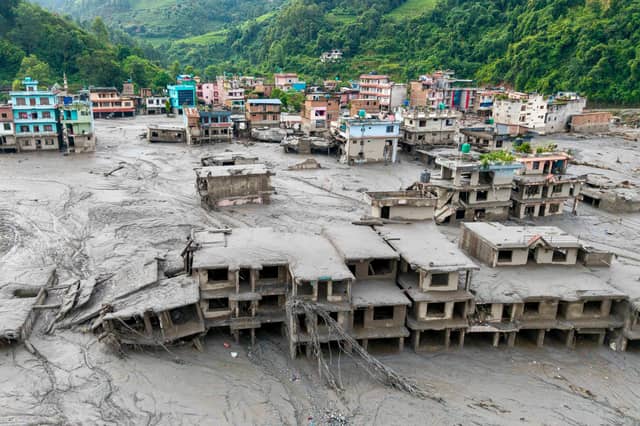

Global environmental politics is in crisis. Seven of the nine planetary boundaries have been breached, and global warming is close to the dangerous threshold of 1.5 degrees Celsius. Heat waves in Europe and devastating floods in Nepal are early warnings of a planetary emergency that our politics are failing to address.
In 2025, the global negotiations for a plastics treaty ended without result, and the United Nations climate negotiations could not agree on a roadmap to phase out fossil fuels. The 17 Sustainable Development Goals, launched by the UN in 2015 with great fanfare as an agenda to “transform our world”, are now in urgent need of a “rescue plan”, according to the UN Secretary-General. Only 36 per cent of assessable SDG targets are on track or show some progress; 15 per cent have even fallen below their 2015 baseline.
To make things worse, nationalist and anti-environmentalist movements are gaining ground. After Donald Trump returned to the US presidency in January 2025, his administration announced the US withdrawal from several international organisations and environmental treaties, including the Paris climate agreement. The Trump administration also cut international funding programmes, rolled back domestic climate policies, and stated that it would “reject and denounce” the Sustainable Development Goals.
World can’t rely on universal agreements
In this crisis, we must rethink global sustainability governance. Since the outset, a common assumption has been that all countries would work together to address these challenges. Whenever a new environmental problem emerged, there would be international negotiations about reaching a universal agreement.
This traditional assumption no longer holds, unfortunately. Today’s politics can no longer rely on the expectation that broad global cooperation with universal participation is still possible. Instead, we need to look for alternative strategies to cope with geopolitical rupture and the disengagement of major powers. Now is the time for smaller coalitions of countries to build powerful institutions to safeguard our planet.
In international politics, such coalitions of like-minded countries are described as ‘plurilateral’. They are not universal, but can still bring together a sizeable group of countries, more so than purely regional approaches. This is never the ideal, and universalism remains preferable. But given the planetary crisis, solutions are urgently needed. Plurilateralism can help overcome nationalist and anti-environmentalist political movements that are holding back international cooperation.
For example, when a universal agreement on phasing out coal, gas and oil proved impossible during the UN climate negotiations, a group of countries organised a separate ‘Conference on Transitioning Away from Fossil Fuels’ in Colombia in April, with a follow-up event planned next year.
There is hope that this new network of like-minded countries can lay the groundwork for a plurilateral agreement on phasing out fossil fuels. Such a fossil fuel treaty has long been advocated by thousands of civil society organisations, over 3,000 scientists, 101 Nobel laureates and 18 countries from the Global South.
Plastic pollution and solar geoengineering
Plurilateralism may also give a new drive to global politics on plastic pollution. Following the failure of the UN negotiations to reach an agreement on a treaty, countries most committed to regulating plastic use and production could now move forward with their own agreement.
Another example is the initiative by African countries to establish a global governance mechanism about solar geoengineering. While a few scientists in the Global North want to explore geoengineering technologies to artificially cool the planet, African countries firmly advocate a non-use agreement on geoengineering, with support from Fiji, Vanuatu and other nations in the Global South. This political initiative is, again, an attempt to create a plurilateral agreement among smaller coalitions of like-minded countries, given the current lack of universal consensus.
Plurilateralism can even be a promising approach to rebuilding the United Nations. When the world organisation was established in 1945, it was not designed with today’s planetary challenges in mind. Numerous civil society leaders and academics are thus calling for a revision of the UN charter. Such a revision, however, would need the consent of the major powers, including the US and Russia, which seems improbable at best.
But alternative approaches are possible. Many reforms could be achieved by nimble coalitions of like-minded countries, as long as they can muster a majority at the UN. For example, the General Assembly could establish by majority vote a strong Council on Sustainable Development to strengthen oversight of SDG implementation.
The assembly could also create a novel Planetary Stewardship Council to assess the state of the planetary commons, including major ice sheets and monsoon systems, and recommend political responses where needed.
Won’t be easy
Such reforms would not find the support of all major powers. Yet this would not be necessary either: plurilateral coalitions of like-minded countries, in novel alliances spanning the Global South and the Global North, could move forward without universal support. Such coalitions could also experiment with innovative political mechanisms beyond the existing system of state representation. For example, stronger roles for civil society, Indigenous peoples or the scientific community could be introduced at the UN even without the support of some ultranationalist countries.
In short, there are numerous ways to advance an ambitious agenda for planetary politics amid today’s geopolitical tensions and conflicts. It will not be easy. And yes, universal cooperation will remain the holy grail of global sustainability governance.
But where consensus is impossible and rogue powers retreat from international cooperation, plurilateral alliances of like-minded countries can and must work together to strengthen international cooperation and protect our planet.
Frank Biermann is professor of global sustainability governance at Utrecht University and director of a new research programme, ‘Plurilateral Planetary Politics’, funded by the European Research Council. On Wednesday, October 21, he will deliver the 47th TB Macaulay Lecture in the National Museum of Scotland in Edinburgh.
Comments
Want to join the conversation? Please or to comment on this article.