
How UK energy plan could put thousands of North Sea jobs and billions in investment at risk – Bob Sanguinetti
Floating windfarms represent a major opportunity for Aberdeen and Scotland but only two out of six plans being considered by the UK government properly support the industry and provide the necessary grid connections
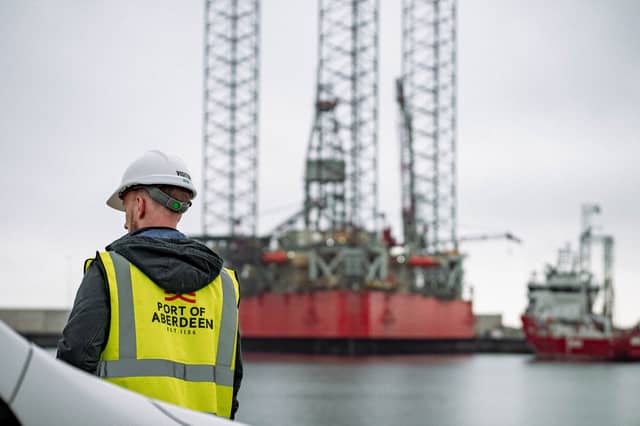

Since 1136, Port of Aberdeen has stood at the gateway between Scotland and the North Sea. Its unforgiving but bountiful waters have tested generations of seafarers, powered industries and helped shape the fortunes of communities along its shores.
That relationship has, for the last half century at least, been defined by oil and gas, the industry that transformed Aberdeen into an international energy hub. During that time, Port of Aberdeen has served as a critical base for offshore operations, and these will remain central to our activity for years to come. But, as a business with almost 900 years of history, we know that standing still is not an option.
Our future, as ever, lies in looking out to sea. As the UK seeks to harness its enormous renewable resources, floating wind – which can be placed in deeper waters, out of reach of fixed bottom turbines – represents a substantial opportunity for Scotland plc.
We are already home to the world's largest, grid-connected floating windfarm, just a few miles from the Granite City. While it only comprises five turbines – some planned ScotWind projects will run into the hundreds – the Kincardine Floating Offshore Windfarm is a bold first step, a statement of intent and an illustration of potential.
If projects progress as planned, it should be just the start, but realising the full potential of this generational pipeline of work depends on resolving a niche but critical policy issue that threatens to hold it back.
Enough energy for 16 million homes
In Scotland alone, Crown Estate Scotland’s ScotWind and Intog offshore wind leasing programmes – the results of which were released in 2022 and 2023 respectively – have led to the creation of 23.5 gigawatts (GW) of floating potential. For context, 1GW of capacity is enough to power nearly 700,000 homes, based on the Scottish government's Renewable Electricity Output Calculator. Fully realised, Scotland’s floating pipeline could provide enough energy for over 16 million UK homes.
While ScotWind opened up areas of Scotland’s seabed for commercial-scale offshore wind development, Intog was designed to encourage smaller, innovative projects and those dedicated to supplying green energy directly to North Sea infrastructure – a must if the UK’s oil and gas industry is to continue trimming its operational emissions.
Our £420 million South Harbour opened in September 2023 and we’re now around 90 per cent ready to service Scotland's floating wind pipeline, backed by more than 50 years of expertise in the offshore-energy supply chain.
READ MORE: Stalled floating offshore wind projects risks leaving Scottish ports as 'stranded assets'
Building on this capability, we are exploring the opportunity to become a major component replacement hub. This shared industry facility would go a long way to answering the vital question of how floating assets in deeper water, with a multi-decade lifespan, will be maintained, a prerequisite before developers commit their cash to these projects.
A turbine would be disconnected offshore, towed into the hub, secured alongside the quay, repaired and towed back to site. Developers could reserve crane capacity for planned maintenance, while it would also be available for unexpected repairs.
Aberdeen, the closest major port to 80 per cent of the ScotWind and Intog floating pipeline, is the natural location for such a facility. We invested in South Harbour to support this critical industry, but it needs policy to deliver the projects.
READ MORE: North Sea chief demands action from Andy Burnham to open 'bigger pipeline' of oil and gas projects
The stakes are huge
The UK government is in the process of finalising its Strategic Spatial Energy Plan, a long-term national blueprint that will determine where Britain's offshore wind gets built and connected. In the coming months, the National Energy System Operator, the independent body responsible for operating and planning the country's energy systems, will present UK Energy Secretary Miatta Fahnbulleh with six possible strategic pathways.
Of those half dozen options, only two properly support Scotland’s offshore wind pipeline and the grid connections it depends on, and even they may not provide the conditions needed to unlock the full potential of floating wind.
Should another pathway be selected, a significant portion of Scotland’s offshore wind pipeline – on which hopes for a just transition for oil and gas workers rest – risks being delayed, scaled back or quietly shelved. Trade bodies and unions put the stakes at more than 21,000 potential jobs a year and tens of billions of pounds of investment.
Great British Energy, the publicly owned energy investment vehicle, is already exploring how a shared major component replacement hub could be delivered, but any inaction on delivering floating wind will come with a real cost for the domestic supply chain.
READ MORE: Record-breaking cable ducts length of Edinburgh’s Royal Mile completed at giant North Sea wind farm
Building a genuine industry
Floating structures in Scottish waters have, to date, been almost entirely repaired in the likes of Denmark, the Netherlands and Norway. Cooperation will always be part of the energy sector and that means working with our neighbours across the water, as Port of Aberdeen has for hundreds of years, but we mustn’t forget we’re competing globally.
We must realise value for our supply chain and deliver for our workforce. More bluntly, our established offshore expertise means we should be able to service Scottish offshore wind in Scotland.
Ports and harbours, from Lerwick to Leith, need the UK government to adopt an energy plan that gives ScotWind and Intog projects the grid connections they need.
Beyond that, ministers must back Aberdeen as Europe’s Capital of Energy Excellence – by making it home to a shared major component replacement hub, ensuring Scotland’s energy supply chain captures as much floating wind work as possible – and work with Port of Aberdeen and floating wind developers to turn a disparate collection of projects into a genuine industry.
We have served the North Sea since 1136. Floating wind is the next chapter and the decision on where it is built is being made now. Let's make sure the new map includes the ports and skills ready to deliver it.
Bob Sanguinetti is chief executive of Port of Aberdeen
Comments
Want to join the conversation? Please or to comment on this article.