
How to cut £320 billion from electricity bills and save Scotland from renewables 'goldrush' – Murdo Fraser
At last, we have an energy policy that can deliver meaningful reductions to people’s bills, writes Murdo Fraser

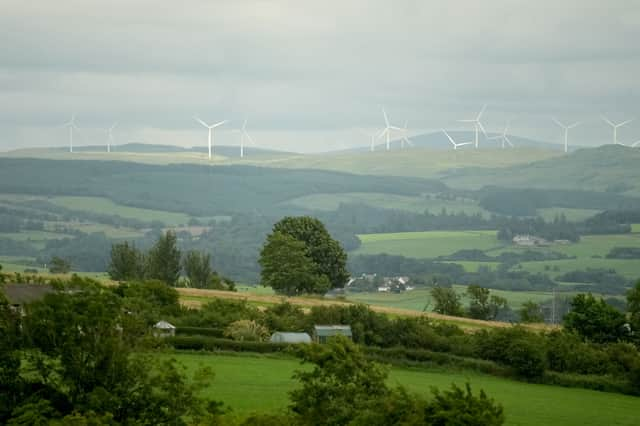
This weekend, the Convention of Perth and Kinross Community Councils will meet to discuss their concerns about the impact of renewables' infrastructure on local communities. This reflects widespread concern across the area, part of the region I represent at Holyrood, about the number of planning applications coming forward for windfarms, solar projects, and battery storage, together with associated infrastructure.
It will be the latest in a series of conventions held in the Highlands, Borders, South of Scotland and Shetland. Well over 200 community councils across the country have now agreed a unified statement, originally drawn up by a Conservative councillor for the Highlands, Helen Crawford, calling for a pause in renewables projects until a national plan is put in place for energy policy.
What we are currently seeing is described by some as a “Wild West” approach with communities feeling deluged by planning applications, and local planning committees having to try and determine these without any real sense of how all this fits into a national energy policy.

Rapid de-industrialisation
The concerns of these community councils are well founded. The UK today faces a perfect storm in relation to energy policy. Our bills are too high and our electricity costs are the highest in Europe.
As a consequence, we are seeing rapid de-industrialisation as heavy users of energy vacate to countries with lower energy costs. These moves reduce our overall carbon emissions and make us look good, but all we are doing is exporting the carbon cost to other countries, such as China.
At the same time, households are seeing record energy bills, and the cost to individuals decarbonising by installing, for example, solar panels or heat pumps, remains unattractively high.
The former Labour energy minister at Westminster, Ed Miliband, was obsessed with renewable energy, and his replacement Miatta Fahnbulleh appears to be adopting a similar approach. This is simply contributing to the ongoing issues with the high cost of energy facing both business and households.
A compelling case
Thank goodness, then, for the Shadow Energy Secretary Claire Coutinho, who last week launched the most detailed energy analysis ever produced in British politics. Researched by the think tank Onward, and drawing on experts in the field, the ‘Firm Foundations’ report makes a compelling case for cheap and reliable power, which will reduce energy costs and provide security of supply for the future.
Coutinho identifies that, whilst well intentioned, net-zero legislation has actually been counterproductive in delivering an energy system that meets our needs whilst reducing emissions. It has driven up costs and exported our industry to more polluting countries. A different approach would, she argues, save over £320 billion on our electricity bills by 2050, representing a staggering £540 per household every year for the next two decades.
This sounds too good to be true, but the report sets out practical steps as to how it might be achieved. It starts by addressing the misconception that renewable energy is cheap compared to other sources.
Because of the issue with intermittent generation from wind and solar, we have been building an expensive electricity system that requires massive investment in not just generation assets, but transmission, storage and interconnectors in addition. The “whole system cost” of electricity generation based primarily on renewables has to take account of all these additional factors, driving bills upwards.
The energy ‘trilemma’
As Onward argues, adding intermittent renewable capacity does not displace the need for reliable generation to ensure security of supply. This means that effectively two generation systems are required, not one. There needs to be reliable gas-powered back-up for wind and solar power for the times that the sun doesn’t shine or the wind doesn’t blow. And these gas generators need to recover their fixed costs, meaning higher prices even when they are not directly contributing to the energy mix.
The current system leads deliberately to overbuilding of capacity, which is one of the reasons we see so many planning applications coming in for wind and solar in sites across Scotland. But these resources are located far away from the highest centres of demand in the south of England, meaning vast sums having to be spent on transmission upgrades.
So what would an alternative approach look like? All those involved in energy policy struggle with what is known as the “trilemma”, balancing security of supply, affordability, and decarbonisation. Net-zero targets have prioritised decarbonisation at the expense of cost, leading to record high bills for consumers and businesses.
Why France has cheap electricity
The Onward report argues this needs to change, with a priority given to the delivery of cheap, reliable electricity, and with a lower emphasis on decarbonisation. This would involve an end to new policy support for renewable energy, storage and interconnector projects from 2030, although existing contracts would be honoured.
Crucially, 20GW of nuclear capacity would be promoted by 2050, ensuring that nuclear becomes a core component in energy policy, as it has been for many years in France (which, incidentally, has Europe’s lowest electricity prices). There would be an ongoing role for gas to provide the necessary back-up for renewables.
Of necessity, a greater proportion of the new generator capacity would be located closer to demand and utilise existing transmission infrastructure, saving billions on network expansion and balancing costs.
The cost savings from adopting this approach would be significant. It would also encourage greater take-up of electric heating systems, such as heat pumps, as electricity would become more competitive compared to gas or oil.
It all represents a credible policy to tackle the ongoing problems with our energy supply, providing security for the future, and, crucially, significantly lower bills, whist promoting decarbonisation. And it would help end the wind ‘goldrush’ affecting communities across rural Scotland that is so exercising the community councils of Perth and Kinross and elsewhere.
Murdo Fraser is a Scottish Conservative MSP for Mid-Scotland and Fife
Comments
Want to join the conversation? Please or to comment on this article.