
How the UK is finally standing up to Iran’s terrorist regime – Struan Stevenson


The UK has at last acknowledged the true character of Iran’s Islamic Revolutionary Guard Corps, but now comes a greater challenge
Britain has finally found its voice. After years of hesitation, equivocation and diplomatic contortions, the UK has designated Iran's Islamic Revolutionary Guard Corps (IRGC) under its new State Threats regime, acknowledging what millions of Iranians, together with intelligence agencies across the democratic world, have understood for decades. The IRGC represents the beating heart of the world's foremost state sponsor of terrorism.
The obvious question remains – why did Britain wait so long? The United States led the way by designating the IRGC in 2019. Canada followed. Australia adopted a similarly robust position. The European Union steadily tightened sanctions against the Guard Corps, its commanders and its financial empire.
Britain lingered at the back of the queue, clinging to the illusion that restraint and quiet diplomacy might somehow temper Tehran's behaviour. Successive governments feared upsetting a regime with which Britain still maintains diplomatic relations through its embassy in Tehran. Appeasement became official policy, wrapped in the comforting language of engagement.
Experience has exposed the bankruptcy of that approach. Since its creation by Ayatollah Ruhollah Khomeini in 1979, the IRGC has never resembled a conventional military force. It exists for one over-riding purpose, preserving clerical rule at any cost.
An iron fist synonymous with fear
Loyalty to the Supreme Leader has always outweighed loyalty to the Iranian people. Its mission extends far beyond defending Iran's borders. It crushes dissent at home, exports revolutionary extremism abroad and spreads instability across an entire region.
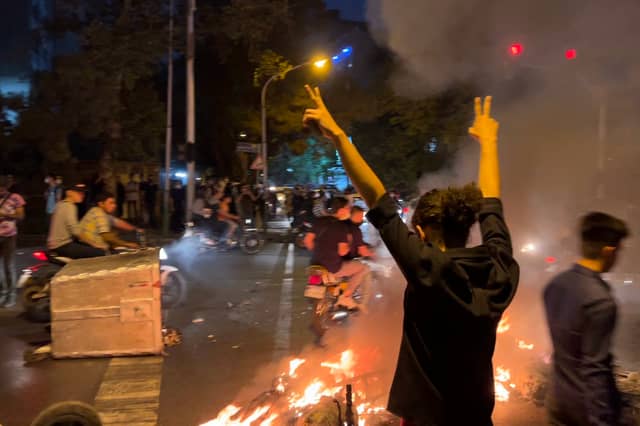
Every Iranian generation has felt the IRGC's iron fist. The Basij militia, under IRGC command, has terrorised students, women, workers and peaceful demonstrators for decades. During the 2009 Green Movement, nationwide protests in 2019 and the 2022 “Woman, Life, Freedom” uprising that followed the killing of Mahsa Amini, the regime answered calls for liberty with live ammunition, mass arrests, torture, executions and disappearances. Children, teenagers and young women joined the long list of victims. The IRGC has become synonymous with fear.
Its record reaches further back. During the summer of 1988, more than 30,000 political prisoners were executed after summary proceedings lasting minutes. Human rights organisations describe those killings as one of the modern Middle East’s gravest atrocities. The machinery of repression established during those dark months never disappeared, it simply evolved.
IRGC’s global reach
Across the wider Middle East, the Guard Corps has perfected the use of proxy warfare. Through its elite Quds Force, it created, trained and armed Hezbollah in Lebanon, sustained Bashar al-Assad's dictatorship in Syria, supported Hamas and Palestinian Islamic Jihad, strengthened Iraq’s Shia militias and transformed Yemen’s Houthis into a formidable military force threatening international shipping and regional stability.
From Beirut to Baghdad, Damascus to Sana'a, the fingerprints of the IRGC appear wherever conflict, sectarian violence and political intimidation flourish.
Investigations have linked Iranian operatives or their proxies to violent plots stretching back decades, including the bombings of the Israeli Embassy and the AMIA Jewish community centre in Buenos Aires and the Mykonos restaurant assassinations in Berlin in the early 1990s, and repeated plots targeting dissidents living across Europe and North America.
British security services have revealed multiple Iranian-linked plots against people in the UK. Tehran's message has remained chillingly consistent: critics remain within reach wherever they seek refuge.
A military dictatorship
Meanwhile, the IRGC has transformed itself into an economic empire. Through vast construction companies, energy interests, banking networks, telecommunications firms and countless front companies, it dominates huge sectors of Iran's economy. Military commanders have become business oligarchs. Political influence, commercial wealth and armed power have merged into a single structure answerable only to the Supreme Leader.
Following the death of Ayatollah Ali Khamenei, that concentration of power has increased. Mojtaba Khamenei may have emerged as the regime's preferred successor, yet he lacks both the religious authority and revolutionary stature of his father, and has been virtually invisible since his death. Real authority increasingly resides with senior IRGC commanders whose influence reaches every institution of the Iranian state. Today's Iran increasingly resembles a military dictatorship cloaked in clerical robes.
That reality makes Britain's decision both welcome and overdue. For years, Western governments drew an artificial distinction between the Iranian regime and the organisation responsible for enforcing its will. Such a distinction has always been fictitious. The IRGC forms the regime. It protects the regime. It finances the regime. It exports the regime's ideology.
Separating one from the other serves little practical purpose. The UK’s designation also carries profound symbolic importance. For courageous Iranians risking imprisonment and death in pursuit of freedom, international recognition of the IRGC's true nature demonstrates that their sacrifices have reached beyond Iran's borders.
Every woman refusing compulsory veiling, every student demanding democracy, every worker challenging corruption and every political prisoner enduring solitary confinement deserves that message of solidarity.
Abandon the failed policies of the past
Yet symbolism alone will never suffice. Britain should move rapidly to dismantle the IRGC's financial networks, expose its front companies, freeze every available asset, prosecute those providing material support and strengthen protection for Iranian dissidents in Europe.
Dialogue without consequences has delivered four decades of expanding repression and international aggression. History offers an unmistakable lesson. Every concession granted to Tehran has encouraged greater adventurism. Every hesitation has invited further escalation. Appeasement has repeatedly failed because the regime interprets compromise as weakness and restraint as opportunity.
Britain has finally acknowledged the IRGC’s true character. That decision deserves recognition. Now comes the greater challenge. The democratic world must abandon the failed policies of the past, stand firmly beside the Iranian people – rather than their oppressors – and ensure that this long-overdue designation marks the beginning of a coherent strategy rather than another symbolic gesture destined to fade into diplomatic history.
Struan Stevenson, who served as an MEP and chair of the Friends of a Free Iran Intergroup, is an author and international lecturer on the Middle East
Comments
Want to join the conversation? Please or to comment on this article.