
How tech companies are failing to keep Scotland’s children safe from online paedophiles, porn and misogyny
The scale of risk and harm that children currently face online is unacceptable, writes Joanne Smith of NSPCC Scotland
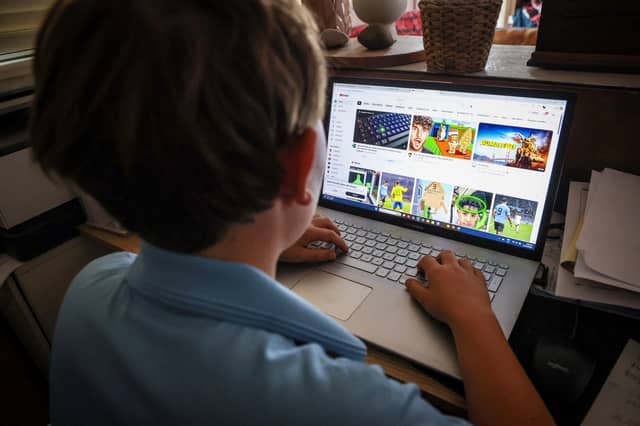

Over a third of adults in Scotland recently named online harms as the greatest risk facing children in a survey commissioned by NSPCC Scotland. The Savanta poll, of over 1,000 adults, also found that the majority (54 per cent) believed the risk of abuse to children was greater now than when they were growing up.
We are publishing this data as part of the charity’s call to all political parties, ahead of the Scottish Parliament election in May, to work together to prevent child abuse and neglect to improve the lives of babies, children and families.
Online safety is one of NSPCC Scotland’s priorities in its recently published Five‑Point Plan for Prevention. This plan offers a roadmap that the next Scottish Government could implement from day one to help keep children safe.
The internet is increasingly becoming a part of children’s lives. They learn, play and socialise online, and enjoy many benefits from social media, messaging apps, gaming and other digital platforms. Children often don’t distinguish between their online and offline lives – both shape who they are.
Record levels of child sexual abuse images
Young people have a right to be safe in the virtual world, but the NSPCC is concerned about the risk of them being exposed to a variety of online harms such as disinformation, pornography, misogynistic content, and bullying. The scale of risk and harm that children currently face online is unacceptable. It is crucial the risks that they face are addressed.
Child sexual abuse image crimes logged by Police Scotland reached record levels last year, with more than 828 offences in 2024/25 – 11 per cent higher than the previous year – while 3,158 offences of communicating indecently with a child were recorded by Police Scotland between 2020 and 2025.
Two recent rulings in the United States have brought renewed attention to the fight to protect children online. In one case, Meta was hit with a fine for hundreds of millions of dollars for misleading users about how safe its platforms are for young users. In another, Meta and Google faced legal action over claims that addictive design features harmed a woman’s mental health when she was a child.
Together, these cases underline the ongoing failure of tech companies to safeguard children and families, with young people still routinely exposed to sexually explicit content, contact from dangerous adults, and other risks that could be prevented.
Scottish Government must act
Effective regulation of social media – a power reserved to Westminster and introduced through the Online Safety Act – is vital but not the only solution. The Scottish Government must play their part too. Devolved child safety online policy must keep up with the fast‑changing digital landscape, including the challenges posed by generative AI.
NSPCC Scotland wants to see a Scotland‑wide approach that brings together early years, education, child protection, the voluntary sector and law enforcement to keep children safe online. We want the next Scottish Government to provide clear leadership on prevention and recovery efforts by retaining a strong and ambitious National Child Safety Online Action Plan, updated annually and aligned with the Online Safety Act, as part of a wider public health approach to preventing child sexual abuse.
We would also like formal mechanisms to be established to ensure children and young people are consulted. It is crucial that their views and experiences are placed at the centre of developing and implementing online safety policy.
While we wait for legislation from Westminster, we also call on the Scottish Government to set up a Strategic AI Advisory Group to provide expert advice to ministers on how AI is used across the public sector, ensuring child safety and equality are built into all national activity in this area.
Our Read, Write, Relationships campaign, which calls for mandatory healthy relationships' education in schools across Scotland, is another of our priority calls to help keep children safe on and offline. Right now, Scotland is the only part of the UK where this vital education is not required by law.
While Relationships, Sexual Health and Parenting (RSHP) education is part of the health and wellbeing area of Curriculum for Excellence, local areas have discretion about what is taught and when. Through our work with young people, we know that RSHP can be inconsistent, patchy, and often fails to cover the issues that matter most to them.
We believe learning about healthy relationships should be a core entitlement for every child – just as fundamental as learning to read and write. Young people are often exposed to inaccurate representations of healthy relationships and sex online, and if this isn’t discussed, they could develop an unhealthy view of how these things should work in the real world.
RSHP helps children to recognise healthy and unhealthy relationships and abusive behaviours in others and themselves. Without high quality education on this topic, we fear that many children may be missing out on vital knowledge that could protect them from harm and abuse.
That’s why we’re calling on whoever forms the next Scottish Government to keep children safe by ensuring all pupils have access to high‑quality, consistent and relevant relationships education. We would also like schools to receive more detailed guidance on the subject so there is consistency in the way it is taught.
Scotland has long aspired to give all children the best possible start in life, so we urge the next government to make our youngest members of society a priority and make this a reality.
Joanne Smith is NSPCC Scotland’s policy and public affairs manager. For more information, see NSPCC Scotland’s Five-Point Plan for Prevention. Young people, up until their 19th birthday, can contact Childline on 0800 1111 or visit Childline.org.uk about any of the issues mentioned.