
How humanity is about to enter climate danger zone with 'catastrophic risks' for billions
As global temperatures keep rising, humanity seems determined to sleepwalk into a world that is becoming increasingly hostile


It’s never too late to act – until it is. As a teenager, the snooze button was my best friend and I would repeatedly hit it until there was no time left for much besides throwing on my uniform, brushing my teeth and running out the door to school.
In my first year at university, I learned to time it so well that I used to follow the lecturer into his 9am class, arriving at my seat at the back just as he began talking. However, in the third term, I made it to just one 9am class and was fortunate that the subject discussed on that particular day came up when I resat the exam.
So I understand very well the all-too-human temptation to delay taking action, to think “just five minutes more” won’t hurt, even when the consequences of repeated delays could be profound.
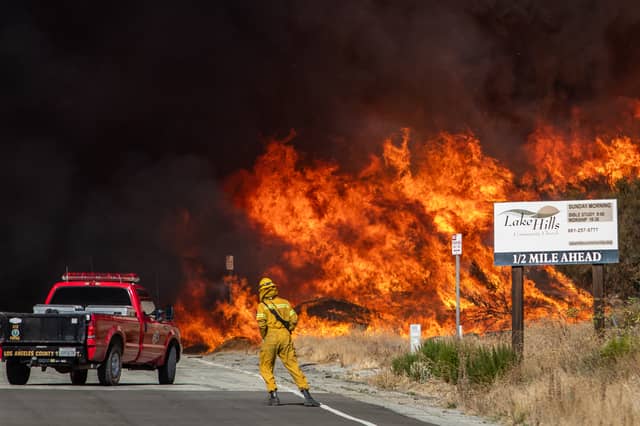
This has essentially been humanity’s story since scientists issued the first real warnings about climate change 40 years ago. After some resistance, most people eventually accepted that global warming was real and we had to do something about it. However, by repeatedly putting off making the difficult but necessary changes to the way we live, we have arrived at a point where global temperatures are about to break through the threshold that scientists warned us to stay within.

Earth heading for terrifying tipping points
There are those who still think it’s possible for the world to remain below a long-term average of 1.5 degrees Celsius of warming. But they are simply not living in the real world, which has already exceeded 1.5C of warming for a year and where global greenhouse gas emissions are continuing to rise.
The main reason for the 1.5C target was to avoid ‘tipping points’ in which the natural world starts to react to global warming in ways that amplify our inadvertent efforts to increase the planet’s temperature or set in train natural processes with devastating consequences.
READ MORE: Giant Scottish strawberries may look delicious - but the changing climate is a flashing red light
In a joint statement after the recent Global Tipping Points Conference, scientists wrote: “Global warming is projected to exceed 1.5C within a few years, placing humanity in the danger zone where multiple climate tipping points pose catastrophic risks to billions of people... every fraction of additional warming dramatically increases the risk of triggering further damaging tipping points.” You may wish to read that again.
It is thought that tropical coral reefs have already crossed their own tipping point and are now experiencing “unprecedented dieback”, with knock-on effects for many marine species and the people who depend on them for food.

The Grapes of Wrath
Public sympathy for coral may be limited, but there are other tipping points that should terrify us all. With the biggest one for the UK last, here are a selection of three from scientists who attended the conference:
Professor Gabi Hegerl, chair in climate system science at the University of Edinburgh, wrote about the dangers of “breaching thresholds for heat or drought that then ripple into food availability, livelihood and ecosystems... I did a research project on the US Dust Bowl and the trigger was drought causing vegetation and crop dieback, [leading to] extreme heat and dust storms in response – and migration, as memorialised in [1939 John Steinbeck novel] The Grapes of Wrath. And, now with warming, all droughts get supercharged.”
Professor Carlos Nobre, a meteorologist who led a major study of the Amazon, said that a mass dieback event affecting the giant rainforest could release about 250 billion tonnes of carbon dioxide into the atmosphere by 2100, as well as resulting in the loss of the largest source of biodiversity on the planet.
Collapse of monsoons
If that’s not scary enough, the collapse of the Atlantic Meridional Overturning Circulation, a giant ocean current, would plunge the UK and much of northwest Europe into prolonged, severe winters while also affecting much of the world’s climate.
Professor Tim Lenton, chair in climate change and Earth system science at the University of Exeter, wrote: “By our own calculation, we could have less than half the viable area for growing a couple of major staple crops, wheat and maize worldwide. We would have a widespread water crisis.
“We could have collapses of the monsoons in West Africa and India that would displace hundreds of millions of people. It is hard to see that as anything other than a catastrophe.”

Science deniers
Well, quite. The problem is that such apocalyptic visions seem all very theoretical to lots of people and there also seem to be growing numbers of people who are in outright revolt against science itself, as seen in the rising concern about measles.
Largely because of one comprehensively discredited study and some delusional conspiracy theorists, we have lost the ‘herd immunity’ produced by 95 per cent vaccination rates, meaning that babies too young to be inoculated and others unable to get the vaccine are at risk of catching this potentially deadly disease.
Following the recent death of a child in Liverpool, Merseyside health officials issued an open letter stressing the safety of the MMR vaccine which gives “lifelong protection against measles, mumps and rubella”. “Studies have shown there is no link between receiving the vaccine and developing autism spectrum disorders,” they added, underlining the persistence of this debunked but still dangerous urban myth.
In a world where humans are turning their backs on life-saving vaccines because of unscientific nonsense, what hope is there that enough people will listen to the warnings of climate scientists and do what is required? Much easier to suppose that it will all be fine.
When I missed all but one lecture of that third term, I rolled a 30-sided dice with my future and came up lucky. As global temperatures and greenhouse gas emissions continue to rise, humanity keeps pressing the snooze button on truly confronting what is an existential threat. So, with the risks only getting bigger, how sleepy – or how lucky – do you feel?
Comments
Want to join the conversation? Please or to comment on this article.