
Euan McColm: Andy Burnham has put John Swinney and SNP on back foot with devolution drive
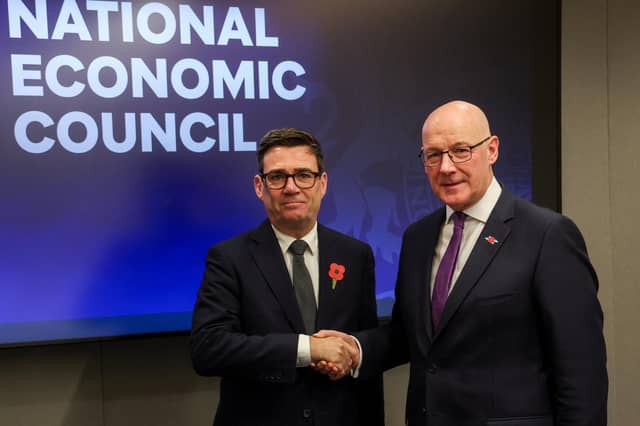

First minister must have had gritted teeth when forced to pledge to work ‘constructively’ with Andy Burnham after Glasgow get-together
His teeth must have been gritted so hard it’s a wonder he was able to speak a word. Normally, we would expect John Swinney to have nothing but negative things to say about a UK prime minister. Accusations of neglecting Scotland are routine, after all.
But, following a meeting with Andy Burnham in Glasgow on Friday, the first minister forced a smile and claimed he was ready to do business with him.
Swinney pledged to work “constructively and collaboratively” with the prime minister on his much-trumpeted devolution agenda. Their meeting had been a “welcome start”.
Behind the bonhomie, however, Swinney was surely fizzing.
Burnham’s decision to hold a meeting of his recently-established National Economic Council in Glasgow left the first minister with little option but to play nice.
The NEC – an intergovernmental body set up to drive collaboration between the UK government and the devolved administrations of Scotland, Wales, and Northern Ireland – was always going to present Swinney with a problem. The SNP’s story has, since the party’s establishment, been that UK governments neglect the needs of Scotland.
Burnham’s declaration, on becoming PM three months ago, that he wanted to drive further devolution across the United Kingdom undermined that narrative. That he appears, genuinely, to believe that more power should lie closer to local communities is quite the SNP gun-spiker.
And so, after Friday’s meeting, Swinney was required, so far as he is able, to inhabit the role of statesman.
Burnham’s decision to establish the National Economic Council was a smart one for two reasons.
First, and most importantly, it is undoubtedly the case that relations between the UK Government and devolved administrations have frequently been so bad as to be damaging to the interests of both and, by extension, the rest of us (the grim politicking between leaders and their spinners during the coronavirus pandemic remains a particular low). And so a body that enables proper collaboration between governments has huge potential to do good.
The second reason Burnham’s decision was wise is that it fundamentally undermines the SNP’s story of Westminster neglect. How does a first minister plausibly argue that a prime minister cares nothing for Scotland if that prime minister insists on visiting Scotland and asking what he can do?
Since the establishment of Holyrood in 1999, Scottish Labour has struggled to defend itself against the SNP’s charge that it’s nothing more than a branch office of the UK party with its leaders taking instruction from London.
Andy Burnham’s establishment of the NEC lets Michael Marra tell a different story.
Marra has made a decent start as successor to Anas Sarwar. Rather than coming out fighting against the SNP on winning his party’s leadership, he spoke of working with John Swinney and Andy Burnham in Scotland’s interests. Marra’s message was that he’d be an honest broker between governments.
Facing this attack of positivity, John Swinney has struggled to find a plausible response.
There was, last week, an attempt by some SNP spinners to paint the prime minister’s visit as an example of him throwing his weight around but it takes a lot of energy to entertain the idea that Burnham came to Scotland last week just to bark orders.
That’s not to say he wasn’t, by visiting Scotland, asserting his authority over Swinney.
For years – especially while the Conservatives are in power at Westminster – the SNP has been very good at persuading a significant number of Scots that the gGovernment of the United Kingdom does not represent them in any meaningful way. Nationalist rhetoric has cabinet ministers in London as little more than colonisers and the Scottish secretary as a viceroy.
This version of events has been at its more plausible during periods when Scottish and English voters walked in different directions.
A majority of either SNP or Labour MPs in Scotland while the Tories govern the UK is perfect them-and-us stuff.
A danger for John Swinney, right now, is that Andy Burnham might remind those Scottish voters who may have forgotten – or been persuaded otherwise – that the UK government is theirs.
The prime minister is currently the most popular political leader among Scottish voters. His net favourability score, in a recent poll, of nine points isn’t the stuff of conquering heroes but it comfortably outstrips John Swinney’s minus-six. That Burnham has connected with Scottish voters in a way a string of his successors failed to is undeniable.
Despite welcoming the prospect of further devolution, Swinney leads a government which has, since 2007, almost entirely centralised power.
Yes, the SNP talks a good game on local decision-making but, in reality, successive nationalist first ministers have preferred to retain as much authority as possible (former FM Nicola Sturgeon was so fiercely protective of her power that she refused to devolve any to the members of her cabinet).
Now, Swinney risks having to be as good as his word on handing power to local communities.
Whether Scotland – or, indeed, any other part of the UK – would actually benefit from further devolution is not clear. Holyrood has achieved little that could not have been done by a pre-devolution Westminster and the sheer volume of scandals that have undermined the Scottish Parliament since 1999 must have had even the most devoted home-ruler wondering whether it was worth it.
But what is clear is that both the SNP and Labour have declared their belief that more devolution is necessary and Andy Burnham has made it more difficult for John Swinney to pick another fight on the constitutional question.
After years of confected SNP outrage over imagined attacks on democracy, the nationalists face a prime minister whose greatest threat to them is his desire to co-operate.
Comments
Want to join the conversation? Please or to comment on this article.