
Ending the cruellest practices in farming makes financial as well as moral sense

High animal welfare standards are increasingly a mark of quality in global food markets
This year, let’s make a resolution we can all keep: to give the animals in our lives not just a life worth living, but a good life. And for once, Westminster has given us reason to believe that resolution can stick.
Just before Christmas, the UK Government unveiled its Animal Welfare Strategy, which is arguably the most ambitious set of reforms in a generation. The direction is clear: tougher rules where standards are weakest, real enforcement and a phased end to some of the cruellest practices – from puppy farming and snares to caged hens and farrowing crates for mother pigs.
It’s a plan I greatly welcome. It speaks to who we are as an animal-loving society and honours the tireless voices that have long said we must do better by our fellow creatures.

Scotland leading the way
Momentum is building. Scotland has already announced its intention to ban cages for laying hens, following the European Union’s milestone commitment to end all cages for animals farmed for food.
These moves signal a turning point: consigning the outdated practice of keeping animals in close confinement to history – a practice that causes animal suffering, harms the environment and produces lower-quality food.
Scotland led the way; now England must deliver. The opportunity before us is for ministers, commissioners and Secretaries of State to turn promises into progress, each reinforcing the other for a better world.
The rationale for doing the right thing is clear – citizens demand it. Public opinion is strong: more than eight in ten Britons – and Europeans – say animal welfare matters.
Cages have long been seen as the worst of the farming systems for animal welfare and with good reason: they stop the animals doing the things that make life worth living.
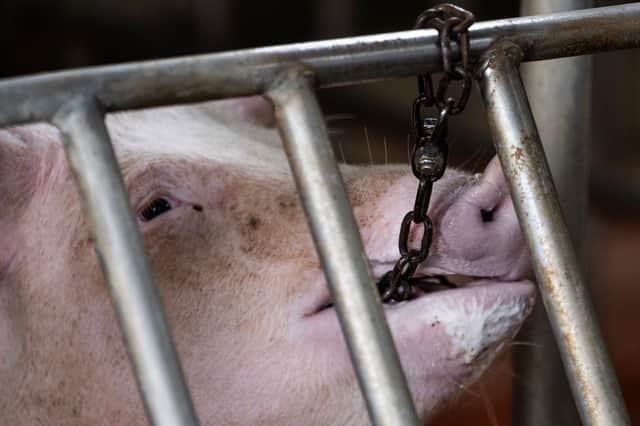
Hens in cages cannot run and peck at the ground or use their wings like nature intended. Similarly, mother pigs kept in farrowing crates are unable to walk or even turn around. They are trapped in one place for weeks at a time.
In short, cages provide conditions of utter deprivation. As a result, confined animals suffer every second of every minute of every day.
But it doesn’t have to be like this. Picture a countryside where barns hum with life, hens dust-bathe under shafts of sunlight and mother pigs nuzzle their young in roomy pens. This isn’t a utopian dream; it’s already reality on thousands of farms that have embraced higher welfare.
These scenes remind us of what farming can be when compassion and common sense prevail. Animals thrive, farmers take pride and food carries a story we can feel good about.
An agricultural revolution
It’s a reality that is very much taking shape – many producers have already moved away from cages – about 80 per cent of UK egg production comes from hens living in non-cage systems such as airy barns, free range or organic. More than half of Britain’s mothering pigs give birth freely without restrictive farrowing crates.
Now is the time for the UK Government to send a clear message to end the cage age altogether.
Cages are a potent symbol of all that is unsustainable in farming. And getting food and farming back on a sustainable footing is vital if we are to save the future for our children.
The benefits of kindness
Science backs compassion: treating animals with kindness is better for the environment and healthier for people. As the UK Government’s Animal Welfare Strategy rightly says, healthier, happier animals help farmers to produce food more sustainably, resulting in lower greenhouse gas emissions.
Better welfare also means safer food: fewer antibiotics, lower disease risk and healthier diets. Protecting animals protects us too – a truth we can’t afford to ignore.
Key to making the necessary transitions across the board is to provide farmers with a clear direction of travel. To leave no doubt that moving to more welfare and climate-friendly agriculture is a priority. And to ensure that farmers are supported financially and practically in making the transition.
Equally important for the transition is to ensure that standards apply equally to imported goods. This is something strongly supported by the public as a trading priority.
Good then to see the government strategy committing to promoting the importance of high animal welfare standards in international negotiations.
A competitive edge for farmers
The way is now clear for Britain and Europe to lead – not just morally, but economically. High welfare standards are increasingly a mark of quality in global markets. Consumers at home and abroad want food they can trust, produced without cruelty.
By embracing this shift, we can give farmers a competitive edge, strengthen reputations for excellence and show that compassion and commerce can go hand in hand. In a world where sustainability sells, doing right by animals is not a cost – it’s an investment in the future.
That’s the future the Animal Welfare Strategy points towards, one where the sights and sounds of contented animals become the norm, not the exception.
History will judge us not by the promises we make, but by the lives we change. Now is the moment to turn words into deeds. Let’s make 2026 the year we consign cages to history, support farmers through the transition and ensure every animal has the chance of a good life. That’s a resolution worth keeping – and delivering.
Philip Lymbery is chief executive of Compassion in World Farming, president of EuroGroup for Animals and UN Food Systems Advisory Board member. His latest book is Sixty Harvests Left: How to Reach a Nature-Friendly Future. Philip is on X/Twitter @philip_ciwf
Comments
Want to join the conversation? Please or to comment on this article.