
An industrial renaissance is within Scotland's grasp if our leaders make right choices – Professor Simon Best
Scotland has what it takes to be a powerhouse of industry once again – we just need to get behind it and start pushing, writes Professor Simon Best
If Prime Minister Andy Burnham is to be taken at his word, then the former industrial heartlands of the North of England will be reinvigorated by a strong wave of cutting-edge, forward-thinking, and diverse new businesses. I have no reason to doubt or downplay Mr Burnham’s ambition – indeed I applaud it.
The fact is that Scotland has already started to implement this sort of idea, and I don’t believe this is as well-known as it might otherwise be, which is lamentable in itself. I suspect that people’s own outlook on the future of the UK and Scotland would be a little more optimistic if they had a more permanent sense of Scotland having a thriving industry at its heart.
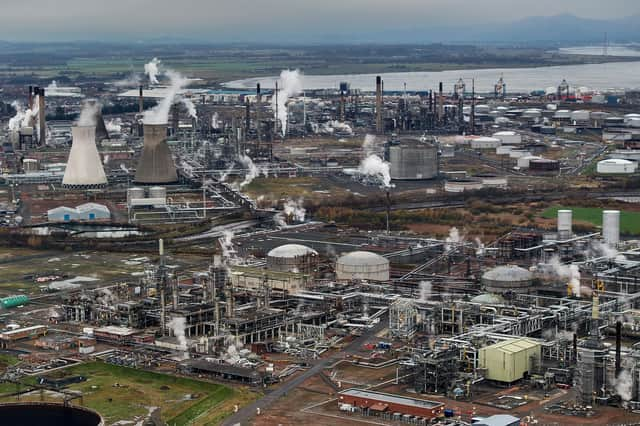
The point is that brownfield sites – those which were formerly home to oil refineries or shipyards, for example – are some of the most fertile areas for Scotland’s own industry renaissance.

The dream of reindustrialisation
Take for example the site at Grangemouth, now home to MiAlgae, a rapidly growing Scottish biotechnology company that uses byproducts from the whisky industry to produce marine Omega 3s – a pipeline that reduces unsustainable dependence on wild fish stocks for the salmon and petfood industries.
Grangemouth is the largest site on the Firth of Forth where there has already been success, but it is not the only opportunity. The Forth Green Freeport scheme covers not only Grangemouth, but Rosyth, Burntisland and Leith into the bargain. This scheme, itself given the go-ahead in November last year, essentially covers Edinburgh, West Lothian, Dunfermline, Fife and Falkirk, making them all prime candidates for industry and business.
In giving the green light to the freeport scheme, some £25m of seed funding was set aside. This is exactly the kind of financial firepower that is required to realise this dream of reindustrialisation. I think we need much more of the same, and it has already shown that it will pay off.
Throw into the mix a restless university sector that is full of experts in a range of subjects, many of whom have research outputs that may well be marketable, and this combination presents a very optimistic scenario for reindustrialisation.
We just need to put some financial weight behind it, and both UK and Scottish governments have plenty of ways they could de-risk this endeavour. It would encourage a culture where much more of our intellectual capital can be translated into commercial opportunities.
For (relatively) small sums of money, governments can create a real business culture that will have a number of positive knock-on effects: putting empty or derelict sites back into industrial use; creating skilled jobs right here in Scotland; and helping the cause of economic growth.
Clydeside once the envy of the world
For all the increasing automation of industry we are witnessing across the world, the need for ready access to transport and a substantial human workforce still exists. These brownfield sites have all the necessary resources. Transport links, in the form of road, rail, air and sea; and upskillable workforces in all of the areas around the Forth. They are all there ready and waiting.
This need not be just an east coast phenomenon. The UK government has recently announced that it will place £6 billion worth of shipbuilding and dockside infrastructure orders with UK companies to upgrade HMNB Clyde at Faslane. Clydeside was the envy of the world at one time when it came to shipbuilding, but many of the sites along the riverbank have lain empty and derelict for decades. According to media reports, shipbuilding company Navantia is seen as a frontrunner for this work, although the bidding process is still to start.
As the floating dry docks are likely to be sited in the Firth of Clyde, then a whole range of repair and maintenance infrastructure must surely follow close behind, once the docks are built.
From Mr Burnham’s words, it seems as though he is willing to make more government support available for the very same agenda and ideas that the Royal Society of Edinburgh’s Enterprise Fellowship – which provides some seed funding and business training to academics with the ideas but without the business experience and training – is designed to support. This is a great overlap if it comes to fruition.
The right noises from Labour and SNP
In his speech to the Labour party conference, Mr Burnham emphasised the need to place universities at the heart of local economies. If leveraging his ‘Manchesterism’ approach in this way really drives a strategy to support regional research and development start-ups and scale-ups, this is something we should also support wholeheartedly.
Whether it be in Forth, Clyde, Moray or a combination of the three, the potential is there. The case must continually be made for governmental match-funding of commercial investment to accelerate growth and scaling. We have the opportunity to create global production centres right here in a new Scottish industrial heartland.
To my mind, the right noises are being made at Number 10, Number 10 North, and Holyrood, so now I hope it is a case of getting out of our own way, so to speak, de-risking new business ventures and investing properly in these sites so that they are viable for university spinouts to find their business feet, and then scale up.
This is the engine of a reinvigorated economy, and it is idling nicely. We just need Messrs Burnham and Swinney to hit the accelerator.
Professor Simon Best OBE is chair of the Royal Society of Edinburgh’s Enterprise Fellowship Scheme
Comments
Want to join the conversation? Please or to comment on this article.